Objectives of a Digital Library
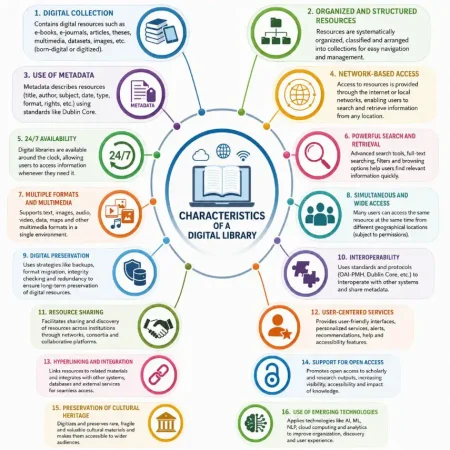
A digital library is an organized collection of digital information resources, supported by technologies that allow users to search for, retrieve, access, preserve, and utilize information electronically. Its goals extend beyond merely converting printed books and documents into digital formats. A well-developed digital library aims to improve access to knowledge, preserve intellectual and cultural resources, support education and research, facilitate information sharing, and provide efficient information services. Below are the ten most important objectives of a digital library, along with examples where applicable.
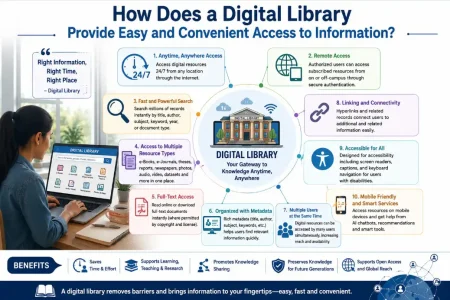
- To Provide Easy and Convenient Access to Information: The most fundamental objective of a digital library is to make information easily and conveniently accessible to users. In a traditional library, users may need to visit the library physically, locate materials through the catalogue, and then find them on the shelves. A digital library simplifies this process by allowing users to search, browse, and access resources electronically through computers, tablets, or smartphones.
Digital libraries may provide access to e-books, electronic journals, theses and dissertations, research papers, reports, conference proceedings, photographs, manuscripts, maps, audio-visual materials, and many other types of digital content. Users can often search these collections by title, author, subject, keyword, publication year, or document type.
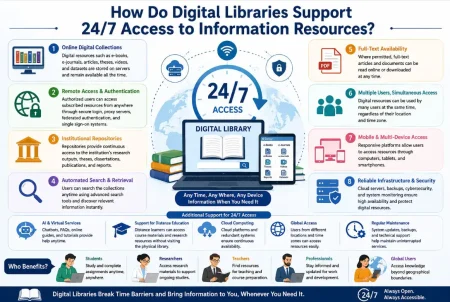
For example, a university student preparing a research paper can search the university’s digital repository from home, locate relevant theses or faculty publications, and access available full-text documents without visiting the physical library. Thus, digital libraries make information access faster, easier, and more convenient. - To Provide Remote and 24/7 Access to Library Resources: Another major objective of a digital library is to extend library services beyond the physical building and normal opening hours. Traditional libraries usually operate according to fixed schedules, whereas many digital resources can be accessed 24 hours a day, seven days a week, depending on licensing and authentication requirements.
Remote access is particularly valuable for distance learners, researchers working from different locations, students studying at night, and users who cannot easily visit the library. Authentication technologies and remote-access services can also enable authorized users to access subscribed electronic resources from outside the institutional network.
For example, a university student who needs journal articles late at night may access the university’s subscribed electronic databases remotely rather than waiting for the physical library to reopen. Similarly, a researcher working from another city or country may be able to access institutional research materials through an online repository.
Therefore, digital libraries help overcome time and geographical barriers and extend the reach of library services. - To Preserve Knowledge and Cultural Heritage: Preservation is one of the most significant objectives of digital libraries. Libraries, archives, museums, universities, and other cultural institutions often hold rare books, manuscripts, newspapers, photographs, maps, historical records, and other materials that may deteriorate because of age, environmental conditions, natural disasters, or frequent physical handling.
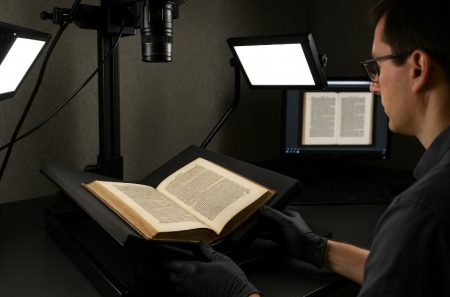
Digitization can create high-quality digital representations of these materials, allowing users to consult the digital copies while the original materials remain protected. This is especially important for rare and fragile collections that cannot safely withstand frequent use.
For example, historical newspapers that have become fragile can be scanned and made available through a digital library. Researchers can then read and search the digitized newspapers without repeatedly handling the original copies. Major institutions such as the Library of Congress and the British Library have developed extensive digital collections containing manuscripts, photographs, maps, newspapers, and other historically significant materials.
Digital libraries, therefore, contribute significantly to the preservation of intellectual, historical, and cultural heritage for future generations. - To Support Teaching, Learning, and Research: Digital libraries play an essential role in modern education and research by providing access to scholarly and educational information. Students need textbooks, reference materials, journal articles, theses, reports, and multimedia resources for their academic activities, while researchers require access to previous studies, datasets, scholarly publications, and other research materials.
A digital library brings many of these resources together within an accessible information environment. This allows users to locate relevant literature more efficiently and supports activities such as preparing assignments, conducting literature reviews, developing research proposals, writing theses, and producing scholarly publications.
For example, a postgraduate student conducting research on artificial intelligence in libraries may search a digital repository for previous theses and dissertations and use electronic databases to identify relevant journal articles. These resources help the student understand existing research and identify gaps for further investigation.
Digital libraries, therefore, strengthen teaching, independent learning, academic research, and lifelong learning. - To Improve Information Search and Retrieval: Providing large quantities of digital content is not enough; users must also be able to find relevant information quickly and accurately. For this reason, improving the organization, discovery, and retrieval of information is a major objective of digital libraries.
Digital libraries use metadata, indexing, subject headings, keywords, classification systems, controlled vocabularies, and search technologies to organize information. Advanced search functions may allow users to limit results by author, title, subject, date, resource type, language, collection, or other criteria.
For example, if a digital repository contains 50,000 theses and dissertations, a researcher does not need to browse every record individually. The researcher might search for “digital library artificial intelligence” and then filter the results by subject, year, department, or document type.
Modern discovery systems may also use full-text searching, relevance ranking, semantic technologies, and artificial intelligence to improve retrieval. The objective is therefore not simply to store information digitally but to ensure that users can discover the right information efficiently. - To Promote Knowledge Sharing and Scholarly Communication: Digital libraries are important platforms for sharing knowledge within and beyond institutional boundaries. Universities, research institutes, government organizations, and other institutions produce large quantities of valuable intellectual output, including journal articles, theses, dissertations, conference papers, reports, working papers, datasets, and teaching materials.
A digital library or institutional repository can collect and organize these materials and make them discoverable to a wider audience. Repository software such as DSpace and EPrints is commonly used by academic institutions to manage and disseminate digital scholarly content.
For example, when a university deposits its students’ theses and faculty publications in an institutional repository, researchers from other institutions may be able to discover and use those materials. This increases the circulation of knowledge and can encourage further research and academic collaboration.
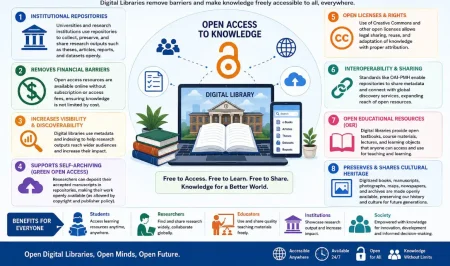
Digital libraries therefore support the creation, dissemination, discovery, and exchange of scholarly knowledge. - To Support Open Access and Increase the Visibility of Research: An increasingly important objective of digital libraries is to support open access to scholarly information. Open access seeks to make research outputs freely available online, subject to copyright, licensing, publisher policies, and institutional requirements.
Institutional repositories are particularly important in this area. Universities can preserve and provide appropriate access to theses, dissertations, research reports, conference papers, preprints, accepted manuscripts, and other scholarly outputs. Search engines and scholarly discovery services may subsequently index repository records, making institutional research easier to discover.
For example, a thesis stored only on a physical library shelf may be consulted by relatively few people. If an authorized digital copy is deposited in an openly accessible institutional repository, researchers from other universities and countries can potentially discover and read it online.
This can increase the visibility, accessibility, discoverability, and potential impact of institutional research while helping institutions showcase their scholarly contributions. - To Facilitate Resource Sharing and Institutional Collaboration: No individual library can acquire and maintain every information resource required by its users. Digital libraries can help address this limitation by supporting resource sharing and collaboration among libraries, universities, archives, museums, and research institutions.
Through interoperable systems, shared repositories, metadata harvesting, consortia, and collaborative digital collections, institutions can make their resources more widely discoverable. Rather than operating entirely as isolated collections, digital libraries can participate in larger information networks.
For example, several universities may contribute metadata or digital materials to a shared discovery platform, enabling users to search resources from participating institutions through a common interface. Similarly, libraries may collaborate on digitization projects to preserve materials related to a particular country’s history or cultural heritage.
Resource sharing reduces unnecessary duplication of effort, increases access to specialized collections, and promotes cooperation among information institutions. - To Ensure Long-Term Preservation and Availability of Digital Information: Digitization alone does not guarantee permanent preservation. Digital files can become inaccessible because of hardware failure, corrupted storage media, obsolete software, outdated file formats, cybersecurity incidents, or technological change. Therefore, ensuring the long-term availability and usability of digital information is a critical objective of a digital library.
Digital preservation involves planned activities such as maintaining multiple backups, monitoring file integrity, using appropriate preservation formats, recording preservation metadata, migrating files when formats become obsolete, and maintaining reliable storage infrastructure.
For example, a university may have thousands of electronic theses stored in its institutional repository. If these files are stored without proper backups or preservation planning, a technical failure could result in permanent loss. A sound digital preservation program keeps multiple copies, performs integrity checks, and manages file formats so that the documents remain accessible as technology changes.
Thus, digital libraries aim to preserve not only physical materials through digitization but also digital materials themselves over the long term. - To Enhance Library Services and User Experience through Technology: A modern digital library should provide more than a collection of downloadable documents. Another important objective is to use technology to make library services faster, smarter, more responsive, and user-friendly.
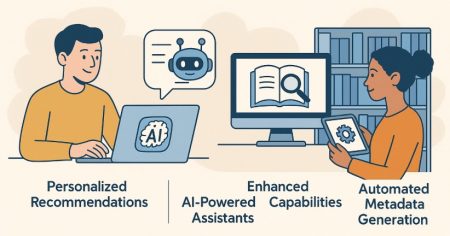
Digital libraries can incorporate technologies such as artificial intelligence (AI), machine learning, natural language processing, recommendation systems, automated metadata generation, optical character recognition (OCR), cloud computing, and virtual reference services. These technologies can help users navigate large collections and obtain assistance more efficiently.
For example, an AI-powered chatbot integrated into a library website can answer frequently asked questions about opening hours, borrowing policies, electronic resources, and research services at any time. OCR technology can convert scanned historical newspapers into searchable text, while recommendation technologies may help users discover resources related to their interests.
User-friendly interfaces, responsive web design, accessibility features, personalized services, and effective search tools also contribute to a better digital library experience. The ultimate objective is to ensure that technology does not merely increase the quantity of available information but also makes library resources and services easier and more effective to use.
The objectives of a digital library reflect the changing role of libraries in the digital information environment. While providing easy access to information remains the central objective, digital libraries also have important responsibilities in preservation, education, research, scholarly communication, resource sharing, open access, and technological innovation. They remove geographical and time barriers, preserve valuable intellectual and cultural materials, improve information discovery, and enable knowledge to reach a much wider audience.