What Is Self-Archiving?
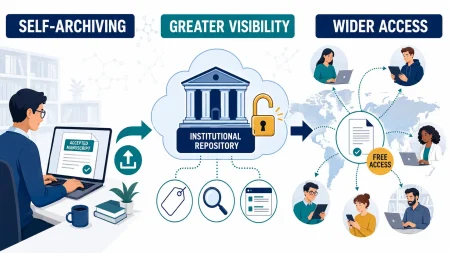
Self-archiving is the practice of authors depositing digital copies of their scholarly or intellectual works in online repositories to enhance accessibility, visibility, and permanent availability. Materials that can be self-archived include journal articles, conference papers, theses, dissertations, book chapters, research reports, presentations, and research datasets. For instance, a university lecturer might deposit a conference paper in the university’s institutional repository, while a student could submit a completed thesis to a digital thesis repository.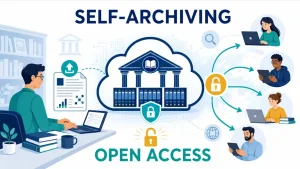
Self-archiving is closely associated with green open access, which enables authors to provide free access to their research without necessarily publishing it in an open-access journal. Depending on the publisher’s policy, authors may archive a preprint (the version submitted before peer review), a postprint (the manuscript accepted after peer review), or, in some cases, the final published version. For example, a researcher may upload the accepted manuscript of a journal article to an institutional repository after a publisher-required embargo period of six or twelve months.
Self-archived materials can be deposited in various types of repositories. An institutional repository preserves the scholarly output of a specific university or research organization. For example, a university repository may contain publications authored by its faculty and theses produced by its students. A subject repository collects works pertaining to a particular discipline; for instance, arXiv provides access to research in physics, mathematics, computer science, and related fields. Researchers may also share eligible versions of their work through personal or departmental websites, although recognized repositories typically offer better organization and long-term preservation.
Self-archiving enhances the accessibility and visibility of scholarly information. For example, a student whose library does not subscribe to a specific journal can still access an author’s archived manuscript free of charge. Making research openly available may also increase readership and potential citations, especially in developing countries where many institutions cannot afford expensive journal subscriptions. Furthermore, institutional repositories help preserve a university’s intellectual output and provide a central platform for showcasing its research achievements.
Libraries and information professionals play a crucial role in self-archiving by managing repositories, creating accurate metadata, preserving digital materials, and advising researchers about copyright and licensing. For instance, a librarian can assist an author in determining whether the publisher allows the accepted manuscript to be deposited and whether an embargo period applies. Thus, self-archiving supports open access, reduces barriers to scholarly communication, preserves research outputs, and promotes the broader exchange of knowledge.
Purposes of Self-Archiving
Self-archiving is the practice of depositing digital copies of scholarly and intellectual works in an online repository, usually free for readers to access, share, and preserve. The types of materials that can be deposited include journal articles, conference papers, theses, dissertations, book chapters, research reports, presentations, and datasets. Authors can choose to deposit their works in an institutional repository maintained by a university or library, or in a subject-specific repository like arXiv.
Self-archiving plays a crucial role in green open access, as it makes research available to a wider audience beyond those with journal and database subscriptions.
The main purposes of self-archiving are discussed in detail below.
- To Ensure Open Access to Knowledge: One of the primary purposes of self-archiving is to make research freely available to everyone. Many scholarly journals require costly subscriptions, which can prevent students, teachers, and researchers from accessing essential articles. When authors deposit permissible versions of their works in repositories, readers can access them without any payment. For example, a student at a university with limited journal subscriptions may download an accepted manuscript from an institutional repository.
- To Increase the Visibility of Research: Self-archiving enhances the discoverability of research through search engines, repository search tools, and academic platforms. A journal article available only on a publisher’s website may be difficult for some readers to find or access. However, when the same permissible version is deposited in a repository with proper metadata—such as the author’s name, title, keywords, abstract, and publication date—it becomes easier to locate.
- To Improve Readership and Citation Impact: Research that is freely accessible can reach a larger audience, including scholars, students, practitioners, policymakers, and the general public. Greater access can increase the number of readers and improve the potential for citations. For instance, an openly archived article on digital libraries may be read and cited by researchers at institutions that do not subscribe to the journal in which it was originally published.
- To Preserve Scholarly and Institutional Output: Self-archiving supports the long-term preservation of research outputs. Digital repositories are designed to store files, metadata, and stable links in an organized manner, reducing the risk of losing important materials if an author changes institutions, a personal website is taken down, or a journal platform changes. For example, a university repository can preserve students’ theses and faculty publications as part of its permanent intellectual record.
- To Support Green Open Access: Self-archiving enables authors to provide open access even when their work is published in a subscription-based journal. Depending on the publisher’s copyright policy, an author may deposit a preprint, an accepted manuscript, or sometimes the final published version. For example, a publisher may allow the author to archive the accepted manuscript after a six- or twelve-month embargo period. This approach expands access while respecting copyright and publishing agreements.
- To Reduce Information Inequality: Many universities, libraries, and research institutions—especially in developing countries—are unable to afford subscriptions to all major academic journals and databases. Self-archiving helps bridge this gap by allowing researchers to share their work openly. It supports equitable access to information and enables scholars from diverse financial and geographical backgrounds to participate more effectively in research and learning.
- To Comply with Institutional and Funder Requirements: Some universities, governments, and research funding agencies require researchers to deposit publications, theses, or research data in an open repository. Self-archiving helps authors meet these requirements and demonstrates that publicly funded research is accessible to the public. For instance, a research grant may mandate that the final report and related publications be deposited in an institutional repository.
- To Showcase Individual and Institutional Achievements: Self-archiving creates a visible record of an author’s academic contributions and an institution’s research productivity. A repository can display publications by department, author, subject, or year, making it easier for others to understand the institution’s research strengths. For example, a university library repository can highlight the publications, theses, and research reports produced by its faculty members and students.
Importance of Self-Archiving for Researchers and Academic Institutions
Self-archiving is important because it allows researchers to deposit copies of their scholarly works in online repositories, making them freely accessible to readers. These works may include journal articles, conference papers, theses, dissertations, research reports, book chapters, and datasets. By engaging in self-archiving, researchers can enhance the visibility of their work since repository records can be discovered through Google Scholar, search engines, and academic databases. For instance, a researcher might deposit the accepted manuscript of a journal article in a university repository, enabling individuals who do not subscribe to the journal to access the article.
Self-archiving can also boost readership and the potential citation impact of research. When a publication is openly available, it can reach students, educators, researchers, policymakers, and professionals across various countries and institutions. This is particularly beneficial for scholars in developing countries or smaller institutions that may not afford subscriptions to all academic journals. For example, a librarian researching digital library services might access an openly archived article from another university’s repository and include it in a literature review or research project.
For academic institutions, self-archiving helps preserve and organize their intellectual output. An institutional repository can gather faculty publications, student theses, conference papers, research reports, and other academic materials in one reliable location. This creates a long-term digital record of the institution’s research and minimizes the risk of materials being lost when researchers change jobs, personal websites are taken down, or publisher platforms are updated. For instance, a university repository can preserve thousands of student theses and faculty publications for future students and researchers.
Self-archiving also allows institutions to showcase their research productivity and academic accomplishments. The content in the repository can be organized by author, department, subject, or year, making it easier for visitors, potential collaborators, accreditation bodies, and ranking organizations to identify the institution’s areas of research strength. Additionally, it can support research assessment, institutional reporting, and knowledge management. Therefore, self-archiving benefits both researchers and institutions by making research freely accessible, improving visibility, fostering collaboration, preserving academic output, and strengthening scholarly communication.
Methods of Self-Archiving
Self-archiving can be done through several methods, depending on the type of material, institutional facilities, and publisher copyright policy.**Institutional Repository**
Authors can deposit their work in a digital repository that is managed by their university, library, or research institution. These repositories typically contain faculty publications, theses, dissertations, conference papers, and research reports. For example, a university lecturer may upload an accepted journal manuscript to the university’s institutional repository.
- Subject-Based Repository: Authors may choose to deposit their works in repositories designed for specific academic disciplines. These repositories ensure that research is accessible to readers with an interest in a particular subject. For instance, arXiv is widely used for research in physics, mathematics, computer science, and related fields, while PubMed Central provides access to biomedical and life-science research.
- Preprint Server: A preprint is a version of a research paper that is shared before it undergoes formal peer review and is published in a journal. Authors can upload preprints to preprint servers to receive early feedback and to rapidly disseminate their research findings. For example, a computer science researcher might submit their paper to arXiv before it is reviewed by a journal.
- Postprint or Accepted Manuscript Deposit: A postprint, also known as an accepted manuscript, is the author’s final version of a paper after peer review but before it has been formatted and laid out by the publisher. Many publishers allow authors to archive this version in a repository, sometimes after a specified embargo period. For example, an author might deposit an accepted manuscript six months after its publication in a subscription-based journal.
- Thesis and Dissertation Repository: Universities often require students to submit electronic copies of their theses and dissertations to a digital repository. This practice preserves student research and makes it available to future researchers. For example, a master’s student may submit a PDF copy of their dissertation to the university library’s repository after graduation.
- Research Data Repository: Researchers can self-archive datasets, software codes, questionnaires, research instruments, and supporting documents in data repositories. This practice encourages transparency, reuse, and verification of research findings. For example, a researcher might deposit survey data and documentation in Zenodo alongside a published article.
- Personal or Departmental Website: Authors may share permitted copies of their publications on personal academic webpages or departmental websites. For instance, a faculty member might maintain a “Publications” page that includes links to openly available versions of their articles. However, repositories are generally preferred because they provide stable links, metadata, indexing, and long-term preservation.
- Academic Social-Networking Platforms: Researchers sometimes share their publications through platforms such as ResearchGate or Academia.edu. While these platforms can enhance visibility and facilitate networking, they are not typically regarded as the best option for long-term preservation. Authors should check copyright permissions before uploading publisher PDFs and, whenever possible, also deposit their work in a trusted institutional or subject repository.