How Do Digital Libraries Support 24/7 Access to Information Resources?
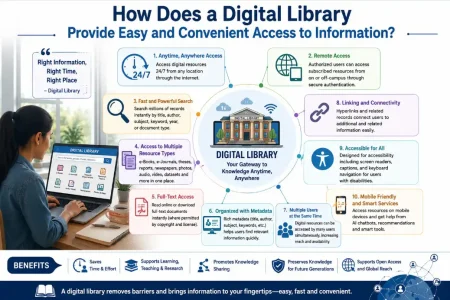
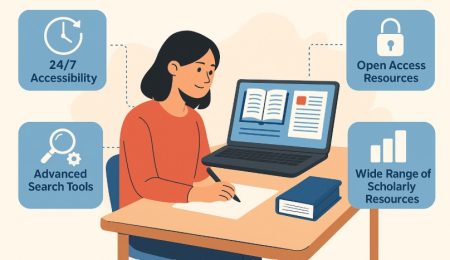
One of the most significant advantages of a digital library is its ability to provide continuous access to information resources, 24 hours a day, seven days a week. Unlike traditional libraries, which operate within fixed hours, digital libraries utilize internet-based technologies to make collections and services available beyond the physical library building. Students, teachers, researchers, professionals, and other authorized users can search for and access digital resources at any time using computers, laptops, tablets, or smartphones. This continuous availability has transformed libraries from places that require physical visits into information services that can be reached whenever and wherever information is needed.
Digital libraries provide 24/7 access by storing and delivering information electronically via online platforms. Resources such as e-books, electronic journals, theses and dissertations, research papers, conference proceedings, reports, institutional publications, photographs, digitized manuscripts, datasets, audio files, and videos can be hosted on servers or cloud-based systems. As these systems can operate outside regular library hours, users do not have to wait for the physical library to open to search for or access available resources. For instance, a student working on an assignment at 2:00 a.m. can search a university’s institutional repository and immediately access an openly available thesis or research paper.
Another important aspect of digital libraries is remote access technology. Academic libraries often subscribe to electronic databases, e-journals, and e-books that are typically restricted to authorized institutional users. Authentication systems allow eligible users to verify their institutional identity and access licensed resources from outside the campus network. Technologies such as proxy servers, federated authentication, single sign-on, and services like OpenAthens support secure remote access. For example, a university student working from home may sign in through the institution’s authentication service and access subscribed journal articles in the evening or during a university holiday, provided it aligns with the library’s licensing agreements.
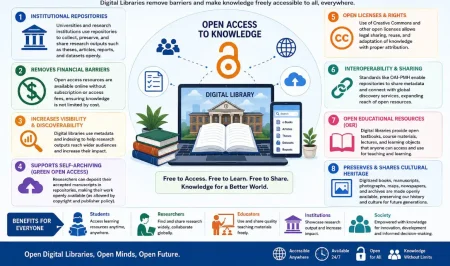
Institutional repositories also play a vital role in ensuring round-the-clock access to information. Universities and research institutions use these repositories to collect, preserve, and disseminate their scholarly and institutional outputs. This may include theses, dissertations, journal articles, conference papers, reports, working papers, and other academic materials. Repository platforms like DSpace offer web-based access to deposited materials continuously. When a document is made openly available, users from different locations and time zones can discover and access it without needing assistance from library staff.
Digital libraries provide continuous access through automated search and retrieval systems. Unlike traditional library services, which often require staff assistance for certain tasks, many functions within digital libraries operate automatically. Users can search collections by title, author, subject, keyword, publication date, document type, or other metadata at any time. Search engines and discovery interfaces automatically process user queries and display relevant results. For instance, a researcher searching for “artificial intelligence in academic libraries” can retrieve pertinent records at any hour, including midnight, just as easily as during regular working hours. This automation ensures that basic information discovery continues even when librarians are not physically present.
The availability of full-text digital content further enhances 24/7 access. When copyright, licensing, and institutional policies allow, users can immediately read or download complete documents after locating them. Open-access digital libraries are particularly significant in this context. For example, Project Gutenberg offers continuous online access to a vast collection of public-domain electronic books. Additionally, an open institutional repository might enable a researcher in Bangladesh to access a university thesis hosted in another country, regardless of time differences.
Digital libraries also make continuous access more feasible by supporting multiple devices and mobile access. Users are no longer reliant on computers located within a library. Responsive digital library websites can be accessed via desktops, laptops, tablets, and smartphones. A student traveling home may search for an electronic resource using a smartphone, while a researcher might download an article using a laptop from a different location. Mobile-friendly access thus extends the availability of digital library services and allows information to be utilized whenever and wherever it is needed.
Another advantage of digital resources is their ability to be accessed simultaneously by multiple users. A printed book is limited in availability since one copy can typically be borrowed by only one person at a time. However, an open-access digital document can often be accessed by many users simultaneously. For example, an openly available thesis stored in an institutional repository can be read by individuals in various countries simultaneously. Although licensed e-books and databases may have restrictions on the number of simultaneous users based on the subscription agreement, digital delivery usually provides significantly more flexible access than a single physical copy.
Cloud computing and reliable server infrastructure are essential for libraries to maintain continuous digital services. Digital collections can be hosted on institutional servers, data centers, or cloud platforms that are designed to remain available 24/7. To minimize service interruptions, libraries can implement backup systems, redundant storage, network monitoring, cybersecurity measures, and disaster recovery procedures. In the event of a failure, well-designed infrastructure allows for the quick restoration of services or continuity through redundant systems. Therefore, having a reliable technological infrastructure is crucial for providing dependable 24/7 access to library services.
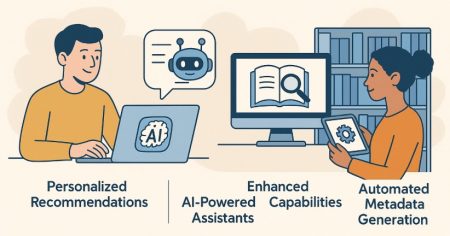
Digital libraries can further enhance round-the-clock assistance through automated and AI-supported services. Tools such as frequently asked questions (FAQs), online guides, knowledge bases, tutorials, virtual reference tools, and AI-powered chatbots can offer basic support even when library staff are unavailable. For instance, if a student visits a library website late at night, they can ask a chatbot how to access an electronic database, renew a book, find an e-journal, or locate an institutional repository. The system can provide immediate guidance or direct the student to the appropriate resource. While automated services cannot replace professional librarians for complex research inquiries, they can provide helpful first-level support outside of staffed service hours.
Continuous access is particularly valuable for distance education and online learning. Students enrolled in online programs may live far from the university campus and might rarely or never visit the physical library. Digital libraries give these students access to course-related readings, electronic books, journal articles, reference materials, and research resources. Therefore, a distance learner can conduct research and complete assignments without needing to be geographically close to the institution. This makes digital libraries an essential component of modern online and blended education.
However, 24/7 availability does not mean that every resource is freely accessible to everyone at all times. Access may depend on subscription licenses, copyright restrictions, user authentication, internet connectivity, system maintenance, server availability, and institutional policies. Some electronic resources may only be available to current students and faculty members, while others may be openly accessible worldwide. Planned maintenance or technical issues can also temporarily interrupt services. As a result, libraries need reliable infrastructure, appropriate licensing arrangements, strong authentication systems, regular backups, and technical support to maintain effective continuous access.