Self-Archiving in Library and Information Science
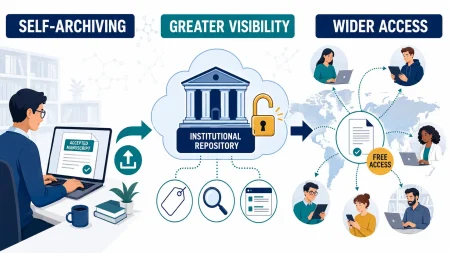
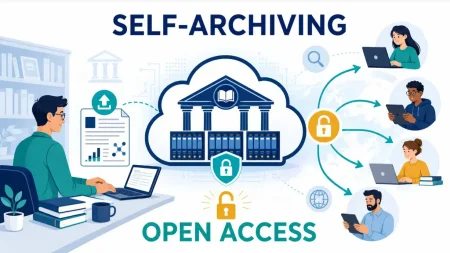
Self-archiving in Library and Information Science refers to the practice of authors depositing free digital copies of their scholarly or intellectual works in online repositories. This allows others to discover, access, and utilize these works. Types of works that can be self-archived include journal articles, conference papers, theses, dissertations, book chapters, research reports, presentations, and datasets.
Authors can deposit their work in various types of repositories, such as an institutional repository maintained by a university or library, a subject-based repository like arXiv, or an approved personal or research website. Depending on the publisher’s copyright policy, the deposited version may be a preprint submitted before peer review, an accepted manuscript revised after peer review, or, in some cases, the final published version.
Self-archiving is generally associated with the green route to open access, as it makes research available without requiring readers to pay subscription fees. Libraries and information professionals support this practice by managing repositories, creating metadata, ensuring long-term digital preservation, advising authors on copyright and licensing matters, and enhancing the discoverability of deposited works.
For example, a researcher may publish an article in a subscription-based journal and then deposit the permitted accepted manuscript in the university’s institutional repository. This enables individuals without journal subscriptions to freely access the research.
The Importance of Self-Archiving in Library and Information Science
 Self-archiving is crucial in Library and Information Science because it facilitates open access to scholarly knowledge. It allows authors to deposit digital copies of their works in institutional or subject-based repositories. This practice makes research accessible to students, teachers, researchers, professionals, and members of the public who may not have the means to afford expensive journal subscriptions. For instance, a researcher may publish an article in a subscription-based journal and then deposit the permitted accepted manuscript in a university repository. This enables readers from resource-limited institutions to access the research freely.
Self-archiving also enhances the visibility, discoverability, and potential impact of research. Materials that are deposited in well-managed repositories can be indexed by Google Scholar and other discovery services, making them easier for researchers worldwide to locate. Increased accessibility may lead to more downloads, citations, academic discussions, and opportunities for collaboration. For example, a thesis stored only on a library shelf may receive limited use, while a digitized copy deposited in an institutional repository can be discovered and consulted by readers from around the globe.
Another significant benefit of self-archiving is the long-term preservation of scholarly and institutional knowledge. Libraries use repositories such as DSpace and EPrints to organize, describe, manage, and preserve journal articles, theses, conference papers, research reports, presentations, and datasets. Accurate metadata, persistent links, standardized file formats, backups, and preservation practices are essential to ensure that these materials remain accessible even if personal websites disappear or computer files are lost. In this way, self-archiving helps libraries maintain a permanent record of their institution’s research and intellectual achievements.
Self-archiving also strengthens the role of librarians and information professionals in scholarly communication. Librarians manage repositories, create and improve metadata, advise researchers on copyright and licensing, identify suitable manuscript versions, and explain publisher embargo requirements. For instance, if a publisher prohibits uploading the final formatted article, a librarian may help the author determine whether the accepted manuscript can be deposited after a six- or twelve-month embargo. This guidance enables institutions to offer wider access to research while respecting copyright and publisher policies. Furthermore, self-archiving promotes knowledge sharing, research transparency, institutional reputation, and equality of access to information. It gives researchers greater control over the distribution of their work and helps universities showcase their research output to funding bodies, prospective students, and international partners. This practice is particularly beneficial for researchers in developing countries, where access to subscription-based resources may be limited.
In summary, self-archiving is a vital practice in Library and Information Science as it advances open access, improves research visibility, preserves intellectual output, supports responsible information management, and contributes to a more inclusive system of scholarly communication.