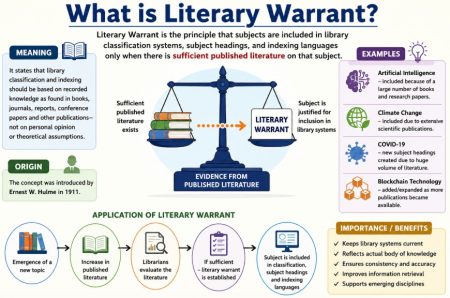
What Is Literary Warrant? Literary warrant is a fundamental principle in Library and Information Science (LIS) that asserts the organization, classification, and indexing of knowledge should…
What Is Literary Warrant? Literary warrant is a fundamental principle in Library and Information Science (LIS) that asserts the organization, classification, and indexing of knowledge should…
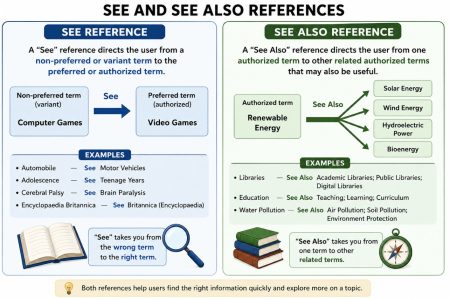
What Is a “See” Reference in Library Cataloging and Indexing? A “See” reference is a type of cross-reference used in library cataloging, indexing, and authority control…
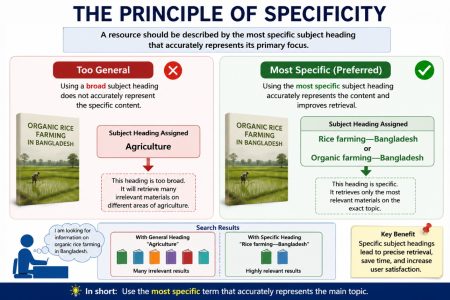
What Is the Principle of Specificity? The Principle of Specificity is an essential concept in subject cataloging, indexing, and information organization. It states that a document…
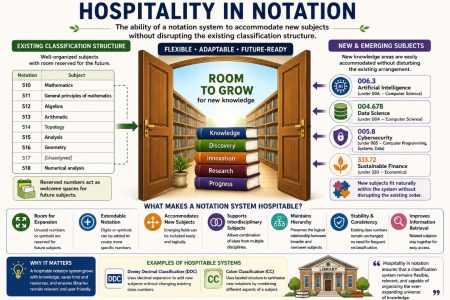
Hospitality in Notation Hospitality in notation refers to a library classification system’s ability to accommodate new subjects, concepts, or subdivisions without disrupting the existing structure. In…

Books on similar subjects receive similar classification numbers because library classification systems are designed to organize knowledge in a logical and systematic way. The primary purpose…
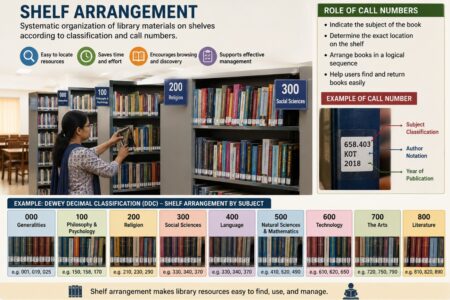
Shelf Arrangement in a Library Shelf arrangement is the systematic organization of library materials on shelves according to a predetermined order, typically based on a classification…
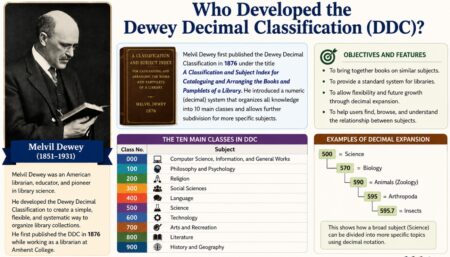
The Dewey Decimal Classification (DDC) system was developed by Melvil Dewey (1851–1931), an American librarian, educator, and a pioneer in library science. Before the DDC was introduced, libraries typically…
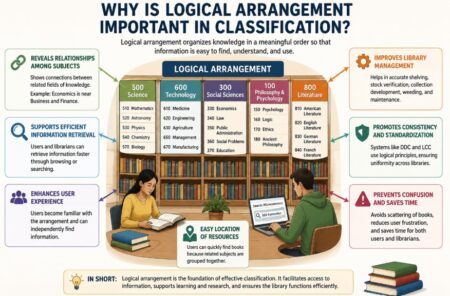
Classification is one of the fundamental operations in library and information management, serving as a systematic method for organizing knowledge and information resources. Its primary purpose…

Library classification is essential for facilitating information retrieval by organizing knowledge in a systematic and logical way. It groups materials on similar subjects together and assigns…

Library classification is essential for organizing materials on library shelves in a systematic way according to their subject content. Instead of arranging books randomly or by…