What Is Literary Warrant?
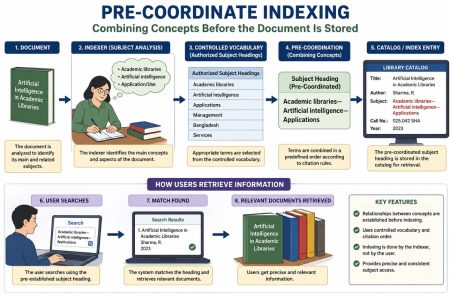
Literary warrant is a fundamental principle in Library and Information Science (LIS) that asserts the organization, classification, and indexing of knowledge should be based on subjects that are actually present in published literature, rather than on theoretical assumptions or personal opinions. This means that a new subject or topic should only be included in a library classification system, subject heading list, or indexing vocabulary if there is a sufficient body of published literature to justify its existence. This principle ensures that library knowledge organization systems accurately reflect the current state of recorded knowledge, remaining relevant to users’ information needs. For example, if libraries begin receiving numerous books and research articles on quantum computing, the growing body of literature provides the justification for creating or expanding classification numbers and subject headings for that topic.
The concept of literary warrant was first introduced by American librarian and classification theorist Ernest W. Hulme in 1911. Hulme argued that library classification should derive its subject categories from existing literature instead of from philosophical or scientific classifications. According to this approach, the amount and diversity of published works on a topic serve as evidence-or “warrant” -for creating a new class, subject heading, or indexing term. For instance, during the early years of the Internet, there were relatively few publications on social media or cloud computing. However, as these subjects gained popularity and thousands of books and scholarly articles were published, library classification systems and controlled vocabularies gradually introduced new subject headings and expanded existing schedules to represent these emerging fields.
Literary warrant plays a crucial role in maintaining the accuracy and currency of library classification systems. As new disciplines emerge and existing fields evolve, libraries continuously revise their cataloging rules, classification schedules, and controlled vocabularies based on the growth of published literature. This ensures that users can efficiently locate information on both traditional and emerging subjects. Topics such as data science, digital humanities, blockchain technology, machine learning, cybersecurity, and generative artificial intelligence have been incorporated into modern classification systems because they are now supported by extensive scholarly literature. Similarly, areas like environmental sustainability and climate change are represented more prominently as research publications on these topics have significantly increased.
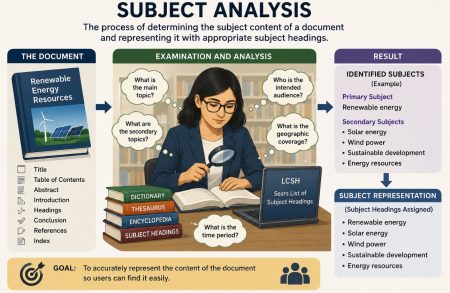
One of the major strengths of literary warrant is that it provides an objective and evidence-based foundation for organizing knowledge. Instead of relying on subjective judgments, librarians examine books, scholarly journals, conference proceedings, government reports, theses, and other authoritative publications to determine whether a subject is deserving of representation in classification and indexing systems. For example, before creating a new subject heading such as “AI Ethics,” catalogers may analyze the number of published books, journal articles, and conference papers specifically focused on ethical issues in artificial intelligence. If substantial literature exists, the new heading is justified. This evidence-based approach improves consistency, enhances information retrieval, and ensures that library collections accurately reflect developments in scholarship.
Literary warrant also influences the development of controlled vocabularies such as the Library of Congress Subject Headings (LCSH) and medical vocabularies like MeSH (Medical Subject Headings). New subject terms are typically introduced only after a sufficient volume of published literature demonstrates that a concept has become an established area of study. For instance, terms such as “COVID-19,” “Long COVID,” and “Coronavirus infections” were rapidly added to controlled vocabularies due to the vast amount of scientific and medical literature that emerged worldwide following the outbreak of the pandemic.
Another practical application of literary warrant can be observed in the Dewey Decimal Classification (DDC). The DDC is updated periodically to incorporate emerging disciplines and interdisciplinary subjects. For instance, recent editions have expanded to include topics related to information technology, artificial intelligence, renewable energy, and digital communication, as these subjects have become increasingly prominent in published literature. Without a literary warrant, accurately classifying these modern topics within existing schedules would be challenging.
However, literary warrant has certain limitations. It relies on the existence of published literature, which means newly emerging topics may not receive immediate recognition until a sufficient number of publications becomes available. For example, when blockchain technology first emerged around 2008-2010, there were relatively few academic publications addressing it, making it difficult for classification systems to represent the subject adequately. As research on blockchain increased over the following decade, libraries gradually updated their classification and indexing systems to reflect this growth. Similarly, topics that are primarily represented through blogs, social media, or community knowledge may lack enough formal publications to establish literary warrant.
Another limitation is that literary warrant may unintentionally overlook indigenous knowledge, oral traditions, local history, and folk culture, which often exist outside formal publishing channels. For instance, traditional medicinal knowledge preserved through oral transmission in indigenous communities holds significant cultural value but may not be adequately represented in library classification systems until documented in books, research articles, or official reports.
In the digital age, literary warrant remains highly relevant, with its scope expanding beyond printed books to include electronic journals, institutional repositories, digital libraries, conference papers, preprints, datasets, and other forms of scholarly communication. Modern library classification systems increasingly evaluate both print and digital publications when determining whether a new subject has sufficient literary warrant. For example, the rapid growth of open-access repositories such as arXiv, PubMed Central, and institutional repositories has hastened the recognition of emerging research fields by providing a substantial body of accessible scholarly literature.
Principles of Literary Warrant
The principle of literary warrant asserts that subjects, concepts, and topics should only be included in library classification systems, subject heading lists, and indexing vocabularies when justified by a substantial body of published literature. Rather than creating categories based on speculation or personal opinion, librarians depend on documented knowledge found in books, journals, reports, conference proceedings, and other authoritative publications. The key principles of literary warrant are as follows:
- Published Literature Is the Basis for Classification: Library classification and indexing systems should be developed from subjects that are genuinely represented in published literature rather than from theoretical ideas. Example: If thousands of books and journal articles are published on artificial intelligence, it merits dedicated classification numbers and subject headings.
- Evidence-Based Subject Representation: A subject should only be included in a classification scheme when there is sufficient documentary evidence supporting its existence and significance. Example: The creation of subject headings for data science was only justified after a substantial body of scholarly publications became available.
- Reflects the Growth of Knowledge: Classification systems should evolve as new fields of knowledge emerge and the volume of literature increases. Example: Subjects such as cybersecurity, blockchain technology, and generative AI have been added or expanded due to their rapidly growing literature.
- User-Centered Organization: Literary warrant ensures that library collections are organized according to the subjects users are most likely to search for in existing publications. Example: A university library with many books on renewable energy should provide appropriate subject headings and classifications for that field.
- Objective and Unbiased Decision-Making: Decisions about creating new classes or subject headings should be based on published evidence rather than personal preferences or opinions. Example: A librarian should not create a new classification category simply because they believe a topic is important if there is little or no published literature supporting it.
- Continuous Revision and Updating: Classification schedules and controlled vocabularies should be reviewed regularly to accommodate newly established subjects supported by literature. Example: The COVID-19 pandemic generated an enormous volume of scientific publications, leading to the rapid addition of new subject headings and indexing terms.
- Consistency in Knowledge Organization: Using literary warrant helps maintain consistency across library catalogs, classification systems, and indexing tools by applying uniform criteria for introducing new subjects. Example: Libraries worldwide can organize books on machine learning under similar subject headings because the topic has extensive published literature.
The principle of literary warrant ensures that library classification and indexing systems are evidence-based, current, objective, and responsive to the growth of recorded knowledge. By relying on published literature as the primary justification for introducing new subjects, libraries can organize information more accurately and provide users with efficient access to both established and emerging fields of knowledge.
Why Is Literary Warrant Considered a Dynamic Concept?
Literary warrant is viewed as a dynamic concept because it evolves continuously in response to the changing nature of recorded knowledge and scholarly communication. Unlike fixed classification principles, literary warrant adapts whenever new subjects emerge, existing disciplines expand, or research trends shift. Since it is based on published literature, any increase, decrease, or transformation in this body of work directly influences how libraries organize, classify, and index information. As human knowledge continues to grow, library classification systems must also evolve to represent newly established fields of study accurately.
The dynamic nature of literary warrant is evident in the emergence of new academic disciplines and technologies. Topics such as artificial intelligence (AI), machine learning, data science, blockchain technology, digital humanities, and quantum computing were either absent or only briefly mentioned in library classification systems a few decades ago. However, as thousands of books, journal articles, conference papers, and research reports have been published on these subjects, they have gained sufficient literary warrant to justify the creation of new classification numbers, subject headings, and indexing terms. The rapid growth of research on COVID-19 during the global pandemic led to the introduction of new subject headings and indexing vocabulary in bibliographic databases and library catalogs.
Literary warrant is also dynamic because knowledge itself is constantly changing. Some subjects become highly significant over time, while others decline in importance. As a result, libraries regularly review and revise classification schedules and controlled vocabularies to ensure they accurately reflect current scholarship. For example, climate change, renewable energy, cybersecurity, and AI ethics have become major research areas due to the increasing volume of published literature, leading to greater representation within classification and indexing systems. In contrast, subjects that receive little ongoing research may eventually require fewer subdivisions or may be merged with broader categories.
The expansion of digital publishing has further reinforced the dynamic nature of literary warrant. Traditionally, literary warrant was established primarily through printed books and scholarly journals. Today, however, librarians also take into account electronic journals, institutional repositories, conference proceedings, preprints, datasets, and open-access publications when determining whether a subject has sufficient warrant. For instance, repositories like arXiv and PubMed Central allow for the rapid dissemination of new research, enabling emerging topics to gain literary warrant much faster than in the past.
Another reason literary warrant is dynamic is that it responds to societal, scientific, and technological changes. As global issues evolve, new areas of knowledge emerge that require representation in library systems. Concepts such as digital privacy, cyber resilience, sustainable development, and generative AI have become increasingly important due to their growing presence in scholarly literature. Libraries must therefore update their classification schemes and subject headings to ensure that users can efficiently and accurately discover relevant resources.