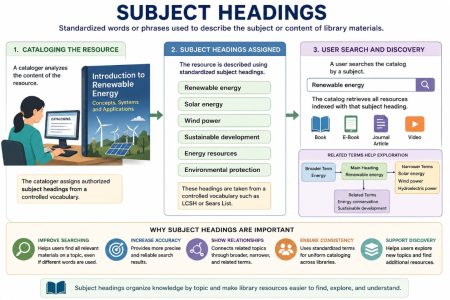
Subject headings for a book are chosen through a process called subject analysis. During this process, a cataloger examines the intellectual content of the resource to identify its primary and secondary subjects. Instead of relying solely on the book’s title, catalogers consider the overall content, purpose, and scope of the work before assigning standardized subject headings from a controlled vocabulary, such as the Library of Congress Subject Headings (LCSH) or the Sears List of Subject Headings. The aim is to ensure that users can easily find the book when searching for information on specific topics.
The first step in selecting subject headings is to analyze the book’s content. Catalogers review important sections of the publication, including the title, subtitle, preface, introduction, table of contents, chapter headings, bibliography, index, and abstract (if available), as well as selected chapters. This thorough examination helps them identify the main themes discussed in the book, rather than relying solely on the title, which may not accurately represent the content. For example, a book titled “The Digital Revolution” may primarily focus on artificial intelligence in libraries. After reviewing its contents, the cataloger might assign subject headings such as “Artificial Intelligence,” “Library Automation,” and “Academic Libraries,” instead of a more general heading related to technology.
Once the subjects are identified, the cataloger determines which topic is the primary subject of the book and which are secondary or supporting subjects. The primary subject typically receives the first subject heading, while additional headings are used to represent other significant topics. For instance, a book titled “Artificial Intelligence Applications in Healthcare” might receive the following subject headings:
- Artificial intelligence
- Medical informatics
- Health services—Technological innovations
- Machine learning
Assigning multiple subject headings allows users to find the same book through different subject searches.
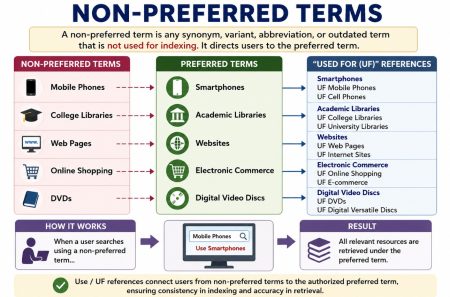
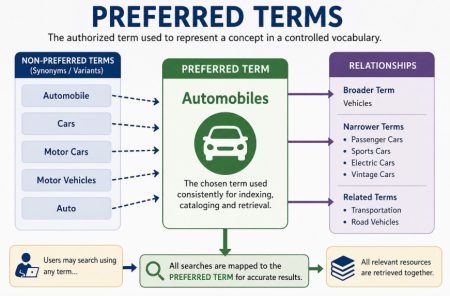
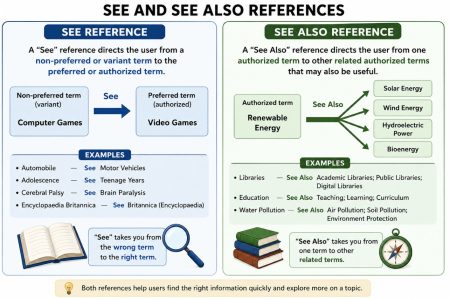
The next step is to consult an authorized subject heading list. Catalogers do not create their own subject terms; instead, they search standardized controlled vocabularies to identify the appropriate authorized heading. If there are multiple terms for the same concept, the cataloger selects the preferred or authorized term. For example, while “Cars” could be used, the authorized subject heading is “Automobiles.” Similarly, in medical subject heading systems, “High blood pressure” is represented by the authorized heading “Hypertension.” Using standardized terms ensures consistency across library catalogs.
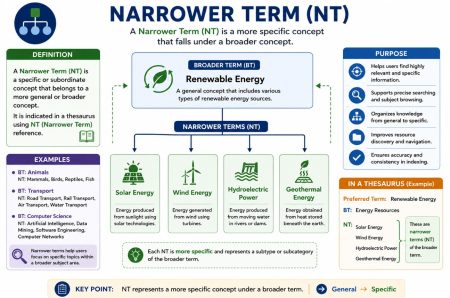
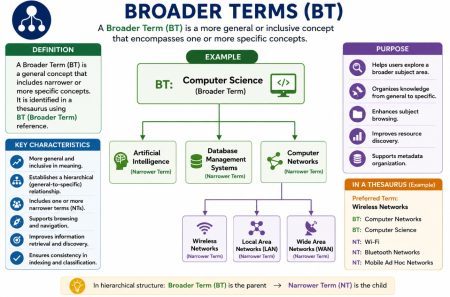
Catalogers also follow the principle of specificity, which means they choose the most specific subject heading that accurately reflects the content. Instead of using a broad heading like “Energy,” a cataloger would select “Renewable energy” if the book focuses specifically on sustainable energy sources. If the book discusses only solar power, the even more specific heading “Solar energy” would be preferred. This approach enhances the precision of information retrieval.
In addition to specificity, catalogers consider the principles of literary warrant and user warrant. Literary warrant means that a subject heading should represent topics that actually appear in published literature, while user warrant emphasizes selecting terms that users are likely to search for. Balancing these principles ensures that subject headings accurately describe the resource while remaining useful to library users.
For interdisciplinary books, catalogers may assign headings from multiple subject areas. For example, a book titled “Big Data in Business Decision Making” could receive subject headings such as “Big data,” “Business intelligence,” “Decision making,” and “Management information systems.” This allows researchers from different disciplines to discover the same resource through their specific subject searches.
Finally, catalogers review the assigned subject headings to ensure they accurately reflect the book’s content and comply with established cataloging standards. The completed subject headings are then included in the bibliographic record of the library catalog, enabling users to retrieve the book through subject-based searches in Online Public Access Catalogs (OPACs), digital libraries, and other information retrieval systems.