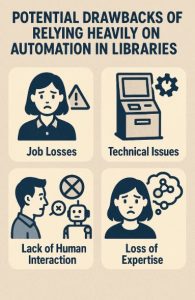
Potential Drawbacks of Relying Heavily on Automation in Libraries
As libraries increasingly adopt automation and technological solutions to improve efficiency and service delivery, they also face several risks associated with…

THE READING ROOM
As libraries increasingly adopt automation and technological solutions to improve efficiency and service delivery, they also face several risks associated with…
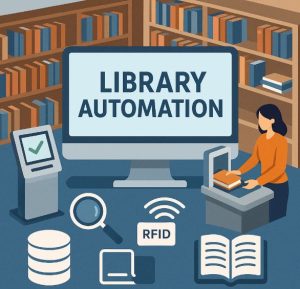
Library Automation refers to the integration of technology into library operations to streamline and enhance various services, particularly in managing resources,…
Library automation offers a wide range of key benefits that significantly improve operational efficiency in modern libraries. By leveraging advanced technologies,…
In the modern era, libraries are increasingly relying on automation to navigate the complex and evolving landscape of information management. With…
The Impact of Automation on Academic Libraries The integration of automation technologies in academic libraries has significantly transformed how libraries manage…
Library automation refers to the integration of technology into library operations to streamline and improve various tasks, such as cataloguing, circulation,…
Expert systems are a type of artificial intelligence (AI) designed to simulate the decision-making capabilities of human experts. In the context…
Library automation, a revolutionary advancement in Library and Information Science, has transformed traditional library operations into streamlined, efficient systems that cater…
Introduction: Radio-frequency identification (RFID) and barcodes are widely used technologies crucial in modern identification, tracking, and data management systems. Both efficiently…
Introduction: RFID automation has revolutionized library services, significantly reducing user wait times. With swift and contactless check-in/check-out processes, self-service kiosks, and…