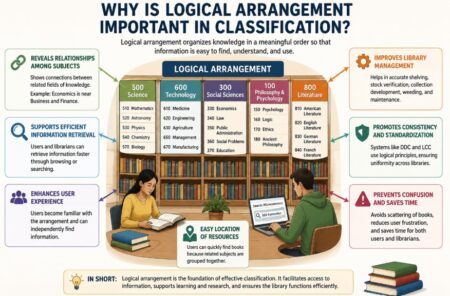
Library classification is essential for facilitating information retrieval by organizing knowledge in a systematic and logical way. It groups materials on similar subjects together and assigns unique class numbers or notations, making it easier for users to locate and access relevant resources. Instead of sifting through an entire library collection, users can go directly to the subject area that matches their information needs. This organized arrangement saves time, reduces confusion, and improves the overall efficiency of the search process.
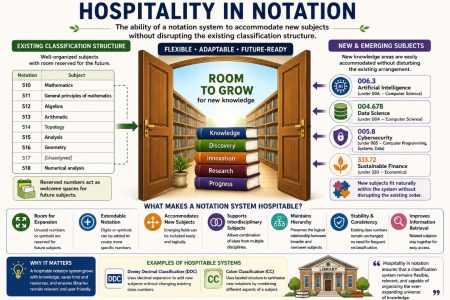
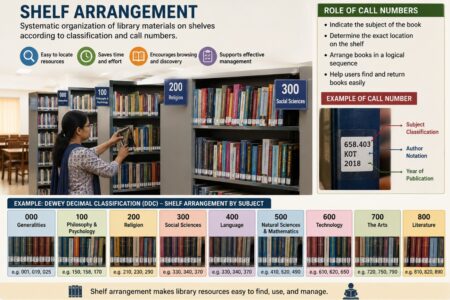
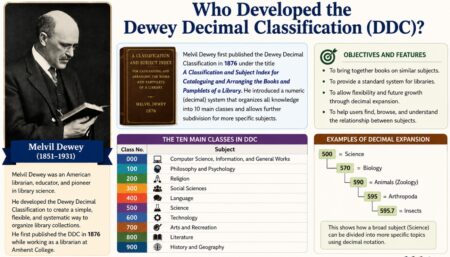
One of the primary ways classification supports information retrieval is by bringing related materials together. For instance, in the Dewey Decimal Classification (DDC) system, books on computer science are generally placed in the 000s, while books on economics are found in the 330s. A student searching for a book on artificial intelligence can visit the computer science section to find not only the desired book but also discover other related resources on machine learning, data science, and robotics. This subject-based arrangement enables users to retrieve information more effectively and encourages exploration of related topics.
Classification also provides a predictable shelf location for library materials. Each item receives a class number that reflects its subject content and determines its position within the collection. For example, a book classified as 005.133 (Programming Languages) will always be located near other books on programming and software development. This consistency allows users and librarians to quickly identify where a resource should be found, whether in a physical library or an online catalog.
In modern libraries, classification enhances information retrieval through Online Public Access Catalogs (OPACs) and digital library systems. Users can search by subject, keyword, or classification number to retrieve a list of related resources. For example, searching for the class number 330 in a catalog will display materials related to economics, while browsing a classification hierarchy can help users move from a broad topic to more specific subjects. This hierarchical structure enables users to refine their searches and locate information with greater precision.
Another significant benefit of classification is its support for subject browsing and serendipitous discovery. When users visit a particular shelf or browse a subject category in a digital catalog, they often come across additional resources that are relevant to their interests. For example, a researcher looking for books on digital libraries may also find nearby materials on information retrieval, metadata, library automation, and knowledge management. Such discoveries are less likely to occur through a simple keyword search alone, making classification a valuable tool for comprehensive research.