How Do Digital Libraries Support Open Access to Knowledge?
Digital libraries play a crucial role in promoting open access to knowledge by providing online access to scholarly, educational, scientific, historical, and cultural information, thereby reducing financial, geographical, and institutional barriers. Open access typically refers to research and scholarly materials that users can read online without paying subscription or access fees, though the ability to reuse such materials depends on copyright and licensing agreements. By collecting, organizing, preserving, and disseminating digital resources through online platforms, digital libraries enable students, researchers, educators, professionals, and the general public to access knowledge worldwide. This fosters a more inclusive information environment where knowledge can be discovered beyond the confines of individual institutions.
One of the primary ways digital libraries support open access is through the development of institutional repositories. Universities, research institutes, and other organizations utilize these repositories to collect and preserve the intellectual output generated by their communities. Such repositories may include theses and dissertations, journal articles, conference papers, research reports, working papers, datasets, teaching materials, and other scholarly works. Repository software like DSpace and EPrints allows institutions to organize these materials and make relevant content openly available online. For example, when a university uploads its students’ theses and faculty research papers to an institutional repository, researchers from other universities or countries can discover and read those works without needing to visit the university library in person.
Digital libraries also promote open access by eliminating or reducing subscription and financial barriers to information. Traditional scholarly publishing often requires libraries or individuals to pay subscription fees to access journals, databases, and other resources. Open digital repositories and digital libraries offer an alternative route for accessing eligible research outputs freely. For instance, a student at an institution with limited journal subscriptions may find an openly available version of a research paper in an institutional or subject repository. This is especially beneficial for researchers and students in developing countries and institutions with constrained information budgets, as it broadens access to scholarly literature that may otherwise be hard to obtain.
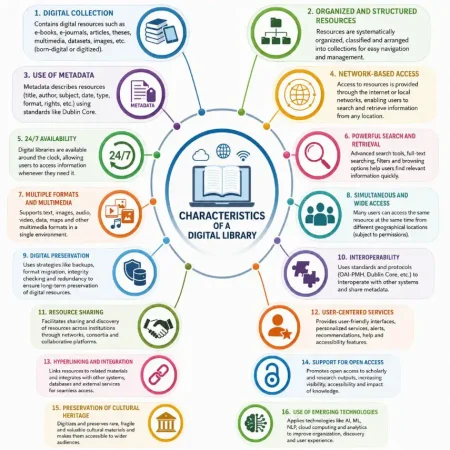
Another significant contribution of digital libraries is their ability to enhance the visibility and discoverability of research. A printed thesis stored on a library shelf might be consulted by a limited number of local users, while a thesis deposited in an open digital repository can potentially be found by users across the globe. Digital libraries utilize metadata—such as titles, authors, abstracts, subjects, keywords, dates, and identifiers—to describe their resources. Search engines and scholarly discovery services can index this information, making research outputs easier to locate. Consequently, digital libraries not only provide access to research but also help institutions and researchers increase the visibility and reach of their scholarly contributions.
Digital libraries enhance open access by facilitating self-archiving, which is often linked to the Green Open Access model. In this approach, researchers deposit an appropriate version of their scholarly work into an institutional or subject-specific repository, in accordance with publisher policies, copyright agreements, and any embargo requirements. For instance, a researcher might publish an article in a subscription-based journal but be allowed to deposit the accepted manuscript in their university’s institutional repository. After any required embargo period, this version can become openly accessible to readers. Thus, digital libraries provide the technical infrastructure necessary for institutions and researchers to effectively participate in Green Open Access.
The use of open licenses can further enhance the contribution of digital libraries to open knowledge. Creative Commons licenses, for example, allow creators and copyright holders to specify how others may use, share, adapt, or redistribute their works. A digital library can prominently display licensing information alongside an item, so that users understand their permissions regarding the content. For instance, an educational resource distributed under a suitable Creative Commons license may allow teachers to share or adapt it under specific conditions. Providing clear rights information helps digital libraries move beyond simple access, promoting lawful reuse and wider dissemination of knowledge.
Digital libraries also support open access through interoperability and metadata sharing. Modern repositories can expose metadata using established protocols and standards, enabling other systems to harvest and consolidate their records. A notable example is the Open Archives Initiative Protocol for Metadata Harvesting (OAI-PMH), which allows repositories to share structured metadata with external discovery services. This means users don’t always need to know the exact repository where a document is stored; a search service can gather metadata from numerous participating repositories and provide a broader discovery interface. Such interoperability helps create networks of open scholarly information and makes locally produced research visible to a global audience.
Open-access digital libraries are crucial for preserving and disseminating theses and dissertations. Universities produce many theses and dissertations containing original research, but traditionally these documents were available only as printed copies in individual university libraries. Now, electronic theses and dissertations can be deposited in institutional repositories and made openly accessible, when permitted by institutional policies and author permissions. For example, a postgraduate researcher studying digital library development in Bangladesh may discover relevant theses from universities in other countries without having to travel to those institutions. This provides access to valuable research that might not have been formally published in journals.
Another significant contribution of digital libraries is the provision of open educational resources (OER). Digital libraries can collect, organize, and provide access to openly licensed textbooks, lecture materials, course modules, presentations, learning objects, and multimedia educational resources. Teachers can utilize these materials to support classroom instruction, while students can access them for independent learning. For instance, an openly licensed digital textbook can be accessed online by students who may otherwise struggle to afford a costly commercial textbook. By supporting OER, digital libraries contribute to more affordable and equitable education.
Digital libraries play a crucial role in democratizing access to cultural and historical knowledge. Open access extends beyond just journal articles and academic publications; it includes a variety of materials from libraries, archives, museums, and cultural institutions. These organizations are increasingly digitizing historical newspapers, photographs, manuscripts, maps, rare books, government records, and other cultural artifacts, making them available through digital collections where rights allow. For example, the Library of Congress offers extensive digital collections, including historical photographs, manuscripts, maps, newspapers, and other cultural resources. Such initiatives enable people worldwide to explore materials that previously required an in-person visit.
Digital libraries also help address geographical inequalities in access to knowledge. While a physical research collection may primarily serve individuals who can travel to the institution, an openly accessible digital collection can reach users across cities, countries, and continents. For instance, a researcher in Bangladesh may consult an open repository maintained by a European university, while a European researcher may access a thesis or research report produced by a Bangladeshi institution. This way, digital libraries facilitate international knowledge exchange and encourage research collaboration across geographical boundaries.
The benefits of open access extend to researchers, institutions, and readers. By depositing scholarly outputs in digital repositories, institutions can create a visible record of their research activities and preserve their intellectual contributions. Researchers may gain a wider readership because their work becomes easier to discover and access. Repository statistics can provide insights into views and downloads, helping to demonstrate how institutional research is being utilized. Thus, digital libraries function not only as storage systems but also as platforms for communicating and showcasing scholarly achievements.
However, managing open access in digital libraries requires careful consideration. Open access does not mean that every digital resource can automatically be made freely available. Factors such as copyright ownership, publisher agreements, licensing restrictions, privacy concerns, sensitive information, and embargo periods can determine how and whether a resource may be shared. For example, a digitized copyrighted book cannot necessarily be made available online for unrestricted public access simply because a library owns a physical copy. Consequently, digital library professionals must navigate copyright permissions, licenses, access conditions, and rights metadata to ensure that open-access services operate legally and ethically.