
What is Library Catalogue?
A library catalogue is a systematic and organized list of all the information resources available in a library. It is designed to help users efficiently identify, locate, and access materials. The catalogue serves as the primary tool for bibliographic control, providing detailed descriptions of books, journals, theses, reports, multimedia items, and other resources. For example, if a student searches for “Principles of Marketing” by Philip Kotler, the catalogue record will display the author’s name, full title, edition (e.g., 16th edition), publisher, year of publication, ISBN, subject headings, and most importantly, the call number that indicates the exact shelf location. This structured information allows users to confirm whether the book is available and where to find it.
The main purpose of a library catalogue is to save users time and effort by organizing resources in a logical and searchable manner. In a large academic library with thousands of books across disciplines such as Business, Engineering, Law, and Pharmacy, physically browsing shelves without a catalogue would be inefficient and confusing. For instance, a student researching “digital marketing strategies” can search by keyword in the catalogue to retrieve a list of relevant books, journal articles, or e-books, rather than having to check multiple shelves manually. Similarly, a faculty member looking for works by a specific author can use the author search option to view all related materials available in the library.
Traditionally, catalogues were maintained in the form of card catalogues, where bibliographic details were either typed or written on index cards and arranged alphabetically by author, title, or subject. For example, under the subject “Library Science,” users would find multiple cards listing books on cataloguing, classification, and information retrieval. However, with technological advancements, most libraries now use Online Public Access Catalogues (OPAC). An OPAC allows users to search electronically by author, title, subject, or keyword, check whether a book is currently available or checked out, and sometimes even reserve or renew items online. For instance, a user can search for “research methodology,” filter results by publication year (e.g., 2020–2025), and instantly see the availability status.
In essence, the library catalogue acts as a “gateway” to a library’s knowledge resources. It connects users with information by organizing materials according to established cataloguing rules and classification systems, such as AACR2 or RDA for cataloguing standards, and systems like Dewey Decimal Classification (DDC) for arranging materials on shelves. By ensuring systematic arrangement and easy retrieval, the library catalogue plays a fundamental role in supporting teaching, learning, and research activities in academic, public, and special libraries.
Components of a Traditional Library Catalogue
A traditional library catalogue, often referred to as the card catalogue, was the main tool used for accessing materials in libraries before computerized systems were introduced. It comprised meticulously prepared catalogue cards that were arranged in drawers and organized according to specific rules and standards. Each component of this traditional catalogue was essential for ensuring systematic access and efficient retrieval of library materials. The major components are discussed in detail below.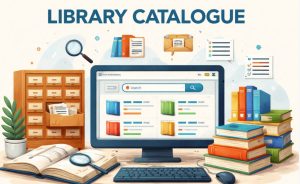
1. Catalogue Cards: The most fundamental component of a traditional catalogue was the catalogue card. Each card represented a single item in the library’s collection. These cards typically measured 3 x 5 inches and were made of durable paper to endure frequent handling. Usually, each book had several cards created for it, including:
- An author card
- A title card
- One or more subject cards
For example, a book titled Introduction to Information Science by John Smith might have:
- An author card filed under “Smith, John”
- A title card filed under “Introduction to Information Science”
- Subject cards filed under “Information Science” and “Library Science”
This multiple-entry system allowed users to search from different access points.
2. Bibliographic Description: The bibliographic description was central to the catalogue card. It adhered to established cataloguing standards, such as AACR2, and included standardized information about the item.
A typical bibliographic description included:
- Author’s name
- Title and subtitle
- Edition statement
- Place of publication
- Publisher’s name
- Year of publication
- Physical description (number of pages, illustrations, size)
- Series statement (if applicable)
For example: Smith, John.
Introduction to Information Science. – 2nd ed. – London: Academic Press, 2018. – 350 p.; 24 cm.
3. Main Entry: The main entry served as the primary access point for creating the full bibliographic record. Typically, the author’s name was utilized as the main entry. In cases where no author was available, the title was used instead as the main entry.
For example:
- If a book had a single author, → main entry is under the author’s name.
- If it were an edited book, → the main entry would be under the editor.
- If it had no identifiable author → main entry under the title.
- The main entry card contained complete bibliographic details.
4. Added Entries: Added entries were additional access points created to enhance retrieval. These included:
- Co-authors
- Editors
- Translators
- Series titles
- Important contributors
When a book has two authors, the second author will have an additional entry card that directs users to the main entry. This ensures users can find the book even when searching by a secondary contributor.
5. Subject Headings: Subject headings were standardized terms used to describe the content of a book. Libraries often followed controlled vocabularies such as Library of Congress Subject Headings (LCSH).
For example:
A book on digital libraries might carry subject headings like:
- Digital libraries
- Information retrieval
- Library automation
These subject cards were arranged alphabetically under each subject, allowing users to browse related materials.
6. Call Number: The call number was an essential part of the catalogue card, as it indicated the precise shelf location of the item. It was typically written in the top left corner of the card.
For example:
025.04 SMI
Here:
- 025.04 represents the classification number (from Dewey Decimal Classification)
- SMI represents the Cutter number (usually derived from the author’s name)
7. Filing System: Traditional catalogues were arranged in a systematic filing order. The most common types were:
- Dictionary catalogue (all entries arranged alphabetically in one sequence)
- Classified catalogue (entries arranged according to classification number)
In a dictionary catalogue, author, title, and subject entries were mixed together in strict alphabetical order. For example:
- Automation
- Brown, David
- Cataloguing
- Information Science
8. Cross-References: Cross-references directed users from one term to another, enhancing search efficiency. These links were usually indicated by:
- See references (directing users to the correct term)
- See also references (suggesting related topics)
Example:
- Cataloging — See Cataloguing
- Library automation — See also Digital libraries
Cross-references helped users navigate terminology differences and discover related resources.
The traditional library catalogue was a meticulously organised manual system intended to ensure systematic organisation and efficient retrieval of library materials. Its key components-including catalogue cards, bibliographic descriptions, main and added entries, subject headings, call numbers, filing systems, and cross-references-worked together to provide multiple access points for users. Although modern libraries now utilise computerised OPAC systems, the fundamental principles of traditional cataloguing continue to support today’s digital catalogues.
The Purpose of a Library Catalogue
The library catalogue serves as the central access tool for a library, designed to systematically organize information resources and make them easily retrievable for users. Its primary purpose is to inform users about what materials the library owns and how to locate those materials. In libraries that house thousands of books, journals, theses, reports, and multimedia items, the catalogue prevents disorder and confusion by presenting structured bibliographic information. For example, if a student needs “Business Research Methods” by Donald R. Cooper, the catalogue allows the student to confirm its availability, edition, and publication details before heading to the shelves.
Another major function of a library catalogue is to help users locate materials accurately. By providing a call number- such as 658.0072 COO under the Dewey Decimal Classification system-the catalogue guides users to the exact shelf location of the book. Without this organized system, finding a single item in a large academic library would be extremely time-consuming. Thus, the catalogue acts as a navigational guide within the library’s physical and digital collections.
The catalogue also performs the important function of collocation, which means it brings together related works. It groups all materials written by a specific author, all works on a particular subject, or all editions of a certain title in one place. For instance, searching under the subject “Information Literacy” will retrieve all books and related resources on that topic available in the library. This is especially helpful for researchers who need comprehensive information on a specific subject area. Furthermore, the library catalogue assists users in selecting appropriate materials. The detailed bibliographic record, including author, title, edition, publisher, year of publication, and physical description, helps users evaluate whether a resource meets their academic needs. A researcher may prefer the most recent edition of a textbook or choose a book published by a reputable academic publisher. The catalogue provides the necessary information for making informed decisions.
In modern libraries, particularly those using Online Public Access Catalogue (OPAC) systems, the purpose of the catalogue has expanded to include remote accessibility and advanced search features. Users can search by keyword, filter results by date or format, check whether a book is checked out or available, and sometimes even reserve or renew items online. This enhances user convenience and supports effective teaching, learning, and research activities.
Why Is a Library Catalogue Important in a Library?
A library catalogue is essential because it serves as the central access point to a library’s entire collection, ensuring that information resources are organised, discoverable, and usable. In any library-especially academic libraries that contain thousands of books, journals, theses, and digital materials-it would be nearly impossible for users to find the resources they need without a structured system. The catalogue provides a systematic record of all holdings, allowing users to confirm whether a specific item exists in the collection and how to access it. For example, if a student is looking for “Research Methodology” by C.R. Kothari, the catalogue helps verify the book’s availability, edition, and shelf location using the assigned call number.
The library catalogue is essential for several reasons, primarily because it saves time and reduces confusion. Instead of manually searching through shelves, users can quickly locate relevant information by searching for authors, titles, subjects, or keywords. This efficiency is especially important in academic environments where students and researchers often face tight deadlines. For example, a faculty member preparing a lecture on digital marketing can simply search the catalog using the subject term “Digital Marketing” to instantly access a list of relevant books and materials available in the library.
Catalogues also play a crucial role in organising knowledge. By grouping materials under standardized subject headings and classification numbers, it ensures that related works are grouped together in a logical manner. This process, known as collocation, allows users to explore all materials on a specific topic or by a particular author in one location. This organization enhances the depth of research and fosters a comprehensive understanding of various subjects. Moreover, the library catalog supports informed decision-making. The detailed bibliographic information, such as author, edition, publisher, year of publication, and physical description, enables users to evaluate the relevance and credibility of resources before accessing them. For instance, a researcher might prefer the latest edition of a textbook or a publication from a reputable academic press, and the catalog provides this vital information upfront.
In modern libraries, the catalogue plays a crucial role in promoting digital accessibility and enhancing user convenience. Online Public Access Catalogues (OPAC) enable users to search for materials remotely, check their availability, place reservations, and, in some cases, renew borrowed items. This system significantly improves the user experience and ensures ongoing access to information resources.
How Does a Library Catalogue Help Users Find Information?
A library catalogue is an essential tool that helps users locate information by providing a structured and organized overview of the entire collection. Rather than searching through shelves randomly, users can consult the catalogue to determine if a specific book, journal, thesis, or other resource is available and where it can be found. Each catalogue entry includes important bibliographic details such as the author’s name, title, subject headings, publication information, edition, and call number. For instance, if a student is looking for “Principles of Marketing” by Philip Kotler, the catalogue allows the student to verify its availability, check which edition the library owns, and find its exact shelf location using the call number.
The library catalogue also helps users by providing various methods to search for materials. Users can search by author, title, subject, keyword, or ISBN, depending on the information they have available. For instance, if a researcher is studying “information literacy,” performing a subject search in the catalogue will yield all relevant materials organised under that topic. This collection of similar materials, known as collocation, enables users to explore a subject in depth. Additionally, searching by an author’s name will show all works by that author that are available in the library.
In addition to helping with identification and collocation, the library catalogue provides guidance for both physical and digital access to resources. The call number directs users to the exact location of a book on the shelves, typically using a classification system like the Dewey Decimal Classification. In modern libraries, Online Public Access Catalogue (OPAC) systems indicate whether items are available, checked out, or reserved. Some catalogues even provide direct links to e-books and online journals, allowing for immediate digital access. By systematically organising resources, offering various search options, and directing users to the correct locations, the library catalogue plays a crucial role in efficient and effective information retrieval.
Reference Articles:
- Chambers, S. (2013). Catalogue 2.0: The Future of the Library Catalogue. Facet Publishing.
- Khochar, R. S. (1999). Modern Cataloguing, (Systems And Practices). Discovery Publishing House.
- Library Catalog—An overview | ScienceDirect Topics. (n.d.). Retrieved March 10, 2025, from https://www.sciencedirect.com/topics/computer-science/library-catalog
- Library Catalogue – Knowledge Organization and Processing –Cataloguing. (n.d.). Retrieved March 10, 2025, from https://ebooks.inflibnet.ac.in/lisp3/chapter/library-catalogue/
- Ramalingam, M. S. (2000). Library Cataloguing and Classification Systems. Gyan Publishing House.
- Wheatley, H. B. (2010). How to Catalogue a Library. Cambridge University Press.


22 Comments
Catlog library information
This is awesome it helped as library is introduced newly to my state school. Thanks buddy for the write up.
Thanks for your inspiration.
definition for cataloguing ,catalogue & cataloguer
Thanks for your information I like it
Thanks for your information I like it
How do I catalog a book…an easy way to catalog a book please
You can follow this link attached: http://www.lisbdnet.com/library-cataloguing-practical-catalogue/
thank for upfating library students of ATBU Bauchi
Thank you. Please discuss the types of catalogue in details.
Definition need purpose of library catalogue seminar topic note . today plzz
Thanks for your contribution
Thanks
Thanks for this information
Thanks for ur information,it helped me
Alot.
This really helped me when I was preparing for an orientation during my attachment
thanks you for the updated
That’s nice update it really help users to retrieve of choice resource. thanks God bless
Thanks because this really helps me it’s edifying indeed!