

What is a Traditional Library?
A traditional library is a physical institution that collects, organizes, preserves, and provides access to printed and tangible information resources to support education, research, and lifelong learning. It serves as a central repository of knowledge where users can consult books, journals, newspapers, magazines, encyclopedias, dictionaries, maps, manuscripts, government publications, and audiovisual materials within a dedicated library building.
Examples of traditional libraries include public libraries, such as city or municipal libraries that serve local communities; school libraries that support teaching and learning; academic libraries in universities, like the North South University Library or the University of Dhaka Library; and national libraries, such as the National Library of Bangladesh, which preserves the country’s published heritage.
Unlike digital libraries, which provide electronic access to information through the internet, traditional libraries primarily rely on physical collections that users can borrow or consult on-site. Librarians organize these collections using standardized cataloging and classification systems, such as the Dewey Decimal Classification (DDC) or the Library of Congress Classification (LCC), making information retrieval efficient and systematic.
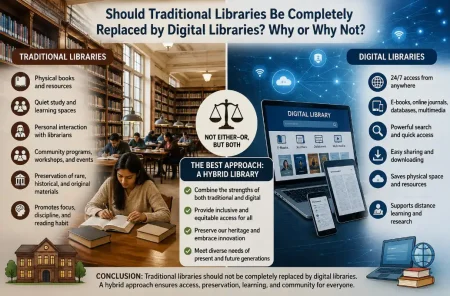
These librarians also offer essential services, including circulation, reference assistance, reader advisory services, information literacy instruction, and access to reading and study spaces. For example, a university student may visit an academic library to consult printed textbooks and research journals, while a researcher might use rare manuscripts or archival collections available solely in a physical library. In addition to providing information, traditional libraries preserve historical documents, cultural heritage, and valuable collections for future generations. Although digital technologies have expanded access to electronic resources, traditional libraries remain indispensable. They offer authentic printed materials, quiet and collaborative learning environments, personalized assistance from professional librarians, and spaces for academic, cultural, and community activities.
Therefore, traditional libraries continue to play a vital role in promoting literacy, supporting education and research, preserving knowledge, and fostering intellectual and cultural development in society.
Characteristics of a Traditional Library
Traditional libraries are essential institutions for education, research, and the preservation of knowledge due to several distinctive characteristics. While many libraries today incorporate digital technologies, the fundamental features of traditional libraries remain important. Below are the ten most significant characteristics of a traditional library, explained in detail:
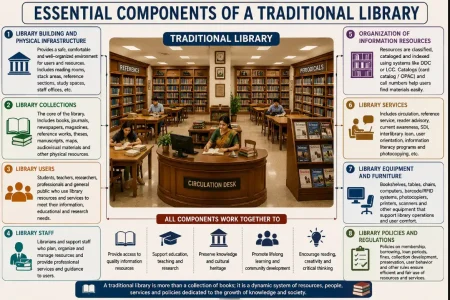
- Physical Infrastructure: A traditional library operates from a dedicated physical building where users visit to access information resources and library services. The building is typically divided into various sections, including circulation, reference, periodicals, reading rooms, stack areas, multimedia sections, archives, and staff offices. The physical environment is designed to provide users with a comfortable, organized, and quiet space for reading, studying, and conducting research. Academic libraries, public libraries, school libraries, and national libraries all maintain physical facilities that accommodate their collections and users.
- Printed and Physical Collections: One defining characteristic of a traditional library is its reliance on printed and tangible information resources. These collections generally include textbooks, reference books, journals, newspapers, magazines, theses, dissertations, government publications, manuscripts, maps, atlases, reports, and audiovisual materials such as CDs and DVDs. Unlike digital libraries that primarily offer electronic resources, traditional libraries preserve physical documents that users can handle, examine, and borrow. Many rare books and historical manuscripts exist only in printed form, making traditional libraries indispensable for historical and archival research.
- Systematic Organization of Information Resources: Traditional libraries organize their collections using internationally recognized cataloging and classification systems. Classification schemes such as the Dewey Decimal Classification (DDC) and the Library of Congress Classification (LCC) group materials according to subject, while cataloging standards provide detailed bibliographic information about each item. This systematic organization allows users to locate resources efficiently through library catalogs and shelf arrangements. Proper organization also facilitates inventory management, resource sharing, and long-term collection maintenance.
- Professional Librarian Assistance: Professional librarians are among the greatest strengths of a traditional library. They possess expertise in information organization, reference services, information literacy, cataloging, collection development, and research support. Librarians assist users in identifying appropriate information sources, developing effective search strategies, answering reference questions, recommending relevant materials, and teaching users how to evaluate information critically. Their personalized guidance is particularly valuable for students and researchers working on complex academic projects.
- Lending and Circulation Services: Traditional libraries provide structured lending services that allow registered members to borrow library materials for a specified period. The circulation department manages book issuance, returns, renewals, reservations, overdue notices, and fines according to library policies. These services ensure that information resources are shared fairly among users while maintaining accountability for library collections. Efficient circulation systems enable libraries to maximize the use of their resources and serve a large number of users.
- Quiet and Conducive Learning Environment: Traditional libraries offer a peaceful and distraction-free environment specifically designed for reading, studying, and research. Reading rooms, silent study areas, research carrels, and group discussion rooms create spaces that support different learning needs. Unlike many public places, libraries emphasize silence and orderly behavior, allowing users to concentrate for extended periods. This environment is especially beneficial for students preparing for examinations, researchers conducting in-depth studies, and individuals seeking uninterrupted access to information.
- Preservation of Knowledge and Cultural Heritage: One of the key responsibilities of traditional libraries is to preserve valuable knowledge for future generations. Libraries protect rare books, manuscripts, archives, historical records, government documents, photographs, maps, and other unique materials through proper storage, conservation, restoration, and environmental control. National and research libraries often have legal deposit collections and culturally significant publications that document a nation’s intellectual and historical heritage. These preservation activities ensure the long-term availability of important information resources.
- User Membership and Controlled Access: Traditional libraries typically operate within a formal membership system. Users must register with the library to receive membership cards that authorize them to borrow materials and access specific services. Different categories of users—such as students, faculty members, researchers, and the general public—may have varied borrowing privileges, loan periods, and access rights. Controlled access helps to protect library collections, maintain accurate borrowing records, and ensure equitable use of resources among all members.
- Educational and Community Support: Beyond serving as repositories for books, traditional libraries act as educational and community centers. They organize programs focused on information literacy, book exhibitions, reading competitions, author talks, seminars, workshops, storytelling sessions, cultural events, and community outreach activities. School libraries support classroom learning, academic libraries facilitate teaching and research, and public libraries promote lifelong learning among individuals of all ages. These initiatives strengthen literacy, encourage intellectual curiosity, and foster community engagement.
- Reliable and Authoritative Information Resources: Traditional libraries maintain carefully selected collections developed through professional collection development policies. Librarians evaluate books, journals, and other materials based on quality, authority, relevance, and credibility before acquisition. As a result, users have access to trustworthy and academically reliable information from recognized publishers, scholarly organizations, government agencies, and research institutions. This commitment to quality distinguishes traditional libraries from many freely available online information sources, where the accuracy and credibility of information can vary significantly.
The characteristics of a traditional library highlight its ongoing importance as a trusted institution for education, research, and knowledge preservation. Its physical collections, systematic organization, professional librarian support, structured lending services, and dedication to preserving cultural heritage make it an indispensable part of society. Even in the digital age, traditional libraries remain valuable as they provide authentic information resources, personalized assistance, and dedicated learning environments that support academic excellence and lifelong learning.
Why Are Traditional Libraries Important?
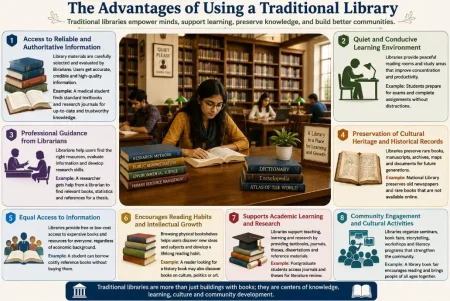
Traditional libraries are essential because they serve as trusted centers for knowledge, education, research, and cultural preservation. They provide access to a wide range of reliable and authoritative information resources, including books, journals, newspapers, reference works, manuscripts, government publications, and archival materials. Unlike many online sources, the materials available in traditional libraries are carefully selected and organized by professional librarians, ensuring their accuracy, credibility, and academic value. By offering equal access to information regardless of a user’s economic background, traditional libraries promote educational equity and lifelong learning. They support students in completing academic assignments, assist researchers in conducting scholarly investigations, and help professionals update their knowledge in their respective fields. For instance, university libraries provide access to specialized textbooks and research journals, while public libraries offer educational and recreational resources to people of all ages.
Traditional libraries also play a vital role in preserving cultural heritage and historical records. Rare books, manuscripts, local history collections, photographs, maps, and government documents are meticulously maintained to ensure that valuable knowledge is preserved for future generations. National libraries, in particular, safeguard a country’s intellectual and documentary heritage through systematic preservation and conservation efforts. Additionally, traditional libraries foster reading habits, critical thinking, and information literacy by encouraging individuals to explore diverse perspectives and evaluate information critically. Librarians provide personalized guidance in locating, selecting, and using information effectively, helping users develop essential research skills.
Another significant contribution of traditional libraries is the provision of a quiet, organized, and inclusive learning environment. Reading rooms, study spaces, and reference sections create an atmosphere that supports concentration, independent study, and collaborative learning. Libraries also serve as community and cultural centers by organizing book exhibitions, seminars, workshops, author talks, storytelling programs, and literacy campaigns that strengthen community engagement and promote intellectual growth. Although digital technologies have transformed access to information, traditional libraries continue to complement digital resources by providing authentic printed materials, professional assistance, and specialized collections that may not be available online. Therefore, traditional libraries remain indispensable institutions that preserve knowledge, promote education, support research, encourage lifelong learning, and contribute significantly to the social, cultural, and intellectual development of society.


3 Comments
This article was helpful in my research and heartedly reference it.
Conclusion for traditional libraries