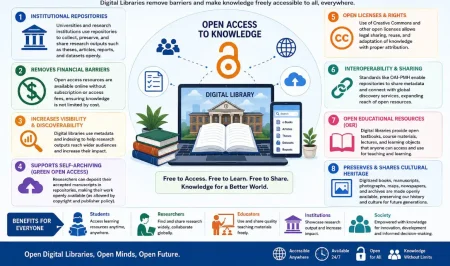
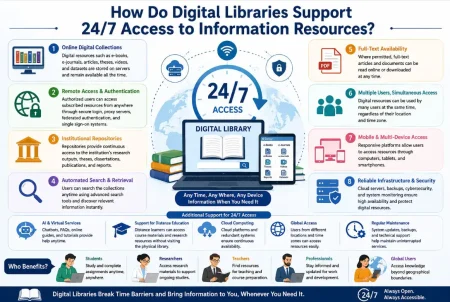
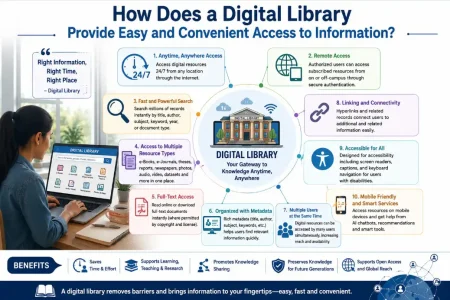
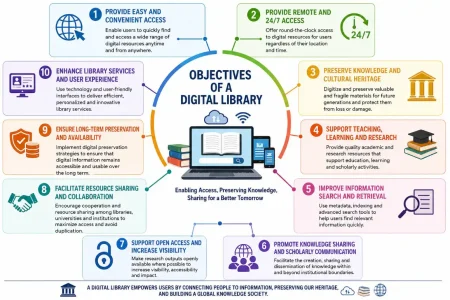
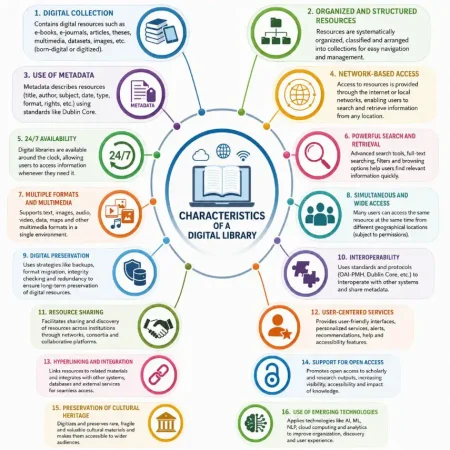
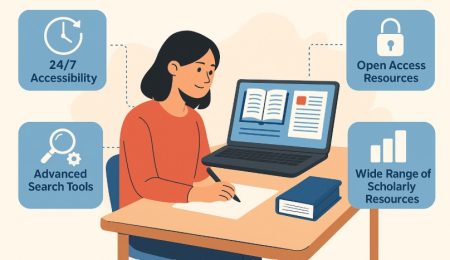
A digital library is an organized collection of information resources that are stored, accessed, and delivered in digital formats through computer networks. Unlike traditional libraries, which rely mainly on physical materials such as printed books and journals, digital libraries provide instant access to a wide range of electronic resources such as e-books (e.g., Springer eBooks), e-journals (e.g., Sage Journals, Taylor & Francis Online), academic databases (e.g., Scopus, JSTOR), and multimedia collections (e.g., educational videos or digital archives). The primary purpose of a digital library is to enhance accessibility and convenience by enabling users to search, retrieve, read, and utilize information at any time and from any location. Modern digital libraries utilize advanced technologies, including metadata standards, full-text search engines, cloud storage, and digital preservation tools such as DSpace or CONTENTdm, to ensure efficient organization, long-term preservation, and seamless delivery of content. They also support collaborative learning and research by offering tools like remote access platforms (e.g., OpenAthens), personalized user accounts, integrated reference managers (e.g., Zotero, Mendeley), and interactive learning resources. Overall, a digital library plays a vital role in modern education and research by breaking geographical barriers, saving time, and providing diverse, up-to-date, and easily navigable resources for students, researchers, and professionals.
Types of Resources Commonly Found in Digital Libraries
Digital libraries have transformed the way users access, store, and interact with information. By offering a wide variety of electronic resources, they support academic study, research, and general learning with unprecedented convenience. These resources span multiple formats, ranging from text to multimedia, enabling diverse learning experiences and catering to the needs of different user groups. The following sections discuss the main types of resources commonly found in digital libraries and explain their significance in the modern information environment.
- E-Books: E-books are among the most widely used resources in digital libraries. They include academic textbooks, reference books, literature, and popular reading materials, all of which are available in digital formats. E-books are accessible on various devices, allowing users to read anytime and from any location. Many digital libraries subscribe to reputable platforms such as Springer eBooks, Elsevier ScienceDirect, and Taylor & Francis eBooks to ensure access to authoritative content. Beyond convenience, e-books offer features like keyword search, highlighting, and instant downloads, making them an ideal resource for students and researchers.
- E-Journals and Scholarly Articles: E-journals and scholarly articles form the foundation of research-oriented digital collections. These resources include peer-reviewed papers, case studies, and review articles published by leading academic publishers such as Springer, Wiley, Sage, and Taylor & Francis. Digital access to journals enables users to stay updated with the latest developments in their fields and retrieve historical issues for deeper investigations. Full-text search capabilities, citation tools, and easy download options further enhance academic productivity. For researchers conducting literature reviews or developing new studies, e-journals serve as indispensable sources of validated academic knowledge.
- Academic Databases: Academic databases are comprehensive platforms that index and host vast collections of scholarly information. Examples include Scopus, JSTOR, IEEE Xplore, PubMed, and Emerald Insight. These databases allow advanced searching, filtering, and citation tracking, making them essential tools for academic research. They provide access to journals, conference proceedings, technical reports, statistical datasets, and specialized discipline-specific materials. Because of their depth and breadth, databases support critical research tasks such as systematic reviews, data analysis, and trend mapping, helping scholars build a strong foundation for their academic work.
- Institutional Repositories: Institutional repositories (IRs) house the scholarly output of a university or research institution. These digital collections typically contain electronic theses and dissertations (ETDs), faculty publications, project reports, and conference papers. Platforms like DSpace and EPrints are commonly used to manage such repositories. Institutional repositories not only preserve academic work but also make it freely accessible, promoting global knowledge sharing. By archiving the intellectual contributions of students and faculty, they enhance institutional visibility and support long-term digital preservation.
- Multimedia Resources: Digital libraries increasingly include multimedia resources that support interactive learning. These may consist of educational videos, audio lectures, animations, podcasts, and recorded webinars. Multimedia materials cater to different learning styles and are particularly useful for subjects that require visual or auditory explanations. For example, science learners benefit from video demonstrations of laboratory experiments, while humanities students may rely on recorded lectures or expert interviews. As digital learning environments expand, multimedia resources have become indispensable components of modern libraries.
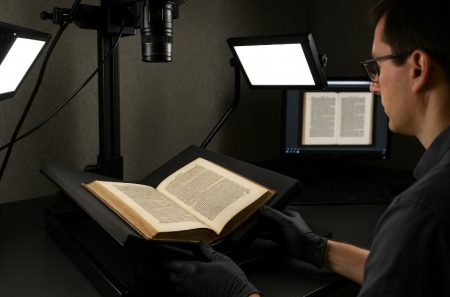
- Digital Archives and Special Collections: Digital archives and special collections preserve rare, historical, or culturally significant materials by making high-quality digital versions accessible to users worldwide. These archives may include scanned books, manuscripts, letters, old newspapers, photographs, and maps. Many libraries digitize fragile or rare items to protect them from physical deterioration while providing global access for research and cultural preservation. These collections are essential for historians, researchers, genealogists, and anyone studying primary sources or local heritage.
- Newspapers and Magazines: Digital libraries often provide access to online newspapers and magazines, including both current and archived content. These resources help users explore daily news, historical events, editorials, and feature stories across time. Platforms such as PressReader, ProQuest Newsstand, and local digital news archives enable comprehensive access to national and international publications. Researchers studying social trends, journalism, or public opinion rely heavily on digitized newspapers due to their rich and time-sensitive content.
- Government and Institutional Documents: Many digital libraries host government publications, policy papers, legal documents, census data, and statistical reports that support academic and policy research. Institutional documents, such as annual reports, strategic plans, and university policies, may also be included. These resources are widely used by researchers, policymakers, and students who require authoritative and reliable information. By providing digital access to such documents, libraries ensure transparency and support evidence-based decision-making.
- Open Educational Resources (OER): Open Educational Resources (OER) are freely accessible teaching and learning materials, including lecture notes, course modules, presentations, and e-learning packages. Educational institutions increasingly support OER initiatives to reduce student costs and promote open access. OER enables instructors to customize content and provides learners with access to high-quality materials without restrictions. Their adaptability and free availability make OER a crucial component of digital library services.
- Reference Tools: Reference tools play a crucial role in supporting research, writing, and information literacy. These tools include online dictionaries, encyclopedias, subject-specific glossaries, and citation management software like Zotero, Mendeley, and EndNote Basic. Digital libraries often integrate such tools to help users verify information, understand concepts, and manage citations effectively. These resources enhance the quality of academic writing and support researchers in organizing their literature efficiently.
Digital libraries offer an extensive and diverse range of resources that support the growing needs of learners, educators, and researchers. By combining traditional scholarly materials with modern digital tools and multimedia content, they remove geographical barriers and make knowledge more accessible than ever before. As technology continues to evolve, digital libraries will remain central to information access, academic innovation, and lifelong learning.