
The selection of library resources is a fundamental aspect of collection development, ensuring that a library provides materials that meet the academic, research, and recreational needs of its users. It is a systematic process through which librarians, often in collaboration with faculty members, students, and subject experts, identify and acquire resources in various formats such as books, journals, databases, and multimedia. For example, an academic library may select new textbooks and reference books to support undergraduate courses in business studies, while also subscribing to scholarly databases like Scopus or IEEE Xplore to meet advanced research needs. The process involves evaluating materials based on criteria like relevance, accuracy, authority, cost, demand, and long-term value to the community. A public library, for instance, may prioritize popular fiction and children’s literature based on user demand, whereas a medical library may focus on evidence-based clinical resources such as PubMed or UpToDate. Effective selection helps maintain a balanced collection that supports the curriculum, promotes lifelong learning, and reflects diverse perspectives. In today’s digital age, the selection process also considers electronic resources, open access content, and technological compatibility- such as choosing e-books that are accessible through multiple devices or subscribing to platforms like ProQuest Ebook Central. By carefully selecting resources, libraries ensure that their collections remain current, reliable, and capable of supporting knowledge acquisition, research, and innovation.
What is the Meaning of Library Resources?
Library resources refer to the wide range of materials, tools, and services that a library provides to support learning, teaching, research, and personal development. These resources are not limited to printed books but also include journals, newspapers, magazines, theses, government documents, and reference works such as dictionaries and encyclopedias. In addition to print collections, library resources also encompass electronic and digital formats like e-books, online journals, databases, institutional repositories, and multimedia materials. For example, a university library may provide access to digital platforms such as ProQuest, ScienceDirect, or Research4Life to meet the research needs of students and faculty. Library resources also extend to non-traditional formats such as maps, microfilms, audiovisual materials, and even digital archives of rare collections. Beyond physical and digital materials, resources include services such as information literacy programs, reference assistance, and research support that enhance users’ ability to find and use information effectively. In essence, library resources are the backbone of a library, designed to meet the diverse information needs of its community and contribute to the advancement of knowledge.
Meaning of the Selection Process of Library Resources
The selection process of library resources refers to the systematic and planned approach through which libraries decide which materials should be added to their collections in order to best serve their users. It goes beyond simply purchasing books or subscribing to journals; it involves carefully identifying, evaluating, and choosing resources that align with the mission, goals, and user needs of the library. For example, in an academic library, the process may include selecting textbooks recommended by faculty to support courses, subscribing to scholarly databases for research, or acquiring specialized resources like case studies and laboratory manuals. In a public library, the selection process might focus on popular fiction, children’s books, or community-specific resources that reflect local culture and interests. The process typically considers factors such as subject relevance, content accuracy, authority of the author or publisher, cost, format, and long-term usefulness. With the rise of digital information, libraries also evaluate electronic resources, such as e-books, online journals, and databases, to ensure technological compatibility and accessibility. In short, the selection process is a thoughtful, criteria-based activity that ensures a library maintains a balanced, up-to-date, and user-centered collection.
Why is the Selection Process Important in Library Collection Development?
The selection process plays a central role in library collection development because it ensures that the library builds and maintains a collection that truly meets the needs of its users. A library is not just a storehouse of books; it is a dynamic knowledge hub that supports learning, teaching, research, and community engagement. The resources it provides, whether printed books, journals, e-books, or online databases, must be carefully chosen through a systematic and well-thought-out selection process. Without proper selection, the collection risks becoming irrelevant, outdated, or imbalanced, limiting the library’s ability to fulfill its mission.
One of the primary reasons the selection process is important is that it ensures relevance to user needs. Every library serves a specific community, and its resources should reflect the requirements of that group. For example, in an academic library, selection may focus on purchasing textbooks, scholarly journals, and databases like Scopus or IEEE Xplore that support the institution’s curriculum and research priorities. In contrast, a public library may prioritize children’s literature, novels, and career development resources based on the interests of its community members. By aligning the collection with user demand, libraries enhance their value and utility.
The selection process also plays a vital role in maintaining a balanced and diverse collection. Libraries must ensure that their resources represent multiple subjects, disciplines, and perspectives to avoid bias and promote inclusivity. For instance, a university library may acquire both local publications in Bangla and international journals such as Nature or The Lancet, giving students access to global and regional knowledge. Similarly, a school library may balance storybooks for younger children with subject-based materials for older students. This diversity allows libraries to serve a wide range of user groups effectively.
Another significant aspect of the selection process is its contribution to academic and research excellence. In higher education, access to reliable and up-to-date resources is essential for quality teaching and impactful research. Subscribing to databases like PubMed helps medical students remain informed about the latest clinical developments, while access to ProQuest or ScienceDirect allows researchers to explore a vast range of scholarly materials. Such carefully chosen resources strengthen the institution’s academic reputation and enhance the quality of research output.
The selection process is equally important in managing library budgets wisely. Financial resources are often limited, and libraries cannot purchase every available resource. Careful evaluation ensures that investments are directed toward the most relevant and valuable materials. For example, instead of subscribing to multiple databases with overlapping content, a library may choose one comprehensive package that meets various needs. Similarly, prioritizing high-demand textbooks or e-book packages ensures maximum benefit for the largest number of users. This makes the collection not only effective but also cost-efficient.
In today’s digital age, the selection process also ensures that libraries keep pace with technological change. Selecting digital resources such as e-books, online encyclopedias like Britannica Online, or institutional repository platforms like DSpace provides users with anytime, anywhere access to information. Considering licensing terms, accessibility features, and compatibility with multiple devices is now as crucial as evaluating subject relevance and authority. By making thoughtful decisions about digital resources, libraries expand their reach beyond physical walls and support remote learning and research.
Finally, the selection process contributes to preserving institutional and cultural heritage. Libraries, particularly academic and national institutions, play a role in collecting and safeguarding rare materials, manuscripts, theses, and local archives. For example, digitizing and selecting rare Bangla manuscripts for preservation ensures that future generations can access and study them. In this way, selection is not just about meeting present needs but also about building a lasting record of cultural and intellectual achievements.
How Has the Selection Process of Resources Changed in the Digital Age?
The selection process of library resources has undergone a significant transformation in the digital age. Traditionally, libraries focused mainly on acquiring print materials such as books, journals, and newspapers, often relying on publishers’ catalogs, book reviews, and faculty recommendations. While these elements still play a role, the scope of selection has expanded to include a wide variety of digital formats such as e-books, online journals, research databases, multimedia collections, and institutional repositories. This shift has required librarians to evaluate not only the content quality but also the accessibility, licensing models, and technological compatibility of digital resources.
Another major change is the increasing reliance on data-driven decision-making. Libraries now use usage statistics, citation analyses, and feedback from users to guide selection choices. For example, if a particular e-journal database shows high download rates among students and faculty, librarians are more likely to renew or expand its subscription. At the same time, demand-driven acquisition (DDA) models, where resources are purchased based on actual user requests or usage, have become more popular, ensuring that funds are spent efficiently and collections remain highly relevant.
The digital environment has also widened access to open educational resources (OER) and open access journals. Libraries today consider not just commercial publications but also freely available scholarly content that supports teaching and research. For instance, including open-access repositories such as arXiv for physics or PubMed Central for health sciences helps reduce costs while expanding the range of materials available to users. This change reflects a growing emphasis on inclusivity and equitable access to knowledge.
Overall, the digital age has made the selection process more complex, dynamic, and user-centered. Librarians must balance traditional selection principles with new considerations such as platform usability, perpetual access rights, and remote availability. By embracing digital resources while still valuing print collections, libraries can provide flexible and comprehensive collections that support diverse learning, research, and community needs.
Selection Process of Library Resources
The selection process of library resources is a vital part of collection development, as it ensures that a library’s holdings remain relevant, balanced, and capable of supporting the academic, research, and recreational needs of its community. Libraries exist to serve their users, and the materials they provide must be carefully chosen to reflect those users’ diverse requirements. Selection is therefore a systematic activity that requires planning, evaluation, and collaboration between librarians, faculty members, and even library patrons. A well-designed selection process not only strengthens the library’s value but also builds its reputation as a reliable knowledge hub.
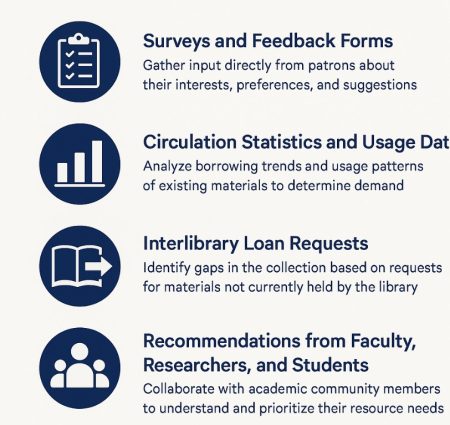
The first stage of the process involves identifying the needs of the users. Every library serves a distinct audience, and the resources must correspond to their expectations. For instance, academic libraries focus on textbooks, reference works, and scholarly databases such as Scopus or IEEE Xplore to support teaching and research, while public libraries emphasize fiction, children’s books, and skill-building resources to serve community interests. Needs are often assessed through surveys, feedback, and consultations with faculty and students.
Once needs are established, librarians evaluate potential resources using clear selection criteria. These criteria include subject relevance, accuracy, authority of the author or publisher, cost, popularity, and long-term value. In the case of medical libraries, priority may be given to highly reliable databases such as PubMed or UpToDate. For public libraries, demand for popular novels or local-language storybooks may be prioritized. In today’s digital environment, additional considerations such as licensing terms, platform usability, and accessibility across devices also play an important role in the evaluation process.
Budgetary limitations make the selection process even more critical. Since libraries cannot purchase every available resource, careful decision-making ensures the most efficient use of funds. Demand-driven acquisition (DDA) models are increasingly adopted, where resources such as e-books are purchased only when requested by users or when usage statistics justify investment. Similarly, libraries may opt for comprehensive packages that serve multiple disciplines rather than subscribing to overlapping databases. This approach ensures both cost-effectiveness and user satisfaction.
The selection process has expanded further in the digital age, moving beyond print resources to embrace digital and open-access materials. Libraries now provide e-books, multimedia, databases, and institutional repositories, in addition to traditional resources. For example, open-access platforms like arXiv or PubMed Central are now integral parts of library collections, broadening access to knowledge without additional cost. Many academic libraries also use repositories such as DSpace to preserve theses, dissertations, and faculty research, ensuring long-term access and visibility.
Another important aspect of selection is the preservation of cultural and institutional heritage. Libraries often prioritize collecting and digitizing rare manuscripts, local history documents, and archival materials. For example, a national library may focus on preserving historical government records, while a university library may curate and digitize student theses to contribute to institutional memory. This role highlights that the selection process is not only about meeting immediate academic or informational needs but also about safeguarding knowledge for future generations.
In conclusion, the selection process of library resources is a deliberate, structured, and ongoing activity that shapes the quality and character of a library’s collection. By identifying user needs, applying thoughtful evaluation criteria, managing financial resources wisely, integrating digital tools, and preserving cultural heritage, libraries ensure that their collections remain dynamic and meaningful. A carefully executed selection process transforms libraries into vibrant, user-centered spaces that foster education, research, and lifelong learning in an ever-changing world.
Criteria for Selecting Library Resources
The selection of library resources is a critical step in collection development, as it ensures that a library’s holdings remain useful, balanced, and capable of meeting the needs of its community. Since libraries work with limited budgets and serve diverse groups of users, careful evaluation is essential before adding new materials to the collection. A well-defined set of criteria helps librarians choose resources that not only reflect academic and research priorities but also provide long-term value.
- Relevance to User Needs: The foremost consideration in selecting library resources is their relevance to the needs of the users. Libraries exist to serve particular communities, and their collections must reflect the academic, research, or recreational demands of those groups. For example, in an academic library, textbooks, reference works, and scholarly databases that support courses and research activities are prioritized. In contrast, a public library might focus on novels, children’s literature, or job-preparation materials that respond to community interests. Understanding user needs through surveys, consultations, and feedback helps libraries make better choices.
- Authority and Credibility: Another important criterion is the authority of the author, editor, or publisher. Materials from recognized scholars, professional organizations, or established publishers are preferred because they provide reliable and trustworthy information. For example, academic libraries often give preference to publications from Oxford University Press, Springer, or Taylor & Francis. In fields such as medicine and law, authority is particularly critical, as students and practitioners depend on accurate and reputable sources for professional practice.
- Accuracy and Quality of Content: Accuracy is central to resource selection because users rely on libraries for factually correct and well-documented information. Librarians must ensure that the content is up-to-date, free from errors, and consistent with current knowledge in the field. For instance, in a medical library, resources like PubMed or UpToDate are chosen because they provide regularly updated clinical and research information. Similarly, in the sciences, journals that frequently publish peer-reviewed research articles are prioritized to ensure high-quality content.
- Cost and Value for Money: Budget considerations significantly influence the selection process. Libraries cannot afford to purchase every available resource, so cost-effectiveness becomes a vital factor. Librarians must weigh the price of resources against their usefulness and long-term value. For example, instead of subscribing to multiple overlapping databases, a library may choose a single comprehensive package that covers various subjects. Many libraries now use demand-driven acquisition (DDA) models, where resources like e-books are purchased based on actual user demand, ensuring efficient use of funds.
- Format and Accessibility: The format of resources, whether print, digital, or multimedia, is another major factor in selection. With the growth of digital information, accessibility has become just as important as content. Libraries consider whether resources are available in formats that meet user needs, such as e-books, online journals, or audio-visual content. They also evaluate accessibility features like remote access, multi-user licenses, and compatibility with various devices. For example, platforms like ProQuest Ebook Central are often selected because they provide flexible access to large numbers of users.
- Demand and Usage Potential: Libraries often select resources based on anticipated or demonstrated user demand. Popularity and expected frequency of use can determine whether an item is included in the collection. For example, high-demand textbooks in academic libraries or bestselling novels in public libraries are often selected because they are likely to be borrowed frequently. Usage statistics and user feedback also help guide future selection decisions.
- Diversity and Inclusivity: A good library collection reflects multiple perspectives, cultures, and disciplines. Diversity ensures that users can access a wide range of viewpoints, preventing bias in information resources. For example, academic libraries may acquire both local-language publications in Bangla and international journals like Nature or The Lancet to give students both regional and global insights. Public libraries may also balance their collections by including resources for children, teenagers, adults, and senior citizens.
- Long-Term Value and Durability: Not all resources are selected for immediate use; some are chosen for their long-term significance. Libraries often acquire classic works, historical documents, or foundational research publications that continue to hold value over time. For example, preserving Shakespeare’s works in literature collections or key historical archives in national libraries ensures access for generations to come. Durability also applies to the physical quality of materials and resources that can withstand long-term use are often prioritized.
- Technical Compatibility: For electronic resources, technical compatibility with existing library systems is a crucial criterion. Resources must integrate smoothly with integrated library systems (e.g., KOHA) or institutional repositories (e.g., DSpace) and support authentication systems like IP-based access or OpenAthens. User-friendliness of platforms and ease of navigation are also considered to ensure smooth access for patrons.
- Preservation and Heritage Value: Finally, libraries often select resources for their role in preserving cultural and institutional heritage. Special collections such as rare manuscripts, student theses, or local archives are chosen not only for immediate use but also for their long-term importance. For example, digitizing and selecting rare Bangla manuscripts ensures that cultural heritage is preserved for future generations. Academic libraries may also collect and preserve theses and dissertations to build an institutional memory.
The criteria for selecting library resources ensure that every acquisition adds value to the collection and serves the needs of the users. By considering factors such as relevance, authority, accuracy, cost, accessibility, diversity, and long-term significance, libraries can build collections that are balanced, sustainable, and impactful. In doing so, libraries remain essential institutions that support education, research, cultural preservation, and lifelong learning.
How Do Relevance, Quality, and Reliability Affect the Selection Process?
The selection process of library resources is not a simple task of buying books, journals, or databases; rather, it is a thoughtful and systematic activity aimed at building a collection that truly benefits the library’s users. Among the many criteria used to evaluate resources, relevance, quality, and reliability stand out as three of the most influential factors. Each plays a vital role in shaping the usefulness of the collection, ensuring that the library remains a trusted hub of knowledge. When these elements are carefully considered, libraries are able to provide resources that are not only widely used but also accurate, trustworthy, and meaningful for long-term learning and research.
- Relevance to User Needs: Relevance is the foundation of the selection process because a library must meet the specific needs of its community. A resource may be of high quality, but if it does not address the requirements of the users, it may sit unused on the shelves or in the database. For example, in an academic library, relevance is often determined by the institution’s curriculum, research priorities, and student demand. Textbooks, reference works, and databases like Scopus, IEEE Xplore, or ScienceDirect are chosen because they directly support teaching and research in science, engineering, and business programs. In a medical library, resources such as PubMed and UpToDate are highly relevant because they provide clinical and research materials for medical students and practitioners. On the other hand, a public library may select resources that appeal to local readers, such as popular fiction, children’s storybooks, or skill-development guides like IELTS preparation materials. Relevance ensures that the collection reflects the interests, goals, and evolving demands of its users, making the library a valuable and responsive institution.
- Quality of Content: Quality is another crucial factor in resource selection because libraries aim to provide accurate, comprehensive, and well-structured information. High-quality resources enhance the learning and research experience by offering content that is clear, authoritative, and thoughtfully organized. In academic libraries, this often means selecting peer-reviewed journals, scholarly monographs, and databases from respected providers. For example, Oxford Handbooks Online or SpringerLink are valued for their academic rigor and depth. In a school library, quality might be measured by how well a children’s book is written and illustrated, ensuring it engages young readers while supporting their literacy development. Quality also extends to the presentation and usability of resources. Print materials should be durable, well-indexed, and easy to navigate, while digital platforms should offer user-friendly interfaces, powerful search functions, and multimedia features to support diverse learning styles. By prioritizing quality, libraries guarantee that the information they provide is not only accurate but also valuable in supporting intellectual growth.
- Reliability of Sources: Reliability ensures that users can trust the information provided by the library. It relates to the authority and credibility of the resource, as well as its stability and consistency. A reliable resource is one that comes from a trustworthy author, editor, or publisher, and one that can be depended upon for long-term access. For example, academic institutions often give preference to journals published by leading organizations such as Elsevier, Wiley, or Taylor & Francis because they are peer-reviewed and uphold rigorous editorial standards. A classic example of reliability in the sciences is The Lancet, a world-renowned medical journal known for publishing high-impact, evidence-based research. Similarly, in digital environments, reliability also refers to the technical stability of access. Databases like ProQuest or JSTOR are considered reliable not only for their content but also for their consistent availability, frequent updates, and long-term preservation policies. Without reliability, libraries risk providing users with outdated, inaccurate, or inaccessible information, which can damage trust and undermine the library’s role as a knowledge authority.
- Interconnection of Relevance, Quality, and Reliability: While each of these three factors, relevance, quality, and reliability, can be considered individually, they are most effective when applied together. For example, a database like PubMed is highly relevant to medical students, maintains high-quality content through peer-reviewed articles, and is reliable because it is supported by the U.S. National Library of Medicine, ensuring both authority and continuity. Similarly, for engineering students, IEEE Xplore is selected because it is relevant to their field, provides high-quality conference proceedings and journals, and is reliable due to its reputation and consistent updates. This interconnection highlights that no single factor alone can guarantee a successful resource; all three must work in harmony to build a strong, impactful collection.
Relevance, quality, and reliability are the pillars of the selection process of library resources. Relevance ensures that materials address the actual needs of the community, quality guarantees that the content is accurate and valuable, and reliability assures users of the trustworthiness and sustainability of the resource. By applying these criteria thoughtfully, libraries can create collections that remain dynamic, useful, and respected. In an age where information is abundant but not always dependable, these three factors help libraries maintain their role as reliable gatekeepers of knowledge, supporting education, research, and lifelong learning.
The Role of User Demand in Selecting Library Resources
User demand plays a central role in the selection of library resources, as libraries exist primarily to serve the needs and interests of their communities. When users express their preferences-whether through direct requests, surveys, borrowing patterns, or usage statistics- librarians gain valuable insight into which materials will be most relevant and beneficial. Meeting these demands ensures that the collection remains dynamic, responsive, and widely used, rather than filled with resources that may sit idle on the shelves or in digital repositories.
In academic libraries, user demand is often reflected through faculty recommendations for textbooks, course readings, and scholarly databases that support specific curricula or research projects. For example, engineering faculty may request access to IEEE Xplore, while business school faculty may prioritize resources like Harvard Business Review or Scopus. By responding to such demands, the library directly supports teaching and research, making itself an essential part of the academic experience. Similarly, student requests for more updated editions of textbooks or additional copies of high-demand titles help guide acquisition decisions.
Public libraries also rely heavily on user demand to shape their collections. Circulation statistics and reservation trends often highlight popular genres, such as children’s literature, novels, or self-help books. If patrons consistently request more fiction in a local language or resources for competitive exams, the library will prioritize these areas to maintain community engagement. For instance, a public library in Bangladesh may choose to increase its collection of Bangla novels and IELTS preparation guides because of high demand among readers and job seekers.
Digital resources also reflect user demand through measurable usage data. Many libraries analyze download counts, search queries, and access reports to determine which e-books, journals, or databases are being used most frequently. For example, if a database like ScienceDirect shows consistently high usage across multiple departments, librarians are more likely to renew or expand its subscription. Conversely, underused resources may be discontinued to free up funds for more relevant materials.
Main Tools Used for Selecting Library Resources
The selection of library resources is a critical process that requires careful planning, evaluation, and informed decision-making. To build a collection that is relevant, balanced, and user-centered, librarians rely on a variety of tools that provide information about potential acquisitions. These tools help identify new publications, assess their suitability, and match them with the needs of the community. The most common tools include review journals, publishers’ catalogues, user requests, bibliographies, professional recommendations, and usage data. Each plays a distinct role in ensuring that the collection remains effective and up to date.
- Review Journals: Review journals are one of the most trusted tools for selecting resources because they provide critical evaluations of new publications. They not only describe the content but also highlight the strengths and weaknesses of each work, enabling librarians to make informed choices. For example, journals like Library Journal, Choice Reviews, or Booklist are widely used in academic and public libraries for book selection. A favorable review in such a journal may encourage a librarian to acquire a resource, especially when the review matches the interests of the library’s users.
- Publishers’ Catalogues: Publishers’ catalogues are another essential tool, as they offer comprehensive lists of current and forthcoming titles. These catalogues help librarians stay updated about new releases across multiple disciplines. For example, academic publishers like Oxford University Press, Cambridge University Press, or Springer regularly release catalogs that detail textbooks, reference works, and scholarly monographs. Librarians often use these catalogs to identify core titles for academic programs or to expand subject coverage in specific areas. In public libraries, catalogues from popular publishers can guide the selection of novels, children’s literature, and general reading materials.
- User Requests: User requests are a direct reflection of demand and play a crucial role in resource selection. When students, faculty, or community members request specific titles or subjects, librarians gain insight into what the collection is missing. For instance, if multiple students request the latest edition of a textbook, the library may prioritize acquiring additional copies. Similarly, if community members in a public library request more local-language fiction, librarians may expand their selection accordingly. Many libraries also use online request forms or suggestion boxes to systematically collect user input.
- Bibliographies and Reference Lists: Bibliographies, subject guides, and reference lists in academic publications also serve as important selection tools. They highlight works frequently cited by scholars, pointing librarians to authoritative resources in a field. For example, a faculty member may recommend resources based on bibliographies in their discipline’s core texts, helping the library acquire materials that support advanced research.
- Professional Recommendations and Faculty Input: Librarians often consult faculty members, subject specialists, or professional associations when making selection decisions. Faculty input is particularly valuable in academic libraries because it ensures that the resources directly support teaching and research. For example, an economics professor may recommend subscribing to databases like EconLit, while a medical faculty may advise acquiring clinical resources such as Cochrane Library.
- Usage Data and Statistics: In the digital era, libraries increasingly rely on usage data as a selection tool. Electronic platforms provide detailed statistics on downloads, searches, and access trends, which guide decisions about renewing or expanding subscriptions. For example, if usage reports show that ScienceDirect is heavily used across several departments, the library may continue its subscription, while underused databases may be discontinued to save costs.
The selection of library resources depends on a combination of tools that provide both qualitative and quantitative insights. Review journals and publishers’ catalogs offer professional guidance on new materials, while user requests and faculty input ensure relevance to community needs. Bibliographies highlight authoritative works, and usage data provides measurable evidence of demand. By combining these tools, librarians can make well-informed decisions that strengthen collections, optimize budgets, and enhance user satisfaction.
Responsibility for Selecting Resources in Academic Libraries
The responsibility for selecting resources in academic libraries is usually shared among librarians, faculty members, and, in some cases, students, with each group playing a vital role in building a collection that supports the institution’s teaching, learning, and research needs. Librarians hold the primary responsibility, as they are trained professionals who understand collection development policies, budgetary constraints, and evaluation criteria. They ensure that acquisitions are balanced, cost-effective, and aligned with the library’s mission. For example, subject librarians or collection development officers regularly review publishers’ catalogs, bibliographies, and usage data to identify potential additions.
Faculty members also play an important role in the selection process because they are subject experts who understand the academic requirements of their departments. They often recommend textbooks, reference materials, and scholarly journals that support course syllabi or research projects. For instance, a law faculty might suggest acquiring resources like HeinOnline, while an engineering faculty may request subscriptions to IEEE Xplore. By collaborating with librarians, faculty ensure that the collection remains academically relevant and closely aligned with the curriculum.
In many academic libraries, students’ voices are also considered in the selection process, especially through suggestion forms, surveys, or feedback channels. Student requests for more copies of high-demand textbooks, popular readings, or digital resources help librarians address gaps and make the collection more user-centered. For example, if students request additional access to e-book packages like ProQuest Ebook Central, the library may prioritize these acquisitions to improve accessibility.
Common Challenges in Selecting Library Resources
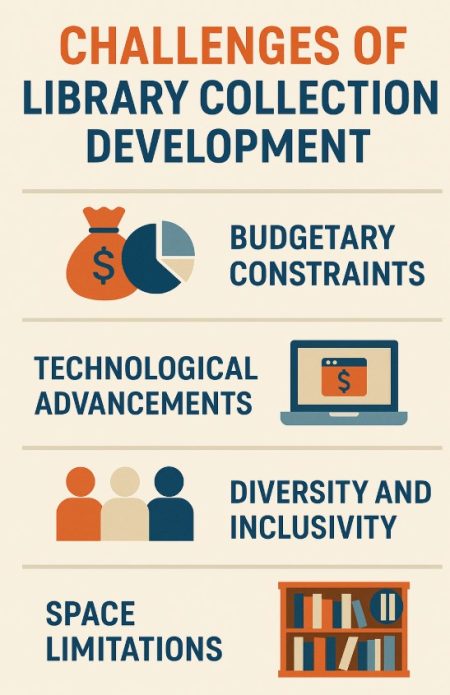
The selection of library resources is one of the most critical aspects of collection development, but it is also one of the most challenging. Libraries must balance user needs, budget limitations, and the rapidly changing landscape of information resources. While the goal is to provide a collection that is current, diverse, and relevant, the process is often complicated by several challenges that librarians must navigate carefully.
- Budget Constraints: One of the most persistent challenges is the limitation of financial resources. Libraries operate within fixed budgets that often fall short of covering the cost of all desirable materials. For example, academic libraries may struggle to subscribe to expensive databases like ScienceDirect or JSTOR, even though they are essential for research. Public libraries may also face difficulty in balancing the purchase of popular fiction, children’s books, and community-focused resources within limited funds. Budgetary challenges force librarians to make difficult choices and prioritize only the most critical acquisitions.
- Rapid Growth of Information: The explosion of information in both print and digital formats creates another challenge. Thousands of new books, journals, and online resources are published every year, making it impossible for libraries to acquire everything. Deciding which resources are most valuable becomes increasingly complex. For instance, in medical libraries, the sheer volume of newly published clinical research means librarians must carefully evaluate which journals or databases are truly essential for their users.
- Balancing Print and Digital Resources: With the rise of electronic resources, libraries face the challenge of balancing print and digital collections. While digital resources such as e-books, online journals, and databases provide convenience and remote access, many users still prefer print materials for study and research. For example, a university student may want access to both a printed textbook for classroom use and a digital version for off-campus study. Meeting these diverse preferences requires careful planning and allocation of resources.
- Changing User Demands: User expectations evolve over time, creating another difficulty in the selection process. Students, researchers, and community members frequently request new formats, subjects, or technologies that may not have been part of the traditional collection. For instance, increasing demand for open-access materials, multimedia resources, or digital learning platforms often requires libraries to rethink their selection strategies. Responding to these demands while maintaining balance across subject areas can be challenging.
- Licensing and Access Issues: In the digital age, licensing agreements and access restrictions present unique challenges. Unlike print books, which can be owned indefinitely, many digital resources are subscription-based and must be renewed annually. Licensing terms may also limit the number of simultaneous users or restrict off-campus access. For example, some e-book packages allow only single-user access, frustrating students who need the same resource for coursework. Negotiating favorable terms with vendors is often a complex task for libraries.
- Ensuring Diversity and Inclusivity: Building a collection that represents multiple perspectives, cultures, and languages can be difficult, especially when resources are limited. Academic libraries must ensure that both local and global voices are represented, while public libraries must serve users from varied backgrounds. For example, selecting Bangla-language materials alongside international publications can be a challenge if budgets or availability are limited. Striking this balance is crucial but not always easy to achieve.
- Evaluating Quality and Reliability: Another challenge lies in ensuring the quality and reliability of resources. With the proliferation of self-publishing, open-access platforms, and online content, not all resources meet the necessary academic or professional standards. Librarians must carefully evaluate the authority of the author, the reputation of the publisher, and the accuracy of the content before making selections. This requires time, expertise, and often consultation with faculty or subject specialists.
- Preservation and Sustainability: Finally, libraries face the challenge of selecting resources that are not only useful in the present but also sustainable for the future. Decisions must account for long-term preservation, especially for digital resources that may become obsolete due to changes in technology. For example, libraries selecting rare manuscripts or digital archives must plan for proper preservation to ensure future access.
The selection of library resources is a complex process shaped by multiple challenges, including financial limitations, information overload, user demands, licensing issues, and the need for diversity and sustainability. While these challenges cannot always be eliminated, careful planning, collaboration with stakeholders, and strategic decision-making allow libraries to overcome them and continue building collections that serve the evolving needs of their users.
How Do Budget Limitations Affect the Selection Process?
Budget limitations have a significant impact on the selection process of library resources, as they directly influence what a library can or cannot acquire. Since financial resources are often restricted, libraries are forced to make difficult decisions about which materials to purchase, which to postpone, and which to exclude entirely. This challenge becomes particularly pressing in academic libraries, where the demand for high-cost scholarly journals, databases, and textbooks often exceeds the available funds. For example, subscriptions to databases like ScienceDirect, Scopus, or JSTOR can consume a large portion of a library’s budget, leaving less room for purchasing other subject-specific resources.
Limited budgets often require libraries to prioritize resources that are most essential for their communities. In universities, this means selecting materials that directly support the curriculum and research needs, sometimes at the expense of broader or recreational resources. For instance, a library may decide to invest in core textbooks and subject-specific journals while reducing purchases of general reading materials or less frequently used resources. Public libraries face similar issues when deciding between acquiring popular fiction to meet immediate user demand and investing in long-term reference or educational materials.
Budget constraints also encourage libraries to adopt cost-saving strategies such as demand-driven acquisition (DDA), where resources are purchased only when requested by users or after demonstrating significant usage. This ensures that funds are used efficiently, but it also limits the flexibility of building comprehensive collections in advance. Furthermore, libraries may have to negotiate with vendors for better subscription terms or cancel overlapping databases to stay within financial limits.
How Can Libraries Avoid Bias While Selecting Materials?
The selection of library materials is a critical responsibility in collection development, requiring librarians to act with fairness, inclusivity, and professional integrity. Because libraries serve diverse communities with a wide range of academic, cultural, and social needs, their collections must represent multiple perspectives rather than narrow viewpoints. If bias influences selection decisions, the collection risks becoming imbalanced and unable to meet the expectations of users. To avoid this, libraries rely on clear policies, objective evaluation practices, and collaborative approaches that help ensure neutrality and inclusiveness.
One of the most effective ways to reduce bias in resource selection is through a formal collection development policy. Such policies establish guidelines that allow librarians to evaluate materials based on relevance, authority, quality, and user demand rather than personal beliefs or preferences. For instance, when selecting political science resources, a policy-driven approach ensures that books and journals representing different ideologies are included, giving users access to a balanced set of viewpoints. By following structured criteria, libraries maintain objectivity in their acquisitions.
Bias can also be minimized when libraries consult multiple sources and stakeholders before making selection decisions. Professional tools such as review journals, bibliographies, publishers’ catalogs, and subject expert recommendations provide objective assessments of potential resources. At the same time, input from faculty, researchers, and students ensures that the collection reflects the actual needs of its community. In an academic library, for example, faculty may recommend databases like Scopus or IEEE Xplore, while students may request more digital resources or updated textbooks. Taking into account these diverse perspectives prevents overreliance on a single viewpoint and strengthens the collection’s relevance.
Ensuring diversity and inclusivity is another essential practice in avoiding bias. Libraries deliberately acquire materials that represent different cultures, languages, and voices, which prevents overrepresentation of any one perspective. For example, a university library in Bangladesh may enrich its collection by including both Bangla-language publications and international journals like Nature or The Lancet. Similarly, public libraries often choose children’s books that reflect various cultural traditions, helping young readers develop awareness of different worldviews. This deliberate inclusion of diverse resources promotes equity and inclusivity.
In addition, libraries avoid bias by regularly reviewing and assessing their collections. Usage statistics, feedback, and collection audits can reveal gaps and underrepresented areas. For example, an assessment might show that there are few resources on women’s contributions to history or limited materials on local culture and heritage. Identifying such gaps allows librarians to adjust their selection strategies and prioritize overlooked subjects in future acquisitions.
In conclusion, avoiding bias in the selection of library materials requires careful planning, objective criteria, and ongoing evaluation. By applying collection policies, consulting varied sources, ensuring inclusivity, and conducting regular reviews, libraries can build balanced and representative collections. This approach enables libraries to remain neutral, reliable, and trustworthy institutions that support education, research, and lifelong learning for all members of the community





6 Comments
am really enjoying your information.am a librarian by profession in one of the national collages in kenya.
Nice information
So educative
thank u for the information
Thanks for information I really enjoy reading and it helps me alot with my research and assignment as an academic student.
That great