What Is Bibliographical Information?
Bibliographical information refers to the structured set of descriptive details that uniquely identify and describe an information source, such as a book, journal article, thesis, or online document. These details typically include the author’s name, title of the work, edition, place of publication, publisher, year of publication, and format-specific elements like page numbers, volume and issue numbers, DOI, or URL. Together, these elements function as the “identity” of a document, allowing readers and researchers to clearly recognize and distinguish one work from another.
For example, in the case of a book, bibliographical information may appear as: Smith, J. (2021). Research Methods in Social Sciences (3rd ed.). London: Routledge. Here, the author (Smith), year (2021), title, edition, place of publication, and publisher collectively provide enough information to locate the exact book. Similarly, for a journal article, bibliographical information might include additional details such as volume, issue, and page range, for instance: Rahman, M. (2020). Information literacy in higher education. Journal of Library Studies, 15(2), 45–60. These details help readers retrieve the specific article from a journal database or library collection.
Bibliographical information is especially important in academic writing because it enables verification and ethical use of sources. When a student cites a source in an assignment or research paper, accurate bibliographical information allows examiners and readers to trace the original work. For example, providing a DOI or stable URL for an online journal article ensures that the cited source can be accessed even if the website structure changes. This practice not only strengthens the credibility of academic work but also helps prevent plagiarism by clearly acknowledging original authorship.
From a library and information science perspective, bibliographical information underpins cataloging, classification, and information retrieval systems. Library catalogs and OPACs use bibliographical data—such as author, title, subject headings, and publication details—to organize and provide access to resources. For instance, when a user searches a library catalog by an author’s name or book title, the system retrieves records based on stored bibliographical information. In the digital environment, reference management tools like Zotero and Mendeley rely on bibliographic information to automatically generate citations and bibliographies in various styles. Thus, whether in print or digital form, bibliographical information remains essential for organizing knowledge, supporting scholarly communication, and guiding users to reliable sources.
Why Is Bibliographical Information Important in Academic and Scholarly Work?
Bibliographical information is essential in academic and scholarly work because it ensures transparency, credibility, and traceability of research. By clearly documenting details such as the author, title, publication year, and source, researchers allow readers to identify the origins of ideas and information used in a study. This transparency enables others to verify claims, consult original sources, and assess the reliability and authority of the referenced materials. As a result, bibliographical information strengthens the overall trustworthiness and academic value of scholarly writing.
Another key importance of bibliographical information lies in upholding academic integrity and ethical research practices. Properly recorded and cited bibliographical details acknowledge the intellectual contributions of original authors, thereby giving them due credit for their work. This practice helps prevent plagiarism, whether intentional or unintentional, by clearly distinguishing between a researcher’s original ideas and those derived from existing literature. In academic environments, accurate bibliographic information also enables instructors, reviewers, and examiners to assess the depth and relevance of the sources used in research.
Bibliographical information also plays a vital role in scholarly communication and knowledge dissemination. It creates a structured link between current research and previous studies, enabling the academic community to trace the development of theories, methods, and findings over time. Through references and bibliographies, scholars position their work within the broader body of literature, demonstrating awareness of existing research and contributing new insights. In addition, standardized bibliographic information facilitates database indexing, citation tracking, and impact analysis, which are important for measuring research influence and visibility.
Finally, bibliographical information supports effective information organization and retrieval in both traditional and digital academic environments. Libraries, databases, and reference management tools rely on accurate bibliographical data to catalog resources and provide efficient access to them. When bibliographical information is complete and standardized, researchers can easily locate relevant books, articles, and other scholarly materials. Thus, bibliographical information is not merely a formal requirement; it is a foundational element that underpins the quality, integrity, and continuity of academic and scholarly work.
Main Elements of Bibliographical Information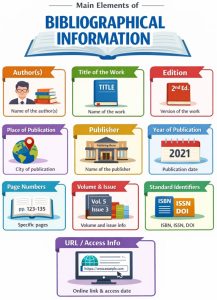
Bibliographical information consists of several core elements that together provide a complete and accurate description of an information source. These elements may vary slightly depending on the type of material (book, journal article, thesis, or online resource), but the following are the most commonly used and essential components in academic and library contexts.
- Author(s): The author element identifies the person(s), organization, or institution responsible for creating the work. It is usually recorded in a standardized form (surname followed by given name or initials) to ensure consistency in catalogs and reference lists. In academic writing, the author’s name helps establish authority and allows readers to trace other works by the same creator.
- Title of the Work: The title provides the official name of the document, book, article, or resource. It clearly indicates the subject or focus of the work and is a primary access point in library catalogs and databases. For books, the main title and subtitle are both included, while for journal articles, the article title is recorded along with the journal title.
- Edition: The edition indicates the version of a work, especially when it has been revised or updated. This element is important because different editions may contain new content, corrections, or reorganized material. Citing the correct edition ensures that readers consult the same version used by the researcher.
- Place of Publication: The place of publication refers to the city (and sometimes country) where the publisher is located. Traditionally important in print publishing, this element helps distinguish between publishers with similar names and provides historical and contextual information about the source.
- Publisher: The publisher is the organization or company responsible for producing and distributing the work. In scholarly contexts, the publisher’s reputation often reflects the quality and reliability of the source. This element is particularly important for books and reports.
- Year (or Date) of Publication: The year of publication shows when the work was published or made available. This element helps readers assess the currency and relevance of the information, which is especially important in rapidly evolving fields such as science, technology, and medicine.
- Pagination (Page Numbers): Page numbers indicate the specific pages where information appears within a source. This element is essential for journal articles, book chapters, and quoted materials, as it allows readers to locate the exact section being referenced.
- Source or Container Information: For materials that appear within a larger work, such as journal articles or book chapters, source information is required. This includes the journal title, volume number, issue number, or the title of the edited book in which the chapter appears.
- Standard Identifiers: Standard identifiers such as ISBN (for books), ISSN (for journals), or DOI (for digital articles) uniquely identify a publication. These identifiers greatly improve accuracy in searching, referencing, and linking to resources, particularly in digital environments.
- URL or Access Information (for Online Resources): For electronic and online resources, a URL or access link is included to show where the resource can be found. In some cases, the access date is also recorded, especially when content is subject to change over time.
Together, these elements form a complete bibliographical record that enables accurate identification, retrieval, and citation of information sources. Understanding and correctly using the main elements of bibliographical information is essential for effective academic writing, ethical research practices, and efficient library and information services.
Why Is Accuracy Important When Recording Bibliographical Information?
Accuracy is critical when recording bibliographic information because it ensures the reliability and traceability of academic and scholarly work. Correct details—such as author names, titles, publication dates, and source information—enable readers to identify and locate the exact sources used by a researcher. Even small errors, like a misspelled author name or incorrect year of publication, can make a source difficult or impossible to find, weakening the usefulness and credibility of the research.
Accurate bibliographical information also plays a key role in maintaining academic integrity. Properly and precisely recorded references ensure that original authors receive appropriate credit for their work. Inaccurate or incomplete bibliographical details may lead to misattribution of ideas, unintentional plagiarism, or confusion about the origin of information. In academic environments, where ethical research practices are highly valued, accurate bibliographic recording reflects a researcher’s professionalism and respect for intellectual property.
From an information management perspective, accuracy is essential for effective organization and retrieval of resources. Library catalogs, databases, and indexing systems rely on precise bibliographical data to function correctly. Errors in bibliographic records can lead to duplicate entries, broken links, or incorrect indexing, hindering users’ ability to retrieve relevant materials efficiently. In digital environments, accurate details such as DOIs, URLs, and standard identifiers are particularly important for ensuring persistent and reliable access to electronic resources.
Accurate bibliographical information supports the continuity and cumulative nature of scholarly communication. Research builds upon previous studies, and precise references allow future researchers to trace the development of ideas, verify findings, and extend existing knowledge. When bibliographical information is accurate, it strengthens the scholarly record and promotes confidence in academic communication. Therefore, accuracy in recording bibliographical information is not merely a technical requirement but a foundational element of high-quality research and effective knowledge sharing.
Why Should Students Be Taught How to Identify Bibliographical Information?
Teaching students how to identify bibliographical information is essential for developing strong academic and research skills. When students understand how to recognize key elements such as the author, title, publication year, publisher, and source, they are better equipped to evaluate and use information effectively. This foundational knowledge helps students distinguish credible academic sources from unreliable or incomplete materials, which is particularly important in an age of information overload.
Another important reason is the promotion of academic integrity and ethical scholarship. Students who can correctly identify bibliographical information are more likely to cite sources accurately and consistently. This reduces the risk of plagiarism and encourages respect for intellectual property by clearly acknowledging the original authors’ work. Learning how to identify bibliographical details also helps students understand the importance of transparency in academic writing, where ideas must be supported by clearly traceable sources.
Identifying bibliographical information also enhances students’ information literacy and research efficiency. When students know where to find bibliographical details in books, journal articles, and online resources, they can quickly record accurate references for assignments and research projects. This skill saves time during the writing process and supports the effective use of reference management tools, which rely on correct bibliographical data to generate citations and bibliographies.
Finally, teaching students to identify bibliographical information prepares them for advanced academic and professional work. At higher levels of study, students are expected to engage in independent research, systematic literature reviews, and scholarly communication. The ability to identify and use bibliographical information confidently enables students to participate meaningfully in academic discourse and supports lifelong learning. Therefore, this skill is not only essential for academic success but also for responsible participation in the broader knowledge society.