What Is an Embargo in an Institutional Repository?
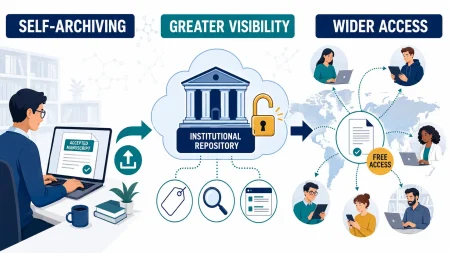
An embargo in an institutional repository is a temporary restriction on public access to research works stored in the repository. This allows institutions to preserve scholarly materials, such as journal articles, theses, dissertations, and research datasets, while delaying access to the full text or specific files for a designated period. During this time, the material remains part of the repository’s collection. Therefore, an embargo separates the act of depositing research from the date it becomes publicly accessible.
There are several reasons why embargoes may be applied. A publisher’s policy may require authors to wait before making a particular version of a journal article openly available. For theses and dissertations, a temporary restriction may be requested to support publication plans, allow time for patent applications, or address confidentiality or commercial concerns. It is essential to consider the institution’s policies and any relevant publishing or funding conditions. Simply planning to publish research does not automatically require an embargo; the publisher’s applicable requirements should be checked.
During an embargo, the document’s descriptive information, known as metadata, often remains publicly visible. This may include the title, author’s name, abstract, keywords, and publication date, allowing users to discover the research even if they cannot download the full text. However, some repositories may also restrict access to certain metadata fields if their disclosure could reveal sensitive information. Additionally, some repositories offer a “request a copy” feature, enabling users to seek access, although providing a copy depends on the relevant permissions and access arrangements.
The length of an embargo varies based on the material and the governing policies. For example, a thesis might be deposited with an approved twelve-month embargo and become openly accessible once that period ends. The release may occur automatically or require review by repository staff, depending on the system and institutional procedures. Authors and librarians should document the reason for the restriction, confirm the release date, and arrange any permitted extensions before the embargo expires. This helps the repository manage temporary access restrictions while supporting the eventual availability of research.
Why Are Embargo Periods Applied to Deposited Research?
An institutional repository serves to preserve and share a university’s research. Sometimes, a work can be deposited immediately, but its full text cannot be made publicly available until a later date. This temporary restriction is referred to as an embargo. For example, a student might deposit a completed thesis in the university’s repository in June, while its PDF is scheduled to be publicly accessible in December.
Publisher requirements are one reason for implementing an embargo. For instance, if a researcher deposits the accepted manuscript of a journal article, and the publisher allows public sharing of that version only after a twelve-month waiting period, the repository can hold the manuscript during those twelve months and make it available once the period ends. The permitted version and waiting period depend on the publisher’s policy and any applicable rights held by the author or institution.
A thesis embargo can provide the author with time to prepare the work for publication. For example, a doctoral researcher might plan to transform several thesis chapters into a book and could ask the university if temporary restricted access is appropriate. Similarly, a researcher developing an invention described in a thesis may need time to discuss a patent application with the university before releasing the thesis. These situations warrant a review of access arrangements; however, an embargo is not automatically necessary whenever someone plans to publish or seek a patent.
Embargoes can also help coordinate the release of related materials. For example, if a research team deposits the dataset behind a forthcoming journal article, the repository may preserve the dataset while delaying public access until the article is published. This approach allows readers to find both the publication and its supporting data together. If the data contains confidential information, the team must decide whether anonymization or other access controls are necessary, as the passage of time alone might not address that concern.
An embargo does not necessarily render the research invisible. A visitor may still find the repository record, read its title and abstract, and see when the full text is scheduled to become available. For instance, a thesis record could appear in search results even while its PDF remains restricted. The information displayed will depend on the repository’s settings and whether any details are sensitive.
Every embargo should have a documented reason and a specified release date. Researchers and repository staff should review publisher agreements, institutional procedures, and funder requirements before applying an embargo. This careful approach allows the repository to protect legitimate interests while making the research openly accessible as soon as the relevant conditions allow.
Types of Repository Materials May Require an Embargo
Institutional repositories contain various types of research materials, including journal articles, theses, datasets, and software. An embargo is a temporary restriction that delays public access to a deposited file. Whether an embargo is necessary depends on the type of material, the associated rights, and the reason for delaying its release.
- Journal Articles: An author may deposit an accepted manuscript shortly after the journal has accepted it, but the publisher’s policy may specify a later date for public access. For instance, if the agreement establishes a twelve-month embargo, the repository can retain the manuscript and release it once that period expires. It is essential to verify the permitted version and timing for each publication.
- Theses and Dissertations: A student may request restricted access temporarily while preparing their thesis for publication as a book or articles, or while an invention described in it undergoes assessment for a patent application. For example, the thesis record may be visible in the repository, while its PDF remains unavailable until the embargo date is reached. The institution will decide whether the reason for the embargo adheres to its policy.
- Conference Papers and Proceedings: These materials may be subject to sharing conditions similar to those for journal articles. A researcher can deposit the accepted version of a conference paper, with public access delayed if required by the publisher’s policy. Some institutions may allow immediate availability through rights retention arrangements, so an embargo should not be assumed for every conference paper.
- Books and Book Chapters: A repository may hold a scholarly book, a chapter in an edited volume, or an accepted manuscript of one. Access to a deposited version may need to be delayed due to publishing agreements. For example, a chapter might have a record in the repository once the book is published, but its file could be released later according to the applicable terms.
- Research Datasets: Data can be deposited before the associated article is published. A temporary embargo may help synchronize their release. For example, a research team might deposit survey tables now and make them downloadable when readers can access the related article. An embargo may also allow time to obtain permission to share material created by someone else.
- Software, Code, and Other Supporting Files: Repositories may accept computer code, images, videos, and other materials generated during research. Some of these files may have a planned release date linked to a publication or temporary rights restrictions. For instance, software used to produce a study’s results might be deposited alongside the study and released when the associated article is published.
The type of material alone does not dictate whether an embargo is necessary. Repository staff should document the specific reason for the embargo, ensure that the temporary delay addresses it, and set an appropriate release date. If information needs to remain confidential after that date, the institution may require measures such as anonymization or controlled access.
Why Might a Researcher Request an Embargo on a Thesis or Dissertation?
A researcher may request an embargo to delay public access to their thesis or dissertation for a defined period while addressing a specific issue. During this time, the thesis can still be deposited in the institutional repository, which preserves the work and often allows others to find its title and abstract. Once the embargo period ends, the full text becomes publicly accessible.
One common reason for requesting an embargo is the intent to publish research from the thesis. For instance, a doctoral researcher might be in the process of developing several chapters into a book or preparing an article based on their findings. They may request time to discuss their publication plans with a publisher before making the complete thesis available online. However, publication plans do not automatically necessitate an embargo; therefore, the researcher should verify the publisher’s stance and the university’s policy beforehand. Additionally, a thesis may describe an invention or research created in collaboration with an external partner. For example, a researcher who has designed a new medical device might seek a temporary restriction while the university evaluates a potential patent application. Conditions set by a collaboration agreement may also dictate the release of commercially sensitive findings. In such cases, the embargo provides time for the researcher and institution to complete the necessary review before public disclosure.
Confidentiality and permissions can also be valid reasons for an embargo. A thesis that includes identifiable interview materials, sensitive information about an organization, or images owned by someone else may require a review before its full text can be shared. An embargo can allow sufficient time to obtain permissions or to prepare a version with specific material removed. If certain information must remain protected even after the proposed embargo period, the researcher and repository should consider redaction or a longer-term access arrangement instead of relying solely on a temporary embargo.
The researcher should clearly explain the reason for the embargo request and agree on an appropriate duration through the university’s approval process. This process may involve the supervisor, repository team, and sometimes a university committee, with funding conditions potentially limiting available options. This collaborative approach ensures that the embargo has a clear purpose and that the thesis can be shared once the relevant issue is resolved.
What Happens When an Embargo Period Expires?
When an embargo period expires, the temporary restriction on public access is typically lifted. During the embargo, the repository record may already display the work’s title, author, and abstract; however, the key change is that visitors can now open or download the file that was previously under embargo. Some repositories automatically release files on the specified date, while others require staff to check and update access permissions. For example, if a researcher deposits a thesis with a twelve-month embargo in January, people can access its record during that year but cannot download the PDF. Once the embargo period ends, the following January, the PDF becomes publicly available. Cambridge’s Apollo repository describes this as an automatic transition for theses under its embargoed access option.
The same principle applies to other deposited materials, although the conditions for release may vary. For instance, an accepted journal manuscript may become publicly accessible once the publisher’s mandated waiting period has passed. A dataset may be released on an agreed date with the repository, potentially coinciding with the publication of the article it supports. While the expiry makes the approved deposited file accessible, it does not alter which version the repository is permitted to share.
If the reason for restricting access has not been resolved, the author must follow the institution’s procedure to request an extension or a different access arrangement. For example, a thesis author who is still seeking permission to include someone else’s copyrighted material should contact the repository before the scheduled release date. Material that cannot be cleared or safely made public may require controlled access or a revised public version. Therefore, the expiry of an embargo is a significant date for both sharing research and ensuring that its release is appropriate.
Configuring and Managing an Embargo in DSpace 7x-10x
In DSpace, an embargo is an access policy with a future start date. You can apply it to an individual file, called a bitstream, or to the entire item. For a thesis, a file embargo is usually appropriate when you want visitors to find the title and abstract while keeping the PDF unavailable until its release date. An item embargo also restricts access to the item’s metadata.
Set an embargo during submission
1. Start a new submission and upload the document.
2. Edit the uploaded file’s access conditions.
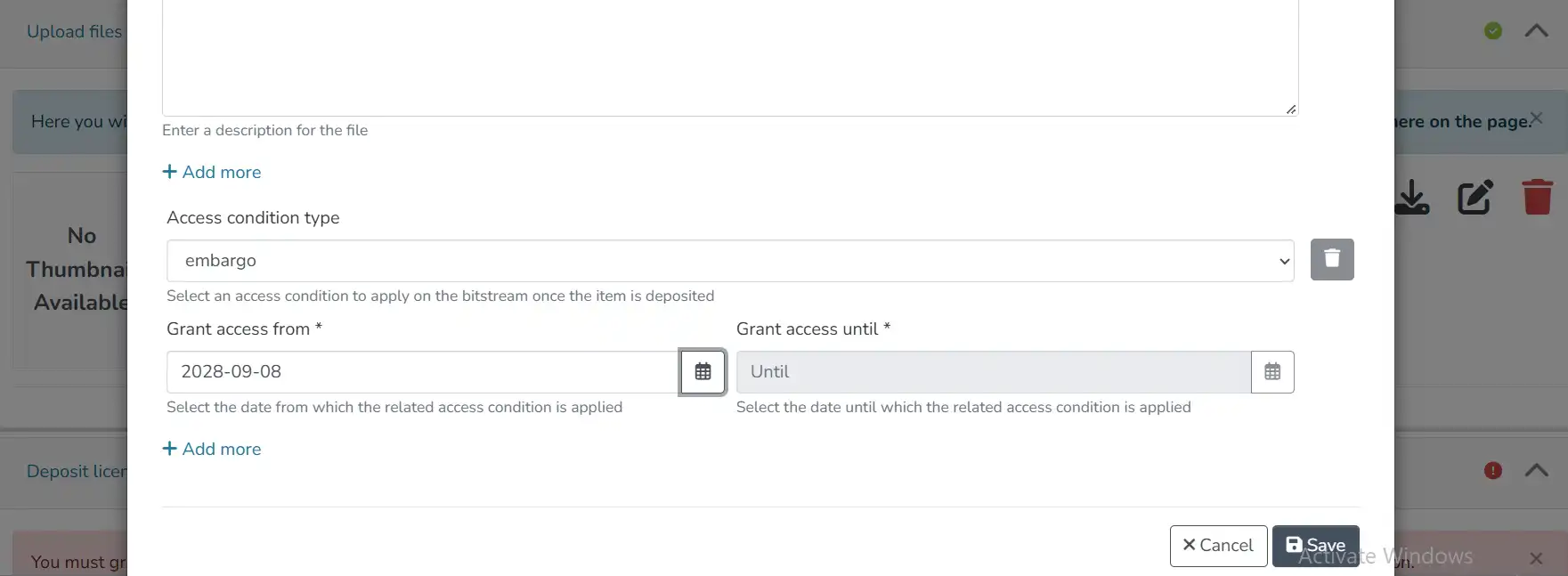
3. Select Embargo and enter the release date in Grant access from.
4. Save the file settings and complete the submission.
For example, setting Grant access from 2028-09-08 keeps the file restricted until that date. File-level embargo options are enabled by default in DSpace 10’s submission interface.
Enable an embargo for the entire item
The item-level access step is disabled by default. On the DSpace backend, open [dspace]/config/item-submission.xml and uncomment this line inside the submission process used by the relevant collection:
<step id="itemAccessConditions"/>
For example, the default traditional process contains this line in a comment. If your collection uses a different process, enable the step in that process instead. Restart the DSpace backend REST API after changing the file. The available embargo choices and date limits are configured in [dspace]/config/spring/api/access-conditions.xml
Change an embargo after deposit
As an administrator, open the item and go to Edit → Status → Authorizations. Select the appropriate Item or Bitstream access policy. You can change its start date to extend or shorten the embargo, or clear the start date to remove it. Check the other access policies on the same object as well, so that an immediate public READ policy does not grant access earlier than intended.
When the date passes, DSpace 10 applies the public access policy automatically. Do not schedule the old embargo-lifter command; the DSpace 10 documentation says it is unnecessary and not recommended. To verify an embargo, test the item while signed out, since an administrator can still access restricted content.