Academic libraries play a vital role in supporting education, research, innovation, and knowledge creation within higher education institutions. At the center of these functions are information resources, which serve as the primary tools through which students, teachers, researchers, and scholars access, generate, and share knowledge. Information resources in academic libraries include a wide range of materials and services, such as printed books, scholarly journals, reference materials, theses, dissertations, electronic databases, e-books, multimedia resources, institutional repositories, and open access publications. For example, printed textbooks and reference books are commonly used for classroom learning, while scholarly journals provide access to recent research findings. Similarly, electronic databases such as Scopus, JSTOR, and ProQuest help researchers locate peer-reviewed academic literature from different disciplines. These resources are essential for fulfilling the academic and research needs of university communities and for promoting intellectual development and lifelong learning.
Over the years, the nature of information resources in academic libraries has changed significantly due to rapid technological advancement and the growth of digital information systems. Traditional library collections that once depended mainly on printed materials are now increasingly complemented or replaced by electronic and online resources. Modern academic libraries provide access to digital databases, cloud-based information systems, remote access services, and online scholarly communication platforms that enable users to access information anytime and from anywhere. For instance, many universities now subscribe to e-book collections and online journal platforms such as Springer and IEEE, allowing students and faculty members to download research articles and academic books remotely. Many institutions also use remote authentication systems such as OpenAthens to provide off-campus access to subscribed resources. This transformation has expanded the scope, accessibility, and usability of library resources, making academic libraries more dynamic and user-centered than ever before.
Information resources are not only important for academic learning but also for supporting advanced research and innovation. Researchers rely on authentic and up-to-date information resources to conduct literature reviews, identify research gaps, analyze previous studies, and develop new knowledge. For example, a doctoral researcher in medicine may use databases such as PubMed to access clinical studies and medical research articles, while engineering students may depend on the IEEE digital library for conference papers and technical standards. Similarly, students use information resources to complete assignments, presentations, and dissertations, while faculty members use them for curriculum development, teaching preparation, and scholarly publication. Therefore, the quality, accessibility, organization, and management of information resources directly influence the effectiveness of academic institutions and their research productivity.
In addition to supporting academic activities, information resources also contribute significantly to the development of information literacy skills among users. Academic libraries help users learn how to locate, evaluate, organize, and ethically use information from different sources. For example, librarians often conduct information literacy workshops on topics such as database searching, citation management, plagiarism awareness, and evaluating online information sources. Tools like Mendeley and EndNote are widely used in academic libraries to help researchers organize references and generate citations automatically. In the digital era, where massive amounts of information are available online, the ability to identify credible and reliable information has become increasingly important. Consequently, academic libraries are expanding their roles from being simple information storage centers to becoming active knowledge and learning hubs that guide users in navigating complex information environments.
Despite their growing importance, managing information resources in academic libraries presents several challenges. Rising subscription costs of electronic databases, copyright and licensing restrictions, information overload, technological obsolescence, digital preservation issues, and unequal access to technology are some of the major concerns faced by academic libraries worldwide. For example, many academic databases require expensive annual subscriptions that may be difficult for smaller universities to afford. Similarly, preserving digital content for long-term access requires reliable technological infrastructure and regular system upgrades. In developing countries, unstable internet connectivity and limited funding may further restrict access to digital resources. At the same time, emerging technologies such as artificial intelligence, big data analytics, institutional repositories, and smart library systems are creating new opportunities for improving information access and user services. For instance, some academic libraries are now using AI-powered chatbots and recommendation systems to assist users in locating information more efficiently.
This article provides a comprehensive discussion of information resources in academic libraries, including their types, functions, classifications, management practices, digital transformation, challenges, and future trends. It also highlights the growing role of academic libraries in supporting teaching, learning, research, and knowledge dissemination in the rapidly evolving digital information environment. Through examples from both traditional and digital library environments, the article aims to provide a clear understanding of how information resources contribute to academic excellence and the advancement of knowledge in higher education institutions.
What are Information Resources in Academic Libraries?
 Information resources in academic libraries encompass various materials, tools, and sources of knowledge that are collected, organized, managed, and provided by libraries to support teaching, learning, research, and academic development. These resources form the foundation of academic activities in universities and higher education institutions by enabling students, teachers, researchers, and scholars to access reliable and relevant information. Academic library information resources exist in both print and digital formats and cover a wide range of subjects and disciplines.
Traditionally, academic libraries focused mainly on printed materials such as textbooks, reference books, journals, newspapers, encyclopedias, theses, dissertations, and government publications. However, with advancements in information and communication technologies, academic libraries now also provide access to numerous electronic and online resources, including e-books, e-journals, online databases, digital repositories, multimedia resources, and open-access materials.
These information resources are essential as they empower users to acquire knowledge, conduct research, solve academic problems, and develop critical thinking skills. For instance, a student preparing a research paper may utilize printed books for theoretical understanding while accessing online databases like Scopus or JSTOR to find recent scholarly articles relevant to their research topic. Similarly, faculty members often rely on electronic journals and citation databases to update course materials and conduct advanced research. Academic libraries also provide specialized reference tools such as bibliographies, indexes, dictionaries, handbooks, and abstracts that help users locate specific information quickly and efficiently.
Modern academic libraries increasingly depend on digital technologies to enhance access to information resources. Many libraries subscribe to electronic platforms provided by organizations such as Springer, IEEE, and ProQuest, allowing users to access scholarly materials remotely through internet-based systems. Institutional repositories are also becoming vital information resources, preserving and providing access to university research outputs, including faculty publications, conference papers, and theses. Additionally, academic libraries often incorporate multimedia resources such as educational videos, audio recordings, online lectures, and interactive learning materials to support diverse learning needs.
Beyond merely storing information, academic libraries systematically organize and manage information resources to ensure easy retrieval. Tools such as Online Public Access Catalogues (OPACs), discovery systems, metadata, and indexing services assist users in searching for and locating materials efficiently. Furthermore, academic libraries play a crucial role in promoting information literacy by teaching users how to search for, evaluate, and ethically use information from various sources. In today’s digital age, where information is produced rapidly and in vast quantities, the role of academic library information resources has become increasingly significant in ensuring access to credible, authentic, and scholarly information. Thus, information resources are regarded as one of the most valuable components of academic libraries and are fundamental in supporting education, research, innovation, and lifelong learning.
Why are Information Resources Important for Academic Institutions?
Information resources are essential for academic institutions, as they form the foundation of education, research, teaching, innovation, and knowledge development. Universities and colleges rely heavily on access to reliable and up-to-date information to support their academic and research activities. These resources enable students, teachers, researchers, and scholars to acquire knowledge, develop critical thinking skills, and stay informed about recent developments in their fields. Without adequate information resources, academic institutions would face significant challenges in maintaining the quality of education and research. Therefore, information resources play a central role in achieving the academic goals and objectives of higher education institutions.
One of the primary reasons information resources are important is that they support teaching and learning activities. Students depend on textbooks, reference books, scholarly journals, lecture materials, and electronic resources to complete assignments, prepare presentations, and enhance their understanding of academic subjects. Faculty members also utilize information resources to design course materials, prepare lectures, and update curriculum content in line with current knowledge and research trends. For example, engineering students may reference technical standards and research papers from IEEE, while business students may access market research and scholarly articles through ProQuest databases. These resources help ensure that teaching and learning processes remain effective, relevant, and research-oriented.
Information resources are equally vital for supporting research and scholarly communication within academic institutions. Researchers require access to authentic, credible, and recent information to conduct literature reviews, identify research gaps, analyze existing findings, and develop new theories or solutions. Academic databases such as Scopus and JSTOR provide access to peer-reviewed journals, conference papers, and scholarly publications that are essential for high-quality research. For instance, a medical researcher may use scientific databases to study previous clinical research before conducting a new experiment, while a social science researcher might examine earlier studies to compare research findings and methodologies. Access to information resources directly contributes to research productivity, innovation, and academic excellence.
Another important aspect of information resources is their role in helping students and researchers develop information literacy skills. In today’s digital environment, users are exposed to vast amounts of information from various sources, including websites, social media, digital repositories, and online publications. Academic libraries assist users in learning how to search for, evaluate, organize, and ethically use information. For example, libraries often provide training on database searching, citation management, plagiarism awareness, and research ethics. Tools like Mendeley and EndNote help researchers organize references and create citations efficiently. These skills are essential for academic success and lifelong learning.
Information resources also play a crucial role in institutional development and enhancing global academic visibility. Universities that possess strong library collections and have access to high-quality information resources tend to be better equipped to produce impactful research, attract talented researchers, and enhance their academic reputation. Institutional repositories, digital archives, and open access platforms help preserve and showcase the intellectual output of universities, including theses, dissertations, faculty publications, and conference papers. This, in turn, increases the visibility and accessibility of institutional research on both national and international stages. Moreover, modern information resources facilitate flexible and remote learning opportunities. With the rise of digital technologies and online education, students and faculty can access academic materials anytime and from anywhere through electronic databases, e-books, digital libraries, and remote authentication systems. This accessibility became especially vital during global disruptions, such as the COVID-19 pandemic, when many academic institutions heavily relied on electronic information resources to continue teaching and research activities remotely.
Types of Information Resources in Academic Libraries
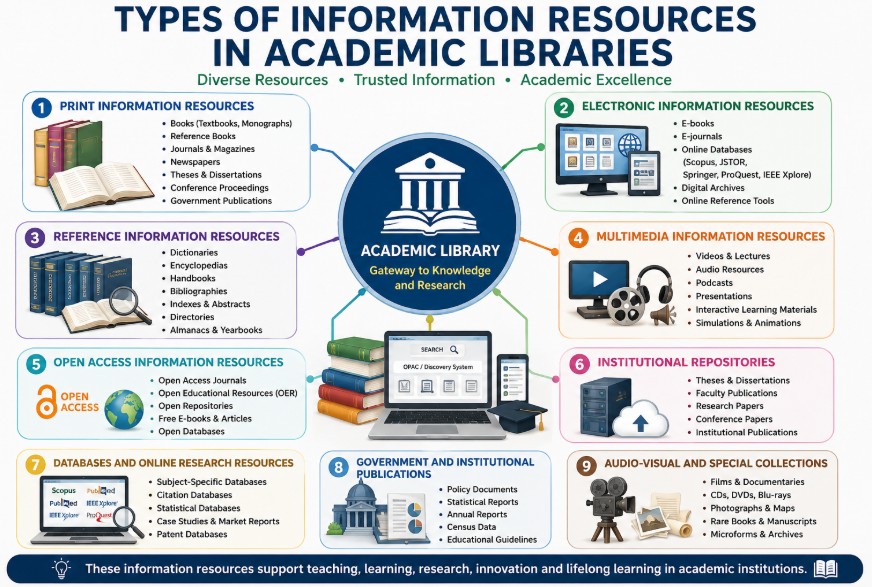 Academic libraries offer a diverse range of information resources aimed at supporting teaching, learning, research, and scholarly communication. These resources are available in both print and electronic formats, and they are tailored to meet the varied information needs of students, faculty, researchers, and academic staff.
With the advancement of digital technologies, the variety and accessibility of information resources in academic libraries have greatly expanded. Today, modern academic libraries provide access not only to traditional print materials but also to a wide array of electronic, multimedia, and online resources. The main types of information resources found in academic libraries are discussed below.
- Print Information Resources: Print information resources are the traditional and most familiar forms of library materials. Although digital resources are increasingly popular, printed materials still remain important in many academic libraries because they provide reliable and long-lasting access to knowledge. Print resources include textbooks, scholarly books, journals, newspapers, magazines, theses, dissertations, government publications, conference proceedings, and reference books. For example, textbooks are widely used by students for course-related study, while printed journals and conference proceedings are important sources of scholarly communication and research findings. Reference books such as dictionaries, encyclopedias, atlases, and handbooks are also valuable print resources that help users quickly locate factual and background information.
- Electronic Information Resources: Electronic information resources refer to digital materials that are accessed through computers, mobile devices, or internet-based systems. These resources have become one of the most important components of modern academic libraries because they provide fast, convenient, and remote access to scholarly information. Electronic resources include e-books, e-journals, online databases, digital archives, institutional repositories, and online reference tools. Academic libraries often subscribe to major electronic platforms such as Scopus, JSTOR, Springer, and ProQuest to provide access to scholarly articles, research papers, conference proceedings, and e-books. These resources are particularly useful because users can access them remotely at any time through internet-enabled devices.
- Reference Information Resources: Reference resources are materials specifically designed to provide quick and accurate information on particular topics or questions. These resources help users locate facts, definitions, statistics, background information, and bibliographic details efficiently. Common reference resources include dictionaries, encyclopedias, bibliographies, indexes, abstracts, directories, handbooks, almanacs, and yearbooks. For example, bibliographies help researchers identify relevant books and articles on a specific topic, while indexes and abstracts guide users to scholarly articles published in academic journals. Reference resources are important because they save users time and help them locate reliable information efficiently.
- Multimedia Information Resources: Multimedia information resources include materials that combine text, audio, video, graphics, and interactive content to support learning and research. These resources are increasingly important in modern academic environments because they provide engaging and flexible learning experiences. Multimedia resources may include educational videos, recorded lectures, documentaries, audiobooks, podcasts, presentations, animations, and interactive learning software. For example, language learners may use audio recordings for pronunciation practice, while medical students may use instructional videos and simulations to understand complex medical procedures. Multimedia resources support diverse learning styles and improve the overall educational experience.
- Open Access Information Resources: Open access resources are scholarly materials that are freely available online without subscription or payment barriers. These resources play a significant role in improving global access to academic knowledge and research findings. Open access resources include open access journals, open educational resources (OER), institutional repositories, and freely available research databases. Many universities maintain institutional repositories where theses, dissertations, faculty publications, and research papers are preserved and shared openly. Open access initiatives help researchers, students, and institutions access scholarly information regardless of financial limitations and promote wider dissemination of knowledge.
- Institutional Repositories: Institutional repositories are digital collections maintained by universities or academic institutions to preserve and provide access to the intellectual output of the institution. These repositories commonly contain theses, dissertations, faculty research papers, conference proceedings, technical reports, and institutional publications. Institutional repositories are important because they increase the visibility of university research, preserve scholarly content for long-term access, and support open access initiatives. They also help showcase the academic achievements and research productivity of institutions.
- Database and Online Research Resources: Academic databases are organized collections of scholarly information that enable users to search and retrieve academic content efficiently. These databases provide access to peer-reviewed journals, research articles, conference papers, statistical data, case studies, and citation information. Databases are often subject-specific and support advanced search and filtering features that help users locate relevant information quickly. For example, researchers in science and engineering frequently use IEEE databases, while medical researchers may rely on PubMed for biomedical literature. Academic databases are considered essential tools for modern research and scholarly communication.
- Government and Institutional Publications: Academic libraries also collect government documents and institutional publications as important information resources. These may include policy documents, statistical reports, census publications, annual reports, white papers, and educational guidelines. Such resources are valuable for research in social sciences, public policy, economics, education, and other disciplines because they provide authentic and official information from government agencies and organizations.
- Audio-Visual and Special Collection Resources: Some academic libraries maintain special collections and audio-visual resources that preserve unique and valuable materials. These collections may include rare books, manuscripts, photographs, maps, archival materials, microfilms, and historical documents. Audio-visual resources such as films, CDs, DVDs, and recorded interviews are also included in this category. These resources are particularly important for historical, cultural, and archival research.
Overall, the different types of information resources available in academic libraries work together to support academic excellence, research productivity, information literacy, and lifelong learning. The integration of traditional and digital resources has transformed academic libraries into dynamic knowledge centers capable of meeting the evolving information needs of modern higher education institutions.
Digital Transformation of Information Resources
The digital transformation of information resources refers to the process through which traditional print-based library materials and services are converted into digital formats and integrated with modern information and communication technologies. This transformation has significantly changed the way academic libraries collect, organize, manage, preserve, and provide access to information. In the past, academic libraries mainly depended on printed books, journals, newspapers, and physical reference collections. However, rapid technological advancements, internet development, cloud computing, and digital publishing have transformed academic libraries into technology-driven knowledge centers that provide instant access to vast amounts of digital information resources. Today, digital transformation is considered one of the most important developments in modern academic librarianship because it has improved accessibility, efficiency, resource sharing, and user experience.
One of the major aspects of digital transformation is the growth of electronic information resources. Academic libraries now provide access to e-books, e-journals, online databases, institutional repositories, digital archives, and multimedia learning materials. These electronic resources allow users to access scholarly information anytime and from anywhere through internet-enabled devices such as computers, tablets, and smartphones. For example, academic libraries subscribe to platforms such as Scopus, JSTOR, Springer, and IEEE to provide access to millions of scholarly articles, conference papers, and academic books. Unlike traditional print collections, digital resources can be accessed simultaneously by multiple users, making information sharing faster and more convenient.
Another important element of digital transformation is the development of digital libraries and institutional repositories. Digital libraries store and organize electronic materials in digital formats, enabling users to search, retrieve, and access resources efficiently. Institutional repositories preserve and provide access to the intellectual output of universities, including theses, dissertations, faculty publications, research papers, and conference proceedings. These repositories improve the visibility and accessibility of institutional research and support open access initiatives. For example, many universities worldwide maintain digital repositories that allow researchers to share their scholarly work globally without physical barriers.
Digital transformation has also improved information retrieval and resource discovery systems in academic libraries. Traditional card catalogues have largely been replaced by Online Public Access Catalogues (OPACs), discovery tools, and integrated library management systems that allow users to search library collections quickly and accurately. Modern search systems support keyword searching, advanced filtering, metadata searching, citation tracking, and full-text retrieval. Users can now locate books, articles, theses, and multimedia resources within seconds using digital interfaces. Discovery platforms also integrate multiple databases into a single search environment, making information retrieval more user-friendly and efficient.
Remote access technology is another major outcome of digital transformation. Academic libraries increasingly use authentication systems such as OpenAthens and institutional login services to allow off-campus access to subscribed electronic resources. This enables students, researchers, and faculty members to continue academic activities from home, offices, or any remote location. The importance of remote access became especially visible during the COVID-19 pandemic, when universities worldwide relied heavily on digital resources and online learning systems to maintain educational continuity.
The integration of multimedia and interactive resources has further enhanced the learning experience in academic institutions. Modern academic libraries now provide access to educational videos, audiobooks, online lectures, podcasts, simulations, and interactive learning materials that support diverse learning styles. For example, medical students may use digital simulations and instructional videos to understand surgical procedures, while language learners may use audio and multimedia resources for listening and pronunciation practice. These resources make learning more engaging, flexible, and accessible.
Artificial intelligence and smart technologies are also contributing to the digital transformation of information resources. Many academic libraries now use AI-powered chatbots, recommendation systems, automated indexing tools, and machine learning technologies to improve library services and user support. AI-based systems can help users locate information quickly, recommend relevant resources, and provide automated assistance through virtual reference services. In addition, technologies such as RFID, cloud computing, and data analytics have improved library management, resource tracking, and user service efficiency.
Despite its numerous benefits, digital transformation also presents several challenges for academic libraries. High subscription costs for electronic databases, copyright and licensing restrictions, digital preservation issues, cybersecurity concerns, technological obsolescence, and unequal internet access remain major obstacles. Many developing countries and smaller institutions face financial and technological limitations in maintaining advanced digital library infrastructures. Furthermore, users require adequate digital literacy skills to effectively use electronic information resources and online research tools.
Access and Retrieval of Information Resources
Access and retrieval of information resources are among the most important functions of academic libraries. Academic libraries collect vast amounts of information in different formats, including books, journals, databases, theses, multimedia materials, and digital resources. However, the true value of these resources depends on how effectively users can locate, access, and retrieve the information they need. Students, teachers, researchers, and scholars rely on efficient access and retrieval systems to support learning, teaching, research, and academic decision-making. In the modern digital information environment, academic libraries use advanced technologies, cataloguing systems, metadata standards, and online search platforms to ensure quick and accurate access to information resources.
Traditionally, access to library resources depended mainly on physical collections and manual cataloguing systems. Users had to visit the library physically and search through card catalogues to identify books and other materials. Retrieval of information was often time-consuming and required assistance from librarians. However, the rapid growth of information technology and digital library systems has transformed the way users access and retrieve information. Modern academic libraries now provide both physical and digital access to resources through integrated library systems, online catalogues, discovery platforms, institutional repositories, and electronic databases.
One of the most important tools for accessing information resources in academic libraries is the Online Public Access Catalogue (OPAC). OPAC is a computerized catalogue system that allows users to search library collections electronically. Through OPAC, users can search for books, journals, theses, dissertations, and multimedia resources using different search methods such as title search, author search, subject search, keyword search, and accession number search. OPAC systems provide detailed bibliographic information, including the title, author, publisher, publication year, subject headings, call number, and availability status of materials. For example, a student searching for books on digital libraries can enter relevant keywords into the OPAC system and instantly retrieve a list of available resources. OPAC has significantly improved the efficiency and accuracy of library resource discovery compared to traditional card catalogues.
In addition to OPAC, academic libraries increasingly use discovery tools and integrated search platforms to simplify information retrieval. Discovery systems allow users to search multiple library resources simultaneously through a single interface. Instead of searching separate databases individually, users can retrieve books, journal articles, e-books, conference papers, theses, and multimedia resources from one unified search system. These systems support advanced search features such as Boolean operators, phrase searching, filtering, sorting, citation tracking, and full-text access. Discovery tools improve the user experience by making information retrieval faster, easier, and more comprehensive.
Electronic databases are another major component of information access and retrieval in academic libraries. Academic libraries subscribe to numerous subject-based and multidisciplinary databases that provide access to scholarly articles, research papers, reviews, case studies, statistical reports, and conference proceedings. Databases such as Scopus, JSTOR, ProQuest, and IEEE are widely used in academic institutions for research and scholarly communication. These databases use indexing, abstracts, metadata, and advanced search algorithms to help users retrieve relevant information efficiently. For example, researchers can filter search results by publication year, document type, author name, subject area, or citation count to locate highly relevant scholarly materials.
Metadata and indexing systems play a crucial role in information retrieval. Metadata refers to descriptive information about a resource, such as title, author, keywords, subject headings, publication date, and format. Proper metadata organization allows search systems to identify and retrieve resources accurately. Indexing services organize scholarly information systematically so that users can locate specific articles, topics, or research materials quickly. Controlled vocabularies, classification systems, and subject headings further improve search precision and retrieval efficiency in academic libraries.
Digital repositories and electronic libraries have also transformed access to information resources. Institutional repositories preserve and provide access to theses, dissertations, faculty publications, conference papers, and institutional research outputs in digital formats. Users can retrieve these materials remotely through internet-based systems without visiting the physical library. Open access repositories further increase the accessibility of scholarly information by removing subscription barriers and allowing free online access to research materials.
Remote access technologies have become increasingly important in modern academic libraries. Authentication systems such as OpenAthens, institutional login portals, and proxy servers enable students and faculty members to access subscribed electronic resources from outside campus environments. This flexibility supports distance learning, online education, and remote research activities. The importance of remote access became particularly evident during the COVID-19 pandemic, when many universities relied heavily on digital library services to maintain teaching and research continuity.
Search strategies and information retrieval skills are also essential for effective access to information resources. Academic libraries often provide information literacy training to help users develop skills in keyword searching, Boolean logic, database navigation, citation searching, and evaluating search results. For example, Boolean operators such as AND, OR, and NOT help users refine search queries and improve retrieval accuracy. Phrase searching and truncation techniques further assist users in locating precise information from large databases and digital collections.
Despite significant advancements, academic libraries still face several challenges related to information access and retrieval. Information overload, poor search skills, inconsistent metadata, technological limitations, subscription costs, and digital divide issues can affect efficient information retrieval. In some cases, users may struggle to identify credible sources among the massive volume of online information. Therefore, academic libraries continue to play an important role in guiding users and improving access systems to ensure effective information retrieval.
Overall, access and retrieval of information resources are fundamental functions of academic libraries that directly influence the quality of education, research, and scholarly communication. Modern technologies, digital systems, metadata standards, and electronic databases have significantly improved the accessibility and retrieval of academic information. As information environments continue to evolve, academic libraries will remain essential in helping users locate, evaluate, and access reliable knowledge resources efficiently and effectively.