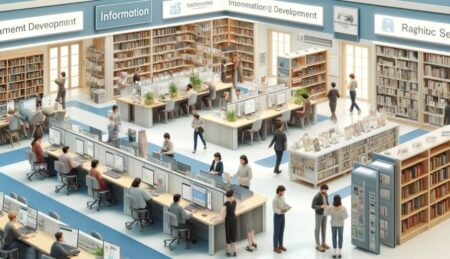
Concept of Information Resources
Information resources refer to the various sources and materials through which information is created, stored, organized, and communicated to users. These resources play a crucial role in education, research, communication, decision-making, and knowledge development. Information resources can exist in printed, digital, audio-visual, or electronic formats and are used to meet the information needs of individuals, institutions, and society. Traditionally, printed materials such as books, newspapers, magazines, encyclopedias, dictionaries, and scholarly journals were considered the primary information resources. For instance, a student might use a textbook to grasp the fundamentals of economics, while a researcher could consult scholarly journals to review previous studies relevant to their research topic. In contemporary times, digital resources like e-books, online journals, databases, websites, institutional repositories, and multimedia content have become equally significant sources of information.
The concept of information resources is closely tied to the processes of acquiring, sharing, and developing knowledge. They provide access to facts, ideas, opinions, research findings, and recorded experiences that assist users in learning and problem-solving. In academic settings, students and researchers heavily rely on information resources to complete assignments, prepare research papers, and conduct scientific investigations. For example, researchers often use databases such as Scopus, PubMed, or Google Scholar to find scholarly articles and citation information. Libraries and information centers organize and provide access to these resources to support teaching, learning, and research activities.
Information resources are commonly classified into three major categories: primary, secondary, and tertiary sources. Primary sources contain original and firsthand information, including research articles, theses, dissertations, interviews, survey data, government reports, conference proceedings, and historical documents. For instance, a scientific experiment published in a peer-reviewed journal is considered a primary source because it presents original findings. Secondary sources analyze, interpret, or summarize primary information; textbooks, review articles, biographies, and critical analyses serve as examples. For example, a literature review article discussing previous research on artificial intelligence in libraries qualifies as a secondary source. Tertiary sources compile and organize information from both primary and secondary sources for quick reference, with encyclopedias, dictionaries, directories, bibliographies, and indexes serving as examples. The Encyclopedia Britannica, for instance, provides summarized information on a wide variety of topics.
The rapid advancement of information and communication technology (ICT) has significantly transformed the nature and accessibility of information resources. Today, users can instantly access information through digital libraries, online databases, search engines, and mobile applications from virtually anywhere in the world. For example, digital libraries like Project Gutenberg offer free access to thousands of e-books, while platforms such as JSTOR and IEEE Xplore provide access to academic journals and conference papers. Multimedia resources, including educational videos, podcasts, webinars, and online tutorials, have also become vital information assets. Students, for example, may use video lectures on YouTube or online courses from Coursera for self-learning and skill development.
Although digital information resources have enhanced accessibility and convenience, they have also introduced challenges such as information overload, misinformation, plagiarism, and difficulties in assessing the credibility of information. Users may encounter unreliable content on social media or unverified websites. Consequently, information literacy skills are essential for identifying authentic, accurate, and relevant information resources. Librarians and educators often train users to evaluate information by verifying the credibility of the author, the publication source, publication date, and the references used.
Knowledge Development
Knowledge development is the process of acquiring, creating, improving, organizing, and applying knowledge through learning, research, experience, observation, and information sharing. It involves transforming information into meaningful understanding that can be utilized for problem-solving, decision-making, innovation, and intellectual growth. Knowledge development is a continuous process that occurs at the individual, organizational, educational, and societal levels.
The process begins with access to information. People gather information from various sources, such as books, journals, databases, research articles, teachers, libraries, websites, and personal experiences. However, information alone does not equate to knowledge unless it is analyzed, interpreted, and understood. For example, when a student reads a textbook on environmental science, they gain information. But when the student comprehends the concepts, applies them in assignments or research, and develops critical thinking about environmental issues, that information transforms into knowledge.
Knowledge development is closely linked to education and research. Educational institutions play a vital role in fostering knowledge by providing learning opportunities, conducting research activities, and encouraging critical thinking. Researchers contribute to knowledge development by discovering new facts, theories, technologies, and solutions to problems. For instance, medical researchers consistently develop new knowledge through experiments and clinical studies that lead to improved treatments and healthcare practices. Similarly, technological innovations—such as artificial intelligence and digital communication systems—result from ongoing knowledge development. Furthermore, knowledge development occurs through experience and social interaction. Individuals learn from practical activities, workplace experiences, discussions, collaboration, and cultural exchange. For example, a librarian develops professional knowledge not only through academic study but also through practical experience in managing library services, digital resources, and user support. Organizations develop knowledge by collecting experiences, conducting training programs, and sharing expertise among employees.
In the digital age, technology has significantly accelerated knowledge development. The internet, digital libraries, online databases, and communication platforms enable people to access and share information quickly across the globe. Platforms such as Google Scholar, ResearchGate, and Coursera allow students, researchers, and professionals to learn new concepts and contribute to global knowledge exchange. However, the rapid growth of information has also heightened the importance of information literacy and critical evaluation skills to distinguish reliable knowledge from misinformation.
Knowledge development is essential for personal growth, academic advancement, scientific progress, and national development. It supports innovation, creativity, informed decision-making, and problem-solving across various fields such as education, science, technology, healthcare, business, and governance. Societies that invest in education, research, libraries, and information systems are generally more equipped to achieve sustainable social and economic progress.
The Role of Information Resources in Knowledge Development

Information resources play a crucial role in knowledge development by providing access to accurate, organized, and relevant information. This access helps individuals learn, think critically, conduct research, and solve problems. Knowledge development occurs when information is collected, analyzed, interpreted, and applied effectively. As a result, information resources serve as the foundation for education, research, innovation, and intellectual growth. These resources include printed materials such as books, newspapers, encyclopedias, and journals, as well as digital resources like e-books, online databases, websites, multimedia content, and institutional repositories.
One of the most significant roles of information resources in knowledge development is their support for education and learning. Students and teachers rely on various information resources to gain a deeper understanding of different subjects and expand their knowledge. For instance, a student studying history may utilize textbooks, historical documents, journals, and online archives to learn about past events. Similarly, science students often rely on laboratory manuals, scholarly journals, and online educational videos to grasp scientific concepts and experiments. Educational platforms such as Google Scholar, Khan Academy, and Coursera enable learners to access academic materials and online courses from anywhere in the world, promoting self-learning, critical thinking, and lifelong education.
Information resources are also essential for research and innovation. Researchers depend on these resources to review existing knowledge, identify research gaps, collect data, and support their findings with evidence. For example, a medical researcher studying diabetes may consult scientific journals, research databases, and clinical reports to analyze previous studies and develop new treatment methods. Engineers may refer to technical reports, patents, and conference proceedings to design innovative technologies. Academic databases like Scopus, PubMed, and IEEE Xplore provide access to high-quality research articles and scholarly publications, significantly contributing to the development of new knowledge.
Libraries and information centers play a major role in facilitating knowledge development by collecting, organizing, preserving, and disseminating information resources. Academic libraries support students and researchers by providing access to books, journals, theses, dissertations, digital databases, and reference services. Public libraries contribute to community learning by offering educational materials, newspapers, internet access, and literacy programs. For example, a university library may subscribe to online databases such as JSTOR or SpringerLink to help researchers access scholarly literature. Librarians also assist users in searching for reliable information and using citation tools effectively, which enhances both research and learning processes.
The advancement of information and communication technology (ICT) has significantly increased the importance and accessibility of information resources in knowledge development. Through the internet, users can instantly access information from various parts of the world using computers and mobile devices. Digital libraries, e-books, online tutorials, webinars, podcasts, and educational videos have transformed traditional learning methods. For instance, a student preparing for an examination may watch tutorial videos on YouTube, access e-books from Project Gutenberg, and participate in online classes through virtual learning platforms. Similarly, professionals can update their skills through online training and certification programs without attending physical classrooms.
Information resources play a crucial role in supporting decision-making and problem-solving across various sectors of society. Governments utilize statistical reports, census data, and research findings to formulate policies and development plans. Healthcare professionals depend on medical databases and clinical guidelines for diagnosing diseases and providing treatment. Similarly, businesses rely on market reports, customer data, and financial information to make strategic decisions. For instance, during public health emergencies, governments and healthcare organizations refer to information from research institutions and health databases to make informed decisions about disease prevention and treatment strategies.
Another significant contribution of information resources to knowledge development is the promotion of communication and knowledge sharing. Researchers, teachers, students, and professionals can exchange ideas and collaborate through scholarly publications, conferences, institutional repositories, and online platforms. For example, researchers may share their findings through open-access journals or academic networking platforms like ResearchGate, enabling other researchers worldwide to learn from and expand upon their work. This global sharing of information accelerates scientific progress and intellectual development.
Despite their importance, information resources also present challenges in the digital age. The rapid growth of online information has led to issues such as information overload, misinformation, fake news, plagiarism, and difficulties in identifying reliable sources. For instance, users may encounter inaccurate health information on unverified websites or misleading news on social media platforms. Therefore, information literacy skills are essential for evaluating the credibility, accuracy, relevance, and authenticity of information resources. Educational institutions and libraries often provide information literacy training to help users engage with information responsibly and effectively.
Types of Information Resources that Support Knowledge Development
Various types of information resources support knowledge development by providing users with access to facts, ideas, research findings, and educational content. These resources help students, researchers, professionals, and the general public acquire knowledge, conduct research, solve problems, and make informed decisions. Information resources can be available in printed, digital, audio-visual, and online formats. Each type of resource serves different purposes and contributes to knowledge development in unique ways.
- Books: Books are one of the oldest and most important information resources for knowledge development. They provide detailed and organized information on specific subjects and are widely used in education and research. Textbooks help students learn academic concepts, while reference books provide quick access to factual information. For example, medical students use anatomy textbooks to understand the human body, and researchers use specialized books for theoretical knowledge in their fields.
- Scholarly Journals and Research Articles: Scholarly journals and research articles are essential resources for advanced learning and research. They contain original research findings, experiments, case studies, and scholarly discussions written by experts. These resources help researchers stay updated with recent developments and contribute to new knowledge creation. For example, a researcher studying artificial intelligence may use articles from journals available through IEEE Xplore or ScienceDirect to review the latest research in the field.
- Newspapers and Magazines: Newspapers and magazines provide current information about social, political, economic, scientific, and cultural issues. They help users stay informed about recent events and trends. For example, business professionals may read financial newspapers to understand market conditions, while students may use news articles to support assignments or debates.
- Encyclopedias and Dictionaries: Encyclopedias and dictionaries are important reference resources that provide concise and reliable information. Encyclopedias offer summarized explanations on various topics, while dictionaries define words, concepts, and terminology. For example, students may use the Encyclopaedia Britannica to understand historical events or scientific concepts.
- Digital Libraries and Online Databases: Digital libraries and online databases have become major sources of information in the digital age. They provide access to e-books, scholarly journals, conference papers, theses, dissertations, and multimedia content. These resources support remote learning and research by allowing users to access information anytime and anywhere. For example, JSTOR and Scopus are widely used academic databases for scholarly research.
- Websites and Online Resources: Websites, blogs, educational portals, and institutional repositories are important online information resources. Educational websites provide tutorials, articles, research materials, and learning tools. For example, Khan Academy offers free educational lessons, while Google Scholar helps users search scholarly literature.
- Audio-Visual Resources: Audio-visual resources such as videos, documentaries, podcasts, webinars, and recorded lectures support knowledge development through visual and auditory learning. These resources are especially useful for explaining practical concepts and improving understanding. For example, students may watch tutorial videos on YouTube to learn programming, mathematics, or scientific experiments.
- Government Publications and Reports: Government documents, census reports, policy papers, statistical reports, and official publications provide authentic information for research and decision-making. Researchers, policymakers, and students often use these resources for social science, economics, public health, and development studies. For example, national census reports help researchers analyze population trends and economic conditions.
- Theses, Dissertations, and Conference Proceedings: Theses and dissertations contain detailed academic research conducted by students and scholars, while conference proceedings present research papers shared during academic conferences. These resources contribute to knowledge development by introducing new research findings and innovative ideas. University institutional repositories often preserve and provide access to these materials.
- Multimedia and Interactive Learning Resources: Modern technology has introduced interactive learning resources such as simulations, e-learning platforms, mobile applications, and virtual learning environments. These resources support self-learning and skill development. For example, platforms such as Coursera and edX provide online courses from universities around the world.
Different types of information resources support knowledge development by providing access to information in various formats and subject areas. Printed resources, digital platforms, scholarly publications, audio-visual materials, and online learning tools all contribute to education, research, innovation, and lifelong learning. In the modern information society, the effective use of these resources is essential for developing knowledge, improving skills, and supporting academic and professional growth.