What Is Pre-coordinate Indexing?
Pre-coordinate indexing is a subject indexing technique in which two or more indexing terms are selected, arranged, and combined into a predetermined sequence before a document is entered into an index, catalog, or database. The term pre-coordinate signifies that the relationship between different subject concepts is established by the indexer during the indexing process, rather than by the user at the time of searching. This method relies on a controlled vocabulary and standardized citation rules to create complete subject headings that accurately describe the content of a document. Consequently, users search for predefined subject headings instead of having to combine individual keywords themselves.
The primary objective of pre-coordinate indexing is to represent the subject content of a document in a precise, consistent, and standardized manner. Before assigning index terms, the indexer performs subject analysis to identify the document’s main topic and related concepts. Appropriate terms are then selected from an authorized list of subject headings or a thesaurus and arranged according to established citation order. For example, instead of assigning separate keywords such as “Academic libraries,” “Artificial intelligence,” and “Services,” a pre-coordinate indexing system combines them into a single structured subject heading like “Academic libraries-Artificial intelligence-Services.” This coordinated heading clearly expresses the relationship among the concepts before the document is stored in the catalog or database.
Another example would be a book discussing digital library management in Bangladesh. In a pre-coordinate indexing system, the subject might be recorded as “Digital libraries-Management-Bangladesh” instead of using separate keywords like “Digital libraries,” “Management,” and “Bangladesh.” Similarly, a document about children’s education through public libraries could receive the subject heading “Public libraries-Services for children-Education.” These examples demonstrate how related concepts are combined into a single, meaningful subject heading before users search the collection.
Pre-coordinate indexing is widely used in traditional library catalogs, printed indexes, bibliographies, and many bibliographic databases, as it provides a structured approach to organizing information. Well-known controlled vocabulary systems such as the Library of Congress Subject Headings (LCSH), Medical Subject Headings (MeSH), and the Sears List of Subject Headings are classic examples of pre-coordinate indexing systems. For instance, the Library of Congress Subject Heading “Libraries-Automation” combines the concepts of libraries and automation into a single authorized heading, allowing users to efficiently retrieve all documents on that specific topic.
Because the subject relationships are established in advance by trained indexers, pre-coordinate indexing ensures consistency, reduces ambiguity, and improves the precision of information retrieval. Although modern search systems often allow users to combine keywords dynamically, pre-coordinate indexing remains an essential method for organizing knowledge in libraries and information centers, particularly in contexts where accurate subject representation and standardized access are required. Its systematic approach continues to support effective cataloging and reliable retrieval of information across academic, public, and special libraries.
The Principle Behind Pre-coordinate Indexing
The fundamental principle behind pre-coordinate indexing is that the relationships between different subject concepts are established before the information retrieval process. In this method, a trained indexer analyzes the content of a document, selects suitable subject terms from a controlled vocabulary, and combines these terms into a single, structured subject heading according to predetermined citation rules. This coordination of concepts occurs at the time of indexing rather than during the user’s search. As a result, users retrieve information by searching for these predefined subject headings instead of creating their own combinations of keywords.
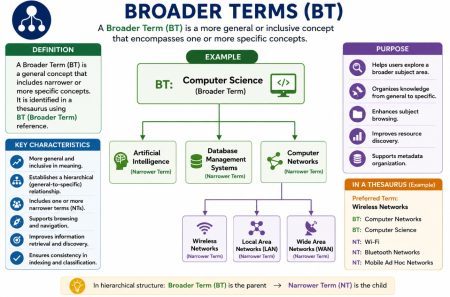
Another important principle is the use of a controlled vocabulary to ensure consistency and standardization in subject representation. This prevents different indexers from using varied terms for the same concept. Authorized subject headings are chosen from established indexing languages such as the Library of Congress Subject Headings (LCSH), Medical Subject Headings (MeSH), or the Sears List of Subject Headings. For example, if a document discusses the use of computers in libraries, the authorized subject heading might be “Libraries—Automation,” rather than alternative expressions like “Computerized Libraries” or “Library Computerization.” This consistency enhances the accuracy and reliability of information retrieval.
Pre-coordinate indexing also adheres to the principle of citation order, which specifies the sequence in which subject terms should be arranged within a heading. This order is not arbitrary; it follows established cataloging and indexing rules to clearly express the relationships between concepts. For instance, a document about digital library management in Bangladesh would be indexed as “Digital libraries-Management-Bangladesh,” where the main subject (Digital libraries) is followed by the aspect (Management) and then the geographic subdivision (Bangladesh). This standardized arrangement aids users in locating related materials more efficiently.
Another key principle is subject specificity, which requires that the most specific subject heading be assigned to accurately represent the content of a document. Instead of using a broad heading such as “Libraries,” a document focused on artificial intelligence in university libraries would receive a more precise heading like “Academic libraries-Artificial intelligence.” This specificity enhances the precision of search results by minimizing the retrieval of irrelevant documents.
Finally, pre-coordinate indexing is based on the principle that it is the indexer, not the user, who determines the conceptual relationships among subjects. Since the coordination of terms is completed before the document is added to the catalog or database, users simply search using the established subject headings. This approach provides consistent, standardized, and highly precise subject access, making pre-coordinate indexing particularly effective in traditional library catalogs, bibliographies, and specialized information retrieval systems.