In today’s information age, we are surrounded by a vast amount of content generated through books, journals, websites, social media platforms, databases, and artificial intelligence tools like ChatGPT and Google Gemini. The rapid growth of digital technologies and the widespread availability of the internet have made information accessible to users anytime and anywhere. For example, students can quickly search for journal articles in online databases, watch educational videos on social media, or use AI tools to gain quick explanations on academic topics. While this easy access to information offers new opportunities for learning, research, communication, and decision-making, it has also led to the proliferation of inaccurate, misleading, outdated, and biased information. False health advice shared on social media or fabricated news articles from unreliable websites can mislead users and create confusion. As a result, individuals often struggle to distinguish between reliable information and false or low-quality content. In this context, assessing the quality of information has become an essential skill for students, researchers, educators, librarians, and general information users.
Information quality refers to the degree to which information is accurate, reliable, relevant, current, complete, and useful for a particular purpose. High-quality information supports effective decision-making, academic research, problem-solving, and knowledge development. In contrast, poor-quality information can lead to misunderstandings, confusion, incorrect decisions, and the spread of misinformation. For instance, a medical researcher who relies on peer-reviewed journal articles from reputable publishers is more likely to obtain accurate findings compared to someone who depends on anonymous blog posts or unverified online forums. Similarly, a university student writing a research paper should utilize scholarly databases and academic books rather than random social media posts or outdated websites. In academic and professional settings, using reliable information is particularly crucial because research findings, policies, educational activities, and organizational decisions largely depend on trustworthy sources. Therefore, evaluating information before using or sharing it has become increasingly important in both digital and traditional information environments.
The assessment of information quality involves examining several key criteria, including accuracy, authority, currency, relevance, objectivity, reliability, completeness, and clarity. These criteria help users determine whether an information source is trustworthy and suitable for their needs. For example, information published on a government website or by a recognized university is generally considered more authoritative than content uploaded anonymously on social media. Additionally, an article on artificial intelligence published in 2026 would typically be more relevant and current than one written ten years earlier. Various evaluation models, such as the CRAAP test, are widely used to guide users in critically analyzing information sources. Furthermore, libraries and information professionals play a significant role in promoting information literacy and teaching users how to identify credible and authentic information sources. For instance, academic libraries often organize information literacy workshops to educate students on how to evaluate websites, scholarly articles, and online resources. In a digital era where misinformation, fake news, and AI-generated content spread rapidly across online platforms, the ability to assess information quality is no longer optional; it has become a fundamental necessity for responsible information use and informed participation in society.
Meaning of Information Quality
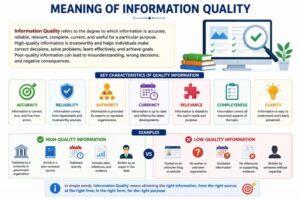 Information quality refers to the standard or value of information based on its usefulness, reliability, accuracy, and suitability for a particular purpose. In straightforward terms, high-quality information is that which users can trust and effectively use for learning, research, decision-making, problem-solving, and communication. This concept is crucial in fields such as Library and Information Science, education, business, healthcare, research, and digital communication, as decisions and actions often rely on the correctness and credibility of the information. For instance, a researcher working on a scientific study needs accurate and up-to-date journal articles, while a doctor requires reliable medical information to diagnose and treat patients effectively. If the information used is incorrect or misleading, it can lead to poor decisions, misunderstandings, or even serious consequences.
The quality of information is typically determined by several important characteristics, including accuracy, authority, currency, relevance, reliability, completeness, objectivity, and clarity. Accurate information should be factually correct and free from errors, while reliable information should originate from trustworthy and dependable sources. Currency refers to how up-to-date the information is, which is particularly important in rapidly changing fields such as technology, medicine, and artificial intelligence. For example, an article about cybersecurity published in 2012 may not adequately address modern cyber threats and security practices in 2026.
Another key aspect is relevance; information must align with the user’s needs and purpose. A school-level textbook may provide a basic overview of climate change, but it may not contain the depth required for advanced academic research.
In today’s digital age, assessing information quality has become increasingly vital as users encounter information from a wide range of online sources, including websites, blogs, social media platforms, online news portals, databases, and AI-powered systems. While many online resources offer valuable and credible information, others may contain misinformation, fake news, biased opinions, or outdated content. For instance, social media posts about health treatments can go viral, even if they lack scientific evidence or expert verification.
Therefore, users must critically evaluate information before accepting, using, or sharing it. Ensuring information quality guarantees that the information is not only accessible but also meaningful, trustworthy, and useful for achieving specific goals in academic, professional, and everyday contexts.
Importance of Assessing Information Quality
Assessing information quality is essential in today’s digital environment, as people frequently rely on information for education, research, professional activities, communication, and decision-making. With the rapid growth of the internet and digital technologies, an enormous amount of information is produced and shared daily through websites, online databases, social media platforms, news portals, blogs, and artificial intelligence tools. While this easy access to information offers many advantages, it has also contributed to the spread of misinformation, fake news, biased opinions, and outdated content. Consequently, users must evaluate the quality of information before accepting or utilizing it. For example, a student preparing an academic assignment should verify whether the information comes from scholarly journals or reliable books instead of relying solely on random websites or unverified social media posts. Without proper evaluation, users may unknowingly use inaccurate information, which can negatively impact learning, research, and decision-making.
The assessment of information quality is particularly crucial in academic and research environments, as reliable information forms the foundation of scholarly work and knowledge creation. Researchers, teachers, and students require accurate, current, and authoritative information to produce credible research findings and foster meaningful academic discussions. For instance, using peer-reviewed journal articles from recognized publishers generally provides more dependable information than anonymous online blogs or unsupported opinions. Similarly, in the healthcare and medical fields, assessing information quality can directly affect human health and safety. A doctor who relies on scientifically verified medical research is more likely to provide effective treatment than someone who depends on unverified online claims or misleading advertisements. In the business and government sectors, high-quality information supports strategic planning, policy formulation, and effective management decisions. Thus, evaluating information quality helps individuals and organizations minimize risks and improve the reliability of their decisions and actions.
Assessing information quality also plays a vital role in promoting information literacy and responsible use of information in society. In the age of social media, false information can spread rapidly and influence public opinion, social behavior, and political decisions. For example, during global health crises, misleading claims and fake treatments are often circulated online, causing confusion among the public. By evaluating information based on criteria such as accuracy, authority, relevance, and objectivity, users can identify trustworthy sources and avoid being misled by false or biased content. Libraries and information professionals significantly contribute to this process by teaching users how to critically assess information sources and use information ethically and responsibly. Additionally, the increasing use of AI-powered systems such as ChatGPT and Google Gemini has made the evaluation of information even more important, as AI-generated content may sometimes contain inaccuracies or fabricated information. Therefore, assessing information quality has become a crucial skill for ensuring informed decision-making, maintaining academic integrity, and fostering responsible participation in the digital society.
Main Criteria for Assessing Information Quality
Evaluating information quality involves analyzing several key criteria that help determine whether the information is trustworthy, accurate, useful, and appropriate for a specific purpose. In academic research, education, healthcare, business, and daily life, people rely on high-quality information to make informed decisions and effectively solve problems. However, not all information available online or in print is reliable or authentic. Therefore, users must critically assess information sources before accepting or using them. The following criteria are commonly used to evaluate the quality of information.
1. Accuracy: Accuracy refers to the correctness and factual reliability of information. Accurate information should be free from errors, supported by evidence, and verified through authentic sources. Information that contains incorrect facts, misleading statistics, or unsupported claims can create confusion and lead to poor decision-making.
For example, a medical article published in a peer-reviewed journal is generally more accurate than a random social media post claiming to provide health advice without scientific evidence. Similarly, academic books and scholarly databases usually maintain higher standards of accuracy because their contents are reviewed by experts before publication.
Indicators of Accuracy
-
- Presence of references and citations
- Verified facts and statistics
- Correct spelling and grammar
- Evidence-based discussion
- Peer-reviewed or expert-reviewed content
2. Authority: Authority refers to the credibility, expertise, and reputation of the author, publisher, or organization responsible for the information. Information created by qualified experts or recognized institutions is generally considered more trustworthy than information from unknown or unverified sources.
For example, information published by a university, government organization, or recognized research institution is usually more authoritative than anonymous blog content. A research article written by a professor specializing in artificial intelligence is more reliable than an article written by someone without expertise in the field.
Indicators of Authority
-
- Author qualifications and expertise
- Institutional affiliation
- Reputation of the publisher
- Professional credentials
- Contact information and transparency
3. Currency: Currency refers to how recent and up-to-date the information is. In rapidly changing fields such as technology, medicine, artificial intelligence, and cybersecurity, current information is extremely important because older information may become outdated.
For example, an article about cybersecurity threats published in 2010 may not adequately explain modern cyberattacks and security solutions in 2026. Similarly, research on AI technologies changes rapidly, making recent publications more valuable for current understanding.
Indicators of Currency
-
- Publication date
- Last updated date
- Recent references and citations
- Updated statistics and examples
- Working website links
4. Relevance: Relevance refers to how well the information meets the needs and purpose of the user. Even accurate and authoritative information may not be useful if it does not relate to the topic or intended audience.
For example, a basic encyclopedia article about climate change may be suitable for school students but insufficient for advanced academic research. Similarly, a technical research paper may be too complex for general readers seeking introductory knowledge.
Indicators of Relevance
-
- Matches the research topic
- Appropriate depth and detail
- Suitable for the target audience
- Supports the purpose of the research or task
- Covers the required subject area
5. Reliability: Reliability refers to the consistency and dependability of information. Reliable information can be trusted because it is supported by evidence, citations, and consistent findings from multiple credible sources.
For example, scholarly databases and peer-reviewed journals are generally more reliable than personal opinions shared on online discussion forums. If several trusted sources provide similar information, the reliability of that information increases.
Indicators of Reliability
-
- Consistent information across multiple sources
- Presence of supporting evidence
- Use of scholarly references
- Transparent research methodology
- Stable and trustworthy publication source
6. Objectivity: Objectivity refers to the degree to which information is free from personal bias, emotional influence, or commercial interests. Objective information presents facts fairly and avoids manipulating readers.
For example, advertisements often provide biased information to promote products or services, whereas scholarly articles usually attempt to present balanced and evidence-based discussions. Similarly, political content on social media may sometimes reflect strong personal opinions rather than objective facts.
Indicators of Objectivity
-
- Balanced presentation of ideas
- Absence of emotional manipulation
- Evidence-based arguments
- Disclosure of sponsorship or funding
- Neutral and professional language
7. Completeness: Completeness refers to whether the information adequately covers the topic without omitting important details. Incomplete information may create misunderstanding or provide only partial knowledge about a subject.
For example, an article discussing the advantages of social media without mentioning its disadvantages may provide an incomplete understanding of the topic. Similarly, research findings without methodology or data explanation may reduce the usefulness of the information.
Indicators of Completeness
-
- Covers major aspects of the topic
- Includes supporting details and examples
- Explains concepts clearly
- Provides sufficient background information
- Addresses limitations where applicable
8. Clarity: Clarity refers to how clearly and understandably information is presented. Clear information is well organized, logically structured, and easy for readers to understand.
For example, a research article with proper headings, simple explanations, and organized discussion is easier to understand than poorly structured content with confusing language. Clear communication improves the usability and effectiveness of information.
Indicators of Clarity
-
- Simple and understandable language
- Logical organization
- Proper headings and formatting
- Clear examples and explanations
- Readable sentence structure
9. Timeliness: Timeliness refers to whether information is available when needed. Information may lose its value if it reaches users too late, especially in situations requiring immediate action or decision-making.
For example, real-time weather updates and emergency alerts are highly time-sensitive because delayed information may reduce their usefulness. Similarly, stock market information must be timely for investors making financial decisions.
Indicators of Timeliness
-
- Fast availability of information
- Updated news and reports
- Immediate access to critical data
- Real-time communication where necessary
10. Validity: Validity refers to the soundness and authenticity of the methods, arguments, or conclusions presented in the information. Valid information is logically developed and supported by proper evidence or research methods.
For example, scientific studies based on proper research methodologies and statistical analysis are considered more valid than unsupported assumptions or opinions. In academic research, validity is important to ensure trustworthy and meaningful findings.
Indicators of Validity
-
- Proper research methodology
- Logical arguments and conclusions
- Evidence-based findings
- Accurate interpretation of data
- Scholarly review and verification
The assessment of information quality is essential for identifying trustworthy, accurate, and useful information in both traditional and digital environments. Criteria such as accuracy, authority, currency, relevance, reliability, objectivity, completeness, clarity, timeliness, and validity help users critically evaluate information sources before using or sharing them. In an age where misinformation, fake news, and AI-generated content are increasingly common, the ability to assess information quality has become a fundamental skill for students, researchers, librarians, professionals, and general users. By applying these criteria, individuals can make informed decisions, improve research quality, and promote responsible information use in society.
Common Models for Evaluating Information
In the digital age, evaluating information has become an essential skill. People are constantly exposed to various sources of information, including websites, online databases, social media platforms, news portals, blogs, and artificial intelligence systems. Since not all sources are reliable or trustworthy, several models and frameworks have been developed to help users critically assess the quality and credibility of the information they encounter. These models offer structured methods for identifying accurate, authoritative, and relevant information while avoiding misinformation, fake news, and biased content. Below, we discuss some of the most widely used information evaluation models.
1. CRAAP Test:
The CRAAP Test is one of the most popular and widely used models for evaluating information sources, especially in academic and library environments. The model was developed to help users quickly determine whether information is reliable and suitable for research purposes. The word “CRAAP” is an acronym representing five important evaluation criteria:
Components of the CRAAP Test
Component – Meaning
Currency – Determines whether the information is recent and up-to-date
Relevance – Examines whether the information matches the user’s needs
Authority – Evaluates the credibility of the author or publisher
Accuracy – Checks whether the information is correct and evidence-based
Purpose – Identifies the intention behind the information
For example, when evaluating a website about climate change, users can check whether the article was recently updated, whether the author is a climate expert, whether scientific evidence is provided, and whether the content is intended to inform or persuade readers.
The CRAAP Test is widely used in academic libraries because it is simple, easy to remember, and effective for evaluating books, journal articles, websites, and online resources.
2. RADAR Method:
The RADAR method is another important framework used for evaluating information sources. It focuses on examining the reliability and quality of information by analyzing five major aspects.
Components of the RADAR Method
Component – Meaning
Relevance – Measures how useful the information is for the topic
Authority – Examines the expertise and credibility of the source
Date – Determines whether the information is current
Appearance – Evaluates the presentation and professionalism of the source
Reason – Identifies the purpose and logic behind the information
For example, a professionally designed university website containing references and recent publications is generally considered more reliable than a poorly designed anonymous blog without citations. The RADAR method encourages users to critically analyze both the content and the presentation of information sources.
3. SIFT Method:
The SIFT Method is a modern information evaluation framework designed mainly for evaluating digital content, social media posts, websites, online news, and viral information. This method is especially useful for combating misinformation and fake news in online environments.
Components of the SIFT Method
Component – Meaning
Stop – Pause before accepting or sharing information
Investigate the Source – Examine who created the information
Find Better Coverage – Compare with trusted and reliable sources
Trace Claims to Original Context – Verify the original source of claims, quotes, or images
For example, if a viral social media post claims that a certain food can cure a serious disease, users should first stop and avoid immediately believing or sharing the post. They should then investigate the source, compare the claim with trusted medical websites, and trace the information back to its original source.
The SIFT method is particularly valuable in the age of social media because false information can spread rapidly online.
4. PROMPT Model:
The PROMPT model is commonly used in higher education and research environments to evaluate scholarly and professional information sources. It provides a more detailed and analytical approach for assessing information quality.
Components of the PROMPT Model
Component – Meaning
Presentation – Examines the structure and organization of the information
Relevance – Determines the usefulness of the information
Objectivity – Evaluates bias and neutrality
Method – Assesses research methods and evidence
Provenance – Identifies the origin and credibility of the source
Timeliness – Checks whether the information is current
For example, when evaluating a research report, users may examine whether the methodology is scientifically sound, whether the information is unbiased, and whether the report comes from a recognized institution.
The PROMPT model is especially useful for evaluating academic articles, research reports, and grey literature.
5. RAVEN Framework
The RAVEN framework focuses on evaluating the credibility and trustworthiness of information sources by examining the author’s expertise, motivation, and neutrality.
Components of the RAVEN Framework
Component – Meaning
Reputation – Reputation of the author or organization
Ability to Observe – Whether the source has direct knowledge or experience
Vested Interest – Whether the source benefits from a specific viewpoint
Expertise – Qualifications and knowledge of the author
Neutrality – Whether the information is unbiased and balanced
For example, an article written by a scientist working directly in vaccine research is generally more credible than an opinion article written by someone without medical expertise. Similarly, content sponsored by commercial companies may contain vested interests that influence objectivity.
6. The Five Ws Approach:
The Five Ws approach is a simple and practical method for evaluating information sources by asking critical questions about the content.
The Five Ws
-
- Who created the information?
- What is the purpose of the information?
- When was the information published?
- Where was the information published?
- Why was the information created?
For example, when reading an online news article, users can examine who wrote the article, when it was published, why it was created, and whether the website is trustworthy.
This method is particularly useful for beginners and general information users because it encourages critical thinking in a straightforward manner.
Importance of Using Evaluation Models
Information evaluation models provide structured methods for identifying reliable and trustworthy information sources. They help users avoid misinformation, fake news, biased content, and manipulated information. In academic research, these models improve the quality and credibility of scholarly work. In everyday life, they help people make informed decisions regarding health, education, finance, politics, and social issues.
These models are also highly important in the age of social media and artificial intelligence tools such as ChatGPT and Google Gemini because AI-generated content and viral online information may sometimes contain inaccurate or misleading information. Therefore, users must critically analyze information before accepting or sharing it.
Various models and frameworks have been developed to help users evaluate the quality, credibility, and reliability of information sources. Models such as the CRAAP Test, RADAR Method, SIFT Method, PROMPT Model, RAVEN Framework, and the Five Ws Approach provide systematic ways to assess information critically. Each model focuses on different aspects of information evaluation, including authority, accuracy, currency, relevance, objectivity, and purpose. In the digital era, where misinformation and fake news spread rapidly, these evaluation models play a significant role in promoting information literacy, critical thinking, and responsible information use.
Challenges in Assessing Information Quality
Assessing information quality has become increasingly challenging in the digital age due to the vast growth of online information sources and the rapid spread of content through the internet and social media platforms. Every day, millions of articles, videos, blog posts, news reports, and social media updates are published, making it difficult for users to differentiate between reliable information and misleading or false content. Unlike traditional print publications, which usually undergo editorial review and quality control processes, much of the information available online can be published instantly and without verification. As a result, users often encounter inaccurate, incomplete, biased, or manipulated information. For example, social media frequently contains viral posts that spread misinformation about health treatments, politics, or current events without scientific evidence or expert review. This overwhelming amount of information, often referred to as “information overload,” complicates users’ ability to critically assess every source they come across.
One of the significant challenges in evaluating information quality is the rapid spread of misinformation and fake news. False or misleading information can easily become viral through social media sharing, online advertisements, and algorithm-driven recommendation systems. In many instances, people share information without verifying its accuracy or authenticity. For example, during public health emergencies, false medical advice and conspiracy theories often circulate widely online, creating confusion and fear. Technologies such as deepfakes and manipulated images or videos further complicate the issue by making false information appear realistic and trustworthy. Additionally, some websites intentionally publish sensational or misleading headlines to capture user attention and increase web traffic, even if the content is factually inaccurate. These practices make it increasingly difficult for users to identify credible and authentic information sources.
Another major challenge is the presence of bias and commercial influence within information sources. Many online platforms, news organizations, and websites may present information to support specific political, ideological, or commercial interests. Sponsored content, advertisements, and promotional articles can resemble genuine news or research content, making it hard for users to recognize hidden motives or biases. For example, product reviews published by companies may exaggerate benefits while downplaying limitations or negative aspects. Similarly, political content on social media often reflects emotional or ideological perspectives rather than balanced and objective discussions. Due to these influences, users must carefully analyze the purpose, authorship, and neutrality of information sources before deciding to trust them.
The increasing use of artificial intelligence technologies has also introduced new challenges in evaluating information quality. AI-powered tools, such as ChatGPT and Google Gemini, can generate human-like text quickly and efficiently, but this content may sometimes contain factual inaccuracies, fabricated references, or outdated information. Since AI-generated responses often read confidently and professionally, users might mistakenly assume that all information produced by AI systems is accurate and trustworthy. Therefore, users still need to verify AI-generated information using authoritative and reliable sources. Additionally, the rise of predatory journals and low-quality online publications creates further difficulties for researchers and students. These journals may claim to be academic or peer-reviewed while lacking proper editorial standards and scientific review processes.
Another important challenge is the lack of information literacy and critical evaluation skills among many users. Some individuals may not know how to verify sources, identify bias, examine publication dates, or assess the credibility of authors and websites. As a result, they may accept unreliable information as true simply because it appears popular or is professionally presented online. This challenge is particularly significant among young internet users and those with limited digital literacy skills. Therefore, libraries, educational institutions, and information professionals play a crucial role in promoting information literacy and teaching users how to critically assess information sources. In today’s digital environment, overcoming these challenges requires critical thinking, digital literacy, an awareness of misinformation, and the consistent application of information evaluation criteria and models.
Role of Libraries and Information Professionals
Libraries and information professionals play a crucial role in helping users identify, evaluate, and utilize high-quality information in both traditional and digital settings. In today’s information society, where misinformation, fake news, biased content, and low-quality online resources are increasingly prevalent, libraries serve as trusted institutions that provide access to reliable, authentic, and well-organized information resources.
Academic, public, school, and special libraries carefully select books, journals, databases, and digital resources to ensure that users receive accurate and credible information for learning, research, and decision-making. For example, university libraries subscribe to scholarly databases and peer-reviewed journals to support academic research and maintain the quality of educational resources available to students and researchers. By providing access to trustworthy information sources, libraries help mitigate the risks associated with unreliable or misleading information.
Information professionals, including librarians, information scientists, and knowledge managers, are also responsible for promoting information literacy and critical thinking skills among users. Information literacy refers to the ability to identify information needs, locate relevant information, evaluate information critically, and use information ethically and effectively. Librarians often organize information literacy programs, workshops, orientations, and training sessions to teach users how to assess the credibility, authority, relevance, and accuracy of information sources. For instance, academic librarians may guide students in distinguishing scholarly journal articles from unreliable websites or in evaluating online sources using models such as the CRAAP test and the SIFT method. These educational initiatives are especially important in the digital age, as users are continually exposed to vast amounts of information through websites, social media platforms, and artificial intelligence tools.
Additionally, librares and information professionals contribute to combating misinformation and promoting ethical information use in society. By teaching users how to verify information sources, identify fake news, recognize bias, and check factual accuracy, librarians cultivate informed and responsible information consumers. During crises such as public health emergencies or political events, libraries often provide access to verified information from government agencies, research institutions, and reputable organizations to prevent the spread of false or misleading content. Furthermore, libraries are increasingly supporting digital literacy initiatives that help users understand online information environments, social media influence, and AI-generated content. Since AI tools like ChatGPT and Google Gemini can sometimes produce inaccurate or fabricated information, librarians encourage users to critically verify AI-generated responses by consulting authoritative sources.
In addition to supporting information evaluation, libraries also preserve, organize, and provide long-term access to knowledge and cultural resources. Modern libraries utilize digital repositories, institutional archives, cataloging systems, and metadata standards to enhance information retrieval and accessibility. Information professionals ensure that resources are systematically organized and easily accessible to users based on their needs. Moreover, libraries are adopting new technologies, such as digital libraries, online databases, research support services, and AI-assisted information systems, to improve user services and information access.
In this rapidly evolving information landscape, libraries and information professionals continue to play a vital role in supporting education, research, digital literacy, lifelong learning, and the effective evaluation and use of quality information.