What Are Subject Headings?
Subject headings are standardized terms or phrases used to describe the subject or content of library materials, including books, journals, theses, reports, audiovisual materials, and digital resources. They serve as a controlled vocabulary, meaning catalogers use approved and standardized terms instead of randomly assigning any word. This consistency allows users to find all resources on a particular topic, even when different authors use varying terminology. Subject headings are essential components of bibliographic records in library catalogs, playing a crucial role in organizing knowledge and improving information retrieval.
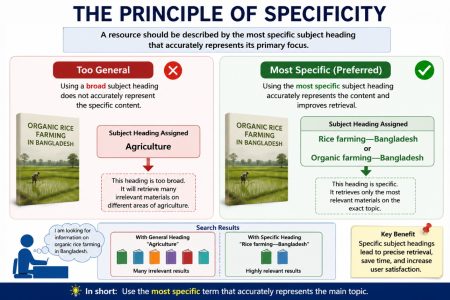
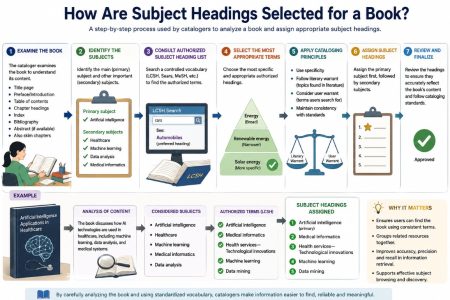
Unlike keywords, which are taken directly from the words present in a document, subject headings are assigned after thoroughly analyzing the resource’s intellectual content. Catalogers identify the main topics discussed in the material and select the most appropriate authorized terms from a recognized subject heading list. For instance, a book titled Introduction to Computer Security might be assigned the subject heading “Computer Security,” while another book titled Cyber Defense Strategies may also receive the same subject heading. Although the titles use different wording, both books can be found together using the standardized subject heading “Computer Security.”
A single resource may be assigned multiple subject headings to represent all of its significant topics. For example, a book titled Artificial Intelligence Applications in Academic Libraries could be assigned subject headings such as “Artificial Intelligence,” “Academic Libraries,” “Library Automation,” and “Information Technology.” As a result, users searching under any of these subjects can discover the same book, increasing its visibility and accessibility.
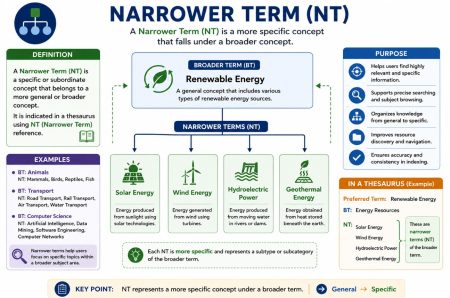
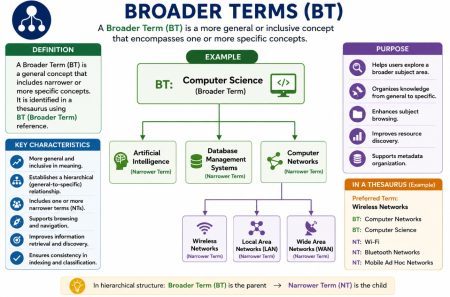
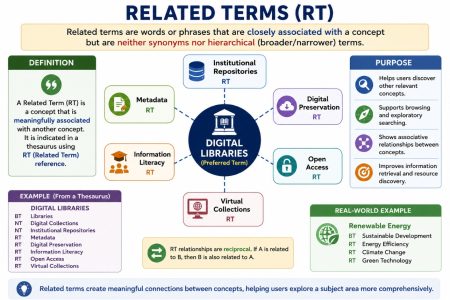
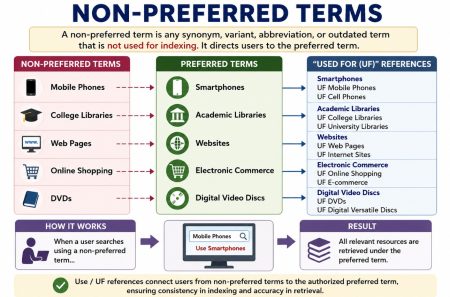
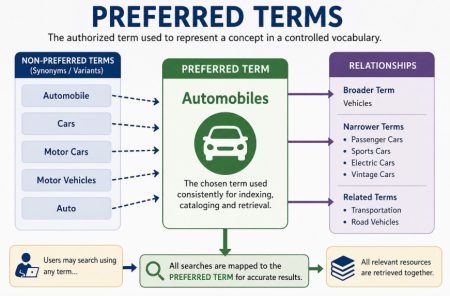
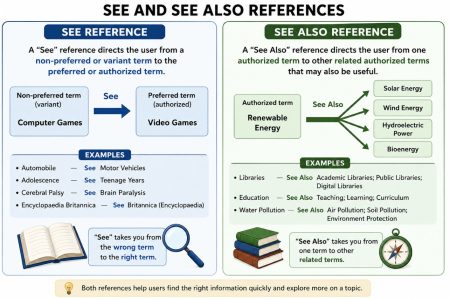
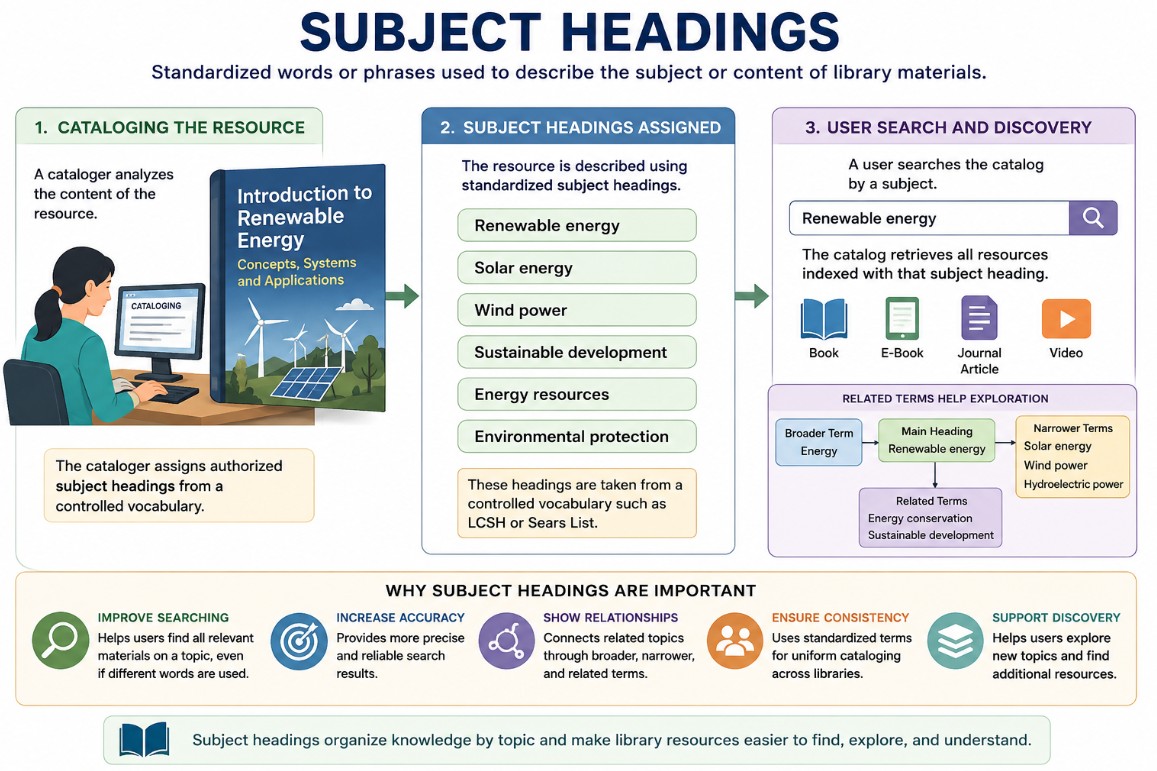
Subject headings also establish relationships between related concepts through broader terms, narrower terms, related terms, and cross-references. These relationships help users explore a topic systematically. For example, someone searching for “Renewable Energy” may be guided to narrower subjects such as “Solar Energy,” “Wind Power,” and “Hydroelectric Power,” or related topics like “Energy Conservation.” Similarly, a search for “Automobiles” may include a cross-reference directing users from the non-preferred term “Cars” to the authorized subject heading “Automobiles,” ensuring consistent and accurate retrieval.
Libraries worldwide rely on standardized subject heading systems to maintain consistency. The Library of Congress Subject Headings (LCSH) is the most widely used system in academic and research libraries. For example, instead of assigning different headings like “Global Warming,” “Climate Problems,” or “Climate Crisis” based on personal preference, catalogers follow the authorized term specified in LCSH. School and small public libraries often use the Sears List of Subject Headings, which employs simpler language that is easier for younger students and general readers to understand. In the medical field, Medical Subject Headings (MeSH) provide standardized terminology for indexing and retrieving biomedical literature. For instance, researchers looking for studies on high blood pressure can find relevant articles under the authorized heading “Hypertension,” regardless of how individual authors phrase their work.
Subject headings are particularly valuable in Online Public Access Catalogs (OPACs) and digital library systems. For example, if a student searches for “Artificial Intelligence” in a library catalog, the system can display not only books with those exact words in the title but also those whose titles might be “Machine Learning Fundamentals,” “Intelligent Information Systems,” or “AI for Healthcare,” provided they have been assigned the appropriate subject heading. This enables users to find more comprehensive and relevant resources than a simple keyword search would provide.
The Purpose of Subject Headings in Library Catalogs
Subject headings are essential tools in library catalogs that help organize information by topic, providing a consistent and standardized method for locating library materials. Their main purpose is to assist users in finding all resources related to a specific subject, regardless of the terminology used in the title, abstract, or text. By assigning authorized subject terms from a controlled vocabulary, libraries ensure that materials covering the same topic are grouped together, making information retrieval more accurate, efficient, and comprehensive.
One of the key benefits of subject headings is their ability to enhance subject-based searching. Different authors often use various terms to describe the same concept, which can make keyword searches unreliable. Subject headings resolve this issue by assigning a single authorized term to all resources on the same topic. For example, a book titled Introduction to Cybersecurity and another titled Information Security Principles may both be assigned the subject heading Computer Security, allowing users to retrieve both books through a single subject search.
Subject headings also improve the precision and recall of search results. Precision refers to retrieving materials that are directly relevant to a user’s query, while recall pertains to the retrieval of as many relevant resources as possible. Because subject headings are assigned based on the intellectual content of each work, they help reduce the number of irrelevant search results and ensure that important resources are not overlooked. For instance, a student researching Renewable Energy can find books on Solar Energy, Wind Power, and Hydroelectric Power, provided these topics are appropriately represented through related or additional subject headings.
Another important function of subject headings is to bring together materials on the same subject, even if they are stored in different physical locations or exist in different formats. A search for Climate Change in a library catalog could yield printed books, e-books, journal articles, theses, government reports, conference proceedings, and audiovisual materials, as they all share the same authorized subject heading. This allows users to explore a topic comprehensively without needing to search each resource type separately.
Subject headings also aid users in discovering related topics through cross-references and hierarchical relationships. Standard subject heading systems include broader terms, narrower terms, related terms, and “see” or “see also” references. For example, a user searching for Cars may be directed to the authorized heading Automobiles, while someone looking for Artificial Intelligence might be encouraged to explore related subjects such as Machine Learning, Natural Language Processing, or Expert Systems. These relationships help users broaden or narrow their searches based on their information needs. Furthermore, subject headings promote consistency in cataloging across different libraries. Because catalogers use established standards rather than personal judgment, users encounter the same subject terminology in various library catalogs. For instance, if two universities own the same book on digital preservation, both can assign it the authorized subject heading Digital Preservation. This consistency facilitates resource sharing, union catalogs, and cooperative cataloging, making it easier for users to locate materials across different library systems.
Subject headings are also valuable in modern Online Public Access Catalogs (OPACs), digital libraries, and institutional repositories. They enable advanced subject browsing, improve search filtering, and support accurate indexing of digital collections. As library collections continue to expand in size and format, subject headings remain a fundamental tool for organizing knowledge, enhancing discoverability, and ensuring that users can efficiently access reliable and relevant information.
Difference Between a Subject Heading and a Keyword
Subject headings and keywords are both essential tools for searching information in library catalogs and databases, but they have significant differences in how they are created, applied, and utilized.
A subject heading is a standardized term chosen from a controlled vocabulary and assigned by a cataloger or indexing professional to describe the main subject of a resource. In contrast, a keyword is any word or phrase that naturally appears in a resource’s title, abstract, table of contents, author-supplied keywords, or full text. While both methods help users locate information, subject headings offer greater consistency and accuracy, whereas keyword searching provides more flexibility.
The most fundamental difference lies in the use of controlled vocabulary. Subject headings are selected from an approved list, such as the Library of Congress Subject Headings (LCSH) or the Sears List of Subject Headings, ensuring that the same concept is consistently represented by the same authorized term. Keywords, on the other hand, have no such restrictions; they simply reflect the language used by authors or users. For example, one author may use the term “Cybersecurity,” another may write “Information Security,” and a third may refer to “Computer Protection.” In a keyword search, each term might yield different results. However, if all these works are assigned the standardized subject heading “Computer Security,” a single subject search will retrieve them all.
Another important distinction is how these terms are assigned. Subject headings are carefully selected after analyzing the intellectual content of a resource. Catalogers determine the primary and secondary subjects, assigning the most appropriate authorized terms. Keywords, however, require no human analysis; they are automatically searchable because they occur naturally within the document or its metadata. For instance, a book titled “The Future of Artificial Intelligence in Healthcare” may contain keywords such as “AI,” “machine learning,” “healthcare,” and “diagnosis.” After reviewing the book, a cataloger might assign subject headings like “Artificial Intelligence,” “Medical Informatics,” and “Diagnostic Techniques,” which more accurately represent its overall content.
Subject headings generally yield more precise search results because they are based on the actual subject matter rather than isolated words. Since catalogers analyze the entire work before assigning headings, irrelevant results are minimized. Keyword searching, while fast and convenient, often retrieves irrelevant materials because it searches for matching words without considering their meaning or context. For example, a keyword search for “Java” may retrieve resources about the programming language, the Indonesian island, or coffee, depending on where the word appears. In contrast, subject headings clarify these meanings by assigning separate authorized headings, such as “Java (Computer Programming Language)” or “Java (Indonesia),” leading to more accurate retrieval.
However, keyword searching has the advantage of flexibility and timeliness. It allows users to search for newly emerging terms that may not yet exist in standardized subject heading lists. For instance, recently coined terms like “Generative AI” or “Prompt Engineering” may appear in recent articles before official subject headings have been established. In such cases, keyword searching can retrieve the latest publications even when subject heading systems have not yet been updated. This feature makes keyword searching particularly useful in rapidly evolving fields such as information technology, artificial intelligence, and biotechnology.
Another distinction involves how users interact with these search methods. Subject heading searches typically require users to know or discover the authorized term used by the catalog or database. Many Online Public Access Catalogs (OPACs) assist users by providing “See” and “See Also” references. For instance, someone searching for “Cars” may be redirected to the authorized subject heading “Automobiles.” In contrast, keyword searching does not require knowledge of standardized terminology; users simply enter any words they deem relevant, making it more intuitive for beginners.
In practice, subject headings and keywords complement each other rather than compete. Researchers often start with a keyword search to identify relevant resources and discover commonly used terminology. They can then use the subject headings assigned to those resources to conduct a more focused and comprehensive search. For example, a student researching climate change might begin with keywords such as “global warming” or “greenhouse gases.” After finding a relevant book, the student may notice subject headings like “Climate Change,” “Global Warming,” and “Greenhouse Gas Mitigation,” which can be used to locate additional high-quality resources on the same topic.
Common Systems Used for Subject Headings in Libraries
Libraries around the world use standardized subject heading systems to ensure consistency in cataloging and information retrieval. These systems provide a controlled vocabulary- a list of authorized terms that catalogers use to describe the subjects of library materials. By following standardized subject heading systems, libraries can organize resources systematically, improve search accuracy, and facilitate resource sharing among institutions. The choice of a subject heading system often depends on the type, size, and specialization of the library.
1. Library of Congress Subject Headings (LCSH):
The Library of Congress Subject Headings (LCSH) is the world’s most widely used subject heading system. Developed and maintained by the Library of Congress in the United States, it contains hundreds of thousands of authorized subject headings covering virtually every field of knowledge. LCSH is primarily used in academic, research, and national libraries because of its comprehensive coverage and detailed hierarchical structure.
For example, a book on machine learning may be assigned the subject heading Machine learning, while a book on environmental protection may receive Environmental protection. LCSH also includes cross-references and relationships among broader, narrower, and related terms, helping users explore topics more effectively.
2. Sears List of Subject Headings:
The Sears List of Subject Headings was developed specifically for small libraries, school libraries, and public libraries. Compared with LCSH, Sears uses simpler vocabulary and fewer subject headings, making it easier for children, general readers, and beginning researchers to understand. It emphasizes commonly used language while maintaining the consistency of a controlled vocabulary.
For example, instead of highly technical terminology, Sears often uses familiar words that are more accessible to everyday library users. Because of its simplicity, many school and community libraries prefer Sears for organizing their collections.
3. Medical Subject Headings (MeSH):
Medical Subject Headings (MeSH) is a specialized controlled vocabulary developed by the U.S. National Library of Medicine for indexing and searching biomedical and health sciences literature. MeSH is widely used in medical libraries, hospitals, research institutions, and health databases such as PubMed.
For example, articles about high blood pressure are indexed under the authorized heading Hypertension, regardless of whether authors use terms such as “high blood pressure” or “elevated blood pressure.” This standardization enables researchers to retrieve comprehensive and accurate medical literature.
4. Canadian Subject Headings (CSH):
Canadian Subject Headings (CSH) is a controlled vocabulary developed by Library and Archives Canada to complement LCSH by providing subject headings that reflect Canadian history, geography, government, culture, and society. Many Canadian academic and public libraries use CSH alongside LCSH to improve access to materials related to Canada.
For example, publications about Canadian Indigenous communities, provinces, or government agencies may be assigned specialized Canadian subject headings that are not fully represented in LCSH.
5. Répertoire de vedettes-matière (RVM):
Répertoire de vedettes-matière (RVM) is a French-language subject heading system developed by the Université Laval in Canada. It serves French-speaking libraries and is widely used in Canada and other French-speaking regions. RVM is largely compatible with LCSH while providing authorized subject headings in French.
For example, a French-language book on climate change may be assigned the heading Changements climatiques, enabling French-speaking users to search effectively in library catalogs.
6. Art & Architecture Thesaurus (AAT):
The Art & Architecture Thesaurus (AAT) is a specialized controlled vocabulary developed for art, architecture, archaeology, design, and cultural heritage collections. Museums, art libraries, archives, and digital repositories use AAT to describe artworks, historical objects, architectural styles, and related concepts.
For example, a book on Gothic cathedrals may receive subject terms such as Gothic architecture, while an art catalog may use headings like Oil painting or Sculpture.
7. ERIC Thesaurus:
The ERIC Thesaurus is a controlled vocabulary developed for education and educational research. It is used primarily in the ERIC (Education Resources Information Center) database and by education libraries to index books, journal articles, reports, and conference papers.
For example, a research paper on digital learning may be indexed under headings such as Online learning, Educational technology, or Distance education, making educational resources easier to discover.
The selection of a subject heading system depends on the library’s mission and user community. Academic and research libraries generally adopt LCSH because of its comprehensive coverage, while school and public libraries often prefer the Sears List because of its simpler vocabulary. Medical libraries rely on MeSH for biomedical literature, education libraries use the ERIC Thesaurus, and art museums and archives frequently use AAT. Some libraries combine multiple controlled vocabularies to meet the diverse needs of their users and collections.