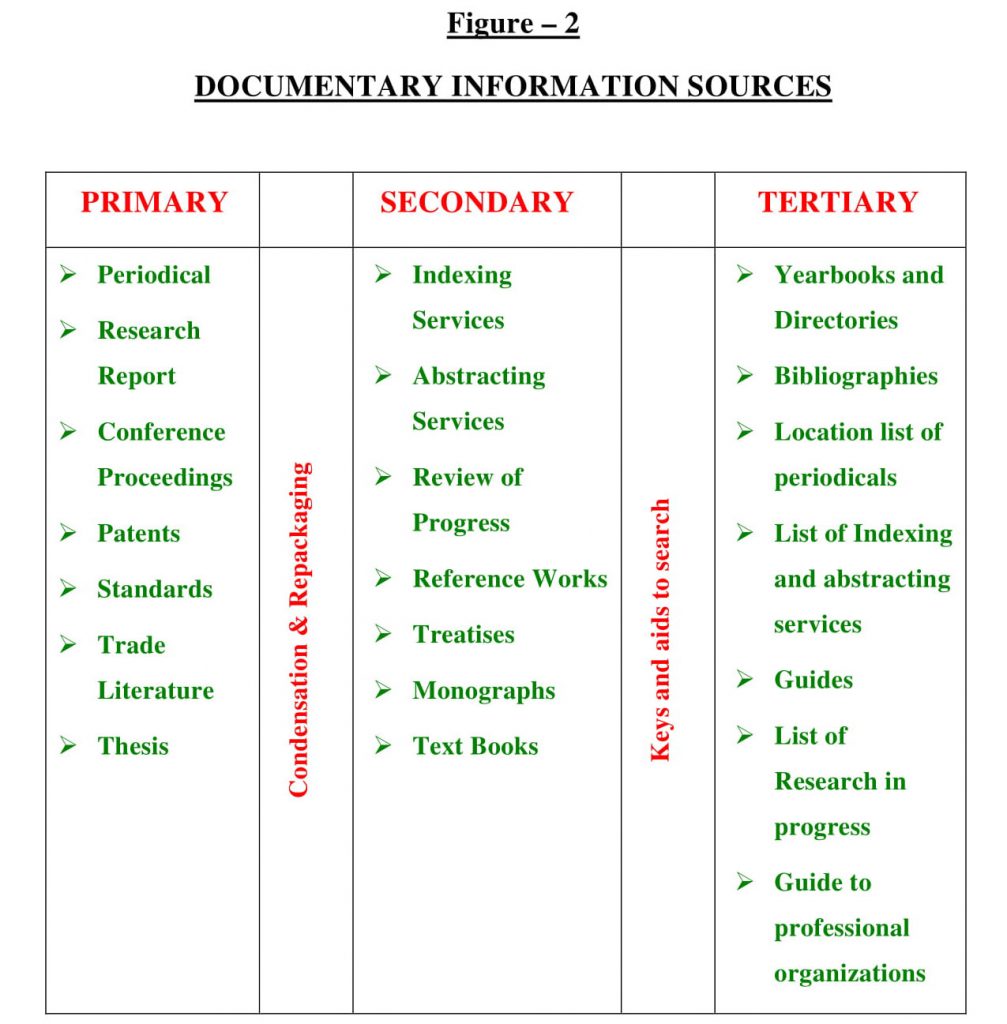
Tertiary sources of information are resources that compile and summarize data from primary and secondary sources. They serve as tools for quick reference, offering an overview or general summary of topics. Unlike primary sources, which provide original data or direct evidence, and secondary sources, which analyze or interpret primary data, tertiary sources aggregate and organize existing information for easy access. Common examples include encyclopedias, dictionaries, bibliographies, fact books, and almanacs. These sources are particularly important in research because they help researchers quickly locate relevant information, find further reading materials, or identify key topics and concepts. While tertiary sources may not offer in-depth analysis or original research, they are vital in providing a foundational understanding of a subject. Their accessibility and ability to distill complex information make them invaluable in academic and general research contexts. However, due to their summary nature, they are often considered less authoritative than primary or secondary sources and, therefore, should be used as starting points rather than the sole basis of academic inquiry.
What are Tertiary Sources of Information?
Tertiary sources of information are materials that provide consolidated and summarized data derived from primary and secondary sources. These sources do not present original research or firsthand accounts but instead offer an organized compilation of information that is easy to access and navigate. Tertiary sources are often used for quick reference and to gather an overview of a particular subject. They include materials such as encyclopedias, almanacs, dictionaries, bibliographies, indexes, and statistical yearbooks. For instance, an encyclopedia provides summarized information on various topics, presenting facts and general knowledge compiled from various secondary sources. Similarly, an almanac might offer statistics, historical events, and other factual data in a concise format. A bibliography, another example, is a list of sources on a particular subject or topic, helping researchers locate primary and secondary materials. While tertiary sources are invaluable for quickly gaining insight into a topic or finding related information, they are typically considered less authoritative than primary and secondary sources because they rely on summarizing and synthesizing existing data rather than providing new evidence or analysis.
Characteristics of Tertiary Sources of Information
Tertiary sources of information play a crucial role in research and knowledge acquisition by providing synthesized and easily accessible summaries of topics. These sources do not present original research or firsthand data but instead, aggregate information from primary and secondary sources into concise formats for quick reference. Understanding the characteristics of tertiary sources is vital for distinguishing them from primary and secondary sources and effectively utilizing them in research. Here are the defining characteristics of tertiary sources and how they contribute to the research process.
- Summary and Compilation of Information: Tertiary sources are essentially reference materials that summarize and compile existing information. They distill content from primary sources (original research or firsthand accounts) and secondary sources (interpretations or analyses of primary data) into easily digestible formats. For example, an encyclopedia provides a condensed summary of a particular subject, while a dictionary offers brief definitions and explanations of terms. These sources are designed for quick retrieval of key facts, making them a great starting point for general understanding or further research.
- Wide-ranging and Generalized Content: Tertiary sources tend to cover a broad range of topics or disciplines in a single resource. They are comprehensive in scope, often providing an overview of various subjects, making them useful for gaining a general understanding of unfamiliar topics. For instance, a comprehensive almanac might offer statistical data on various fields, from historical events to modern-day facts, while a bibliographic database indexes resources from multiple academic disciplines. This wide coverage contrasts with the narrower, more specialized focus of primary and secondary sources.
- No Original Research or Analysis: One of the most important characteristics of tertiary sources is that they do not present new data, original research, or in-depth analysis. Instead, they provide a collection of summarized information that is easily accessible. Tertiary sources serve as a starting point for research, offering essential facts and helping users navigate more detailed primary and secondary sources. For instance, a textbook may present an overview of historical events, but it will not introduce new interpretations or findings about those events.
- Easy Accessibility and Convenience: Tertiary sources are designed to be quick and convenient references for users. They are often organized alphabetically, chronologically, or categorically, allowing users to find the information they need with minimal effort. This feature makes tertiary sources particularly useful in both academic research and everyday situations where a broad understanding of a topic is needed. Resources like atlases, factbooks, and directories allow users to quickly locate basic information such as geographical data, statistics, or lists of key facts.
- Credibility and Reliability: Although tertiary sources aggregate information from primary and secondary sources, they may not always be as authoritative or reliable as the original sources. Since tertiary sources summarize content, there is always the possibility that the information has been simplified, altered, or taken out of context. It is crucial for researchers to evaluate the credibility of tertiary sources, especially when used in academic writing or professional work. For instance, while a well-established encyclopedia or a peer-reviewed database may be reliable, online databases or open-access websites may require further scrutiny.
- Examples of Tertiary Sources: Several types of materials qualify as tertiary sources, and they can be found across various formats, including print and digital. Some common examples of tertiary sources include:
- Encyclopedias: Comprehensive reference works that summarize knowledge on a wide range of topics, such as the Encyclopedia Britannica.
- Dictionaries: Books or digital platforms that provide definitions, meanings, and usage of words or terms, such as the Oxford English Dictionary.
- Almanacs: Publications that offer annual collections of facts, statistics, and records, such as the World Almanac.
- Indexes and Bibliographies: Listings or databases that provide references to primary and secondary sources, such as the Library of Congress Catalog or citation indexes.
- Atlases and Maps: Collections of geographic information, offering maps, charts, and data on countries, cities, or regions.
- Factbooks and Directories: Publications that compile statistical data on countries, organizations, or institutions, such as the CIA World Factbook.
- Role in the Research Process: Tertiary sources are often the first step in the research process. They provide a broad overview of a topic, helping researchers understand the basics before diving into more detailed or specialized resources. For instance, if a researcher is interested in studying the history of World War II, they might first consult an encyclopedia for an overview before exploring primary sources like war documents or secondary sources like books analyzing the conflict. Tertiary sources can also assist in finding secondary and primary sources for further exploration, making them an essential part of the research toolkit.
Tertiary sources of information are indispensable tools in academic and everyday research. They provide summarized, organized, and easily accessible content from primary and secondary sources, allowing users to gain an overview of a subject quickly. While they may not offer original research or in-depth analysis, tertiary sources are invaluable for providing a foundation of knowledge, guiding users to more detailed resources, and aiding in the search for further information.
Reliability of Tertiary Sources Compared to Primary and Secondary Sources
Tertiary sources of information are often considered less reliable than primary and secondary sources due to their summarizing nature. While they play a crucial role in providing quick overviews and consolidating information, they do not offer the same depth of analysis or firsthand evidence as primary sources or the interpretation of data seen in secondary sources. Tertiary sources typically aggregate data from various primary and secondary materials, which means the original context or nuanced details may be lost or simplified. As a result, the reliability of a tertiary source depends heavily on the accuracy and credibility of the sources it compiles.
Primary sources, such as original research studies, diaries, or historical documents, are generally considered the most reliable because they offer firsthand evidence and unaltered information directly from the source. Secondary sources, like scholarly articles or books that analyze primary data, provide interpretations and analyses that are also more specific and detailed than tertiary sources. In contrast, tertiary sources like encyclopedias, factbooks, or bibliographies are not as authoritative because they offer only summarized or extracted information without offering the depth, context, or original analysis that primary or secondary sources provide.
While tertiary sources can be valuable for gaining quick, broad insights or finding references to more detailed materials, they should not be relied upon as the sole source of information, especially in academic or research contexts. It’s always important to verify the facts presented in tertiary sources by consulting primary and secondary sources to ensure a more accurate and comprehensive understanding of the topic at hand. Thus, while tertiary sources are reliable for general background information, they are not suited for critical or detailed analysis, which requires a more direct engagement with primary or secondary materials.
How Tertiary Sources Contribute to the Research Process
Tertiary sources play an essential role in the research process by providing foundational knowledge, helping researchers organize their thoughts, and guiding them to more specialized and detailed materials. These sources are typically used in the early stages of research to gain a general understanding of a topic, identify key concepts, and locate further resources for in-depth investigation. While they do not offer original research or detailed analysis, tertiary sources consolidate and summarize information from primary and secondary sources, making them invaluable for laying the groundwork for more rigorous academic work.
One of the primary contributions of tertiary sources is offering a broad overview of a subject. For example, encyclopedias, dictionaries, and almanacs provide concise summaries that allow researchers to familiarize themselves with the basics of a topic without having to sift through numerous primary or secondary sources. This initial understanding is critical when embarking on more complex or specialized research, as it sets the stage for identifying gaps in knowledge and determining the direction of further inquiry.
Tertiary sources also help researchers find relevant primary and secondary materials by offering bibliographies, indexes, and citations that point to more in-depth sources. For instance, a bibliography in a scholarly dictionary or encyclopedia entry can direct the researcher to original studies, articles, or books that offer detailed analysis. This aspect of tertiary sources allows for efficient navigation through the vast amount of available information, saving time and providing a structured approach to research.
Tertiary sources are valuable for confirming facts, clarifying terminology, and establishing context. When researchers encounter unfamiliar terms or concepts, a dictionary or glossary can quickly provide definitions, while an almanac or statistical yearbook offers up-to-date factual data. This ensures that the researcher has accurate, verified information as a foundation for more detailed analysis, making the research process smoother and more efficient.
While tertiary sources are not suitable for drawing conclusions or performing in-depth analysis, they are indispensable for getting started, organizing research, and accessing key resources. By contributing to the initial stages of research, guiding the identification of relevant sources, and confirming basic facts, tertiary sources support the broader research process and help researchers focus their inquiries on more specialized, authoritative sources.
Advantages of Using Tertiary Sources Compared to Primary and Secondary Sources
Tertiary sources offer several advantages over primary and secondary sources, particularly in terms of accessibility, convenience, and the ability to provide a broad overview of a topic. While primary and secondary sources are invaluable for detailed research and analysis, tertiary sources are often more suitable for quickly acquiring basic information and understanding key concepts. Here are some key benefits of using tertiary sources in the research process.
- Ease of Access and Convenience: One of the primary advantages of using tertiary sources is their ease of access and convenience. Tertiary sources are designed to be user-friendly and are often organized for quick reference. Whether in the form of dictionaries, encyclopedias, or databases, these sources allow researchers to find information quickly without the need to sift through lengthy documents or complex analyses. For example, a researcher looking for the definition of a term can consult a dictionary in seconds, whereas finding the same information in a primary or secondary source might involve reading through several pages of text or even an entire article. This time-saving aspect makes tertiary sources invaluable for users seeking basic facts or summaries without the need for detailed exploration.
- Broad Overview of a Topic: Tertiary sources provide broad overviews of a topic, which is particularly helpful when beginning research on a new subject. They condense the essential aspects of a topic into concise entries, presenting key facts, major events, or common theories without overwhelming the reader with unnecessary detail. For instance, an encyclopedia entry on climate change will summarize the history, causes, and effects of climate change, offering a solid foundation for further exploration. This general overview helps researchers develop a foundational understanding before delving deeper into more specific or complex primary and secondary sources. In contrast, primary and secondary sources tend to focus on narrower aspects of a subject, requiring more effort to understand the broader context.
- Time Efficiency: Tertiary sources are a valuable resource for researchers who need to quickly gather basic information or confirm facts. They provide quick access to summarized content, allowing researchers to avoid spending hours searching through multiple primary and secondary sources. For example, a student working on a history paper might use an almanac to verify a historical date or reference a dictionary to clarify a term. This quick retrieval of essential information saves time and helps researchers focus their efforts on more specialized tasks, such as analyzing primary sources or critically engaging with secondary research. This time-saving benefit is particularly important when researchers have tight deadlines or when a broad understanding of a topic is needed rapidly.
- Guiding Further Research: Another significant advantage of tertiary sources is that they serve as gateways to primary and secondary sources. Many tertiary sources, such as bibliographies, indexes, and reference books, provide references to primary and secondary materials, which are invaluable for researchers looking to conduct more detailed studies. A researcher might start by reading a general entry in an encyclopedia to gain an overview of a topic and then consult the bibliographies within that entry to locate specialized primary or secondary sources for deeper investigation. Therefore, tertiary sources provide immediate information and direct researchers toward additional resources that will enrich their understanding and help them build upon their research.
- Reliable and Credible for Basic Information: While tertiary sources do not offer original research or in-depth analysis, they are often created by experts who draw upon reputable primary and secondary sources. As a result, they are reliable for confirming basic facts, terminology, or general concepts. For example, a dictionary is a trusted resource for accurate definitions, and an encyclopedia is an established reference for comprehensive overviews of topics. Since tertiary sources are built from well-regarded primary and secondary materials, they provide a level of reliability for introductory research or fact-checking that makes them indispensable tools in academic and professional settings.
- Organization and Structure: Tertiary sources are often highly structured and organized, making it easy for researchers to find the information they need. Whether they are presented alphabetically, chronologically, or categorically, these sources are designed with user accessibility in mind. For instance, an atlas provides maps organized by region, while a statistical yearbook presents data in clear, indexed formats. This organization allows researchers to quickly navigate through large volumes of information and pinpoint specific data or facts without unnecessary complexity. This feature contrasts with the often dense or narrative format of primary and secondary sources, which may require more effort to extract specific information.
- Versatility Across Disciplines: Tertiary sources are versatile and can be useful across various fields of study. Whether it’s a legal researcher consulting a law dictionary, a history student reading an almanac for historical events, or a scientist referencing a scientific factbook, tertiary sources serve many different disciplines. This versatility is especially valuable in multidisciplinary research, where a researcher might need to consult multiple types of tertiary sources to understand a variety of perspectives. The ability to quickly access a wide range of information from diverse fields allows tertiary sources to facilitate cross-disciplinary research and broaden the scope of inquiry.
Tertiary sources offer distinct advantages over primary and secondary sources, making them an essential tool in the research process. Their ease of access, ability to provide broad overviews, time efficiency, and structured organization help researchers quickly obtain foundational information. Tertiary sources are also invaluable for guiding further research by pointing to primary and secondary materials. While they do not offer original analysis or detailed insights, their reliability for basic facts and clarity of presentation make them indispensable in the early stages of research. By serving as quick-reference tools and offering clear pathways to more detailed resources, tertiary sources play a crucial role in helping researchers build a solid base of knowledge, enabling them to move forward with more in-depth studies.
How Tertiary Sources Help in Understanding Complex Concepts or Unfamiliar Topics
Tertiary sources are invaluable when it comes to understanding complex concepts or unfamiliar topics. Their primary function is to provide concise, summarized, and organized information, which makes them an excellent starting point for those who are new to a subject or seeking to clarify a topic. By synthesizing information from primary and secondary sources, tertiary sources offer a broad overview that helps researchers and learners build a foundational understanding before diving into more detailed or specialized materials.
One of the key ways in which tertiary sources aid in comprehending complex concepts is by breaking down difficult ideas into simpler terms. Resources like encyclopedias, dictionaries, or glossaries define terms and explain concepts in a clear, accessible manner. For example, if someone is unfamiliar with a term in philosophy or science, a dictionary or an academic glossary can provide an immediate definition, enabling the reader to grasp the meaning of the term quickly. This is especially helpful when encountering jargon or technical language that may be intimidating in more advanced texts.
Tertiary sources also organize information in a structured way, which can help users make sense of vast or intricate topics. They often categorize information into clear headings, sections, or entries, guiding users to the most important aspects of a subject. For example, an encyclopedia article on climate change will typically outline the causes, effects, and solutions to the issue in a logical and systematic manner. This organization enables users to approach complex topics step by step, gradually building their understanding rather than feeling overwhelmed by dense, unstructured information. Moreover, tertiary sources often provide historical context, summaries of key debates, and essential background information that help users frame their understanding of a subject. When faced with an unfamiliar topic, having access to background information, such as the history of a scientific discovery or an overview of a political movement, can provide crucial insights that make the topic more comprehensible. For example, an almanac or timeline may present a series of events related to a particular issue, allowing the reader to see how the issue has developed over time.
In addition to offering clarity and structure, tertiary sources often direct readers to primary and secondary sources for further study. By providing bibliographies, references, or lists of recommended readings, they serve as guides to more detailed, in-depth research. If a researcher encounters a concept in a tertiary source that sparks further interest or requires more exploration, they can use the citations within that source to locate primary studies, academic books, or journal articles that offer a deeper, more nuanced examination of the topic.
Limitations of Relying on Tertiary Sources in Academic or Professional Work
While tertiary sources provide valuable overviews and easy access to summarized information, they have significant limitations when it comes to academic or professional work, where in-depth analysis, original research, and comprehensive evidence are typically required. These sources, which include encyclopedias, dictionaries, factbooks, and bibliographies, are useful for gaining a basic understanding of a topic. Still, they are not considered authoritative or detailed enough for rigorous academic or professional inquiries. Here are some of the key limitations of relying on tertiary sources in these contexts:
- Lack of Depth and Original Analysis: Tertiary sources are designed to summarize and condense information from primary and secondary sources, often omitting the depth, critical analysis, and original perspectives found in these other types of materials. For academic work that requires detailed discussion, hypothesis testing, or theoretical development, tertiary sources fall short because they do not provide the nuanced interpretations or original contributions necessary for higher-level research. They present only a surface-level overview, making them inadequate for deep analysis or for supporting complex arguments.
- Risk of Oversimplification: In order to make complex topics accessible, tertiary sources often simplify or generalize information. While this is helpful for gaining a quick understanding, it can lead to the omission of important details, context, or controversies. This oversimplification can result in a lack of accuracy or incomplete information, especially in fields that require precise and nuanced understanding. For example, an encyclopedia entry on a scientific concept might exclude important caveats or recent developments, which would be found in primary or secondary sources.
- Dependence on Secondary Sources: Tertiary sources typically rely on the aggregation and summarization of secondary materials, which in turn are based on primary sources. This chain of reliance means that tertiary sources are far removed from the original research or firsthand accounts. As a result, they may inadvertently perpetuate errors, biases, or misinterpretations found in the secondary sources they draw upon. For rigorous academic work, using primary and secondary sources directly is essential to ensure the reliability and authenticity of the information being cited.
- Limited Scope for Contemporary or Specialized Topics: Tertiary sources may not always provide up-to-date or highly specialized information, particularly for contemporary or niche topics. Since these sources are designed to be comprehensive summaries, they may not include the most recent research or cutting-edge developments in rapidly changing fields such as technology, medicine, or social sciences. Academic and professional work often requires the latest data and theories, which can only be found in primary and secondary sources.
- Not Acceptable for Citations in Scholarly Work: In academic research, primary and secondary sources are generally preferred because they offer more reliable, original, and detailed information. Tertiary sources are typically not considered credible enough to be cited as authoritative references in scholarly writing. Citing tertiary sources in academic papers can lead to a lack of credibility or depth in the argument being made, as these sources are seen as secondary to the original research and interpretations found in primary or secondary materials.
- Lack of Specificity: Tertiary sources often provide general information about a wide range of topics, which can be too broad for specific academic or professional inquiries. For example, an encyclopedia article might offer a general history of a scientific theory but lack detailed insights into specific experiments, findings, or debates within that field. Academic or professional work often requires highly specific data, theories, or case studies, which tertiary sources are not equipped to provide.
While tertiary sources are valuable for providing quick, summarized information and helping orient researchers to a new topic, they are insufficient for detailed academic or professional work. Their lack of depth, simplification of complex issues, and reliance on secondary sources make them inadequate for rigorous, original research. To ensure accuracy, credibility, and a comprehensive understanding of a subject, it is essential to rely on primary and secondary sources for academic or professional purposes.
The Importance of Tertiary Sources in Everyday Life Beyond Academic Research
Tertiary sources play a significant role in everyday life, far beyond the confines of academic research. These sources, such as dictionaries, encyclopedias, almanacs, and factbooks, provide accessible and easily digestible information that is useful for general knowledge, decision-making, and problem-solving in various everyday contexts. Whether we are trying to settle a trivia question, confirm a piece of historical information, or understand a term we encountered in conversation, tertiary sources offer quick and reliable answers. For instance, a dictionary is frequently consulted to clarify the meaning of unfamiliar words, while an encyclopedia entry can help people understand complex issues such as climate change or technological advancements in a simplified manner.
In addition, tertiary sources are invaluable tools for staying informed about the world. Almanacs, statistical yearbooks, and factbooks compile data on everything from global demographics to economic trends, making it easier for individuals to access important information at a glance. These resources can be particularly helpful for those trying to make informed decisions about personal finance, travel, or even health and wellness. For example, a quick look at a country’s GDP or population statistics can provide context when evaluating international news or planning a trip.
Tertiary sources also play a role in improving everyday communication by offering authoritative references and standard knowledge. Whether it’s preparing for a presentation, engaging in casual conversation, or participating in community discussions, having access to clear and reliable background information from tertiary sources can help individuals express themselves more confidently and accurately. They also help bridge knowledge gaps, ensuring that people can engage meaningfully in various social, professional, and personal settings.