What is Comparative Librarianship?
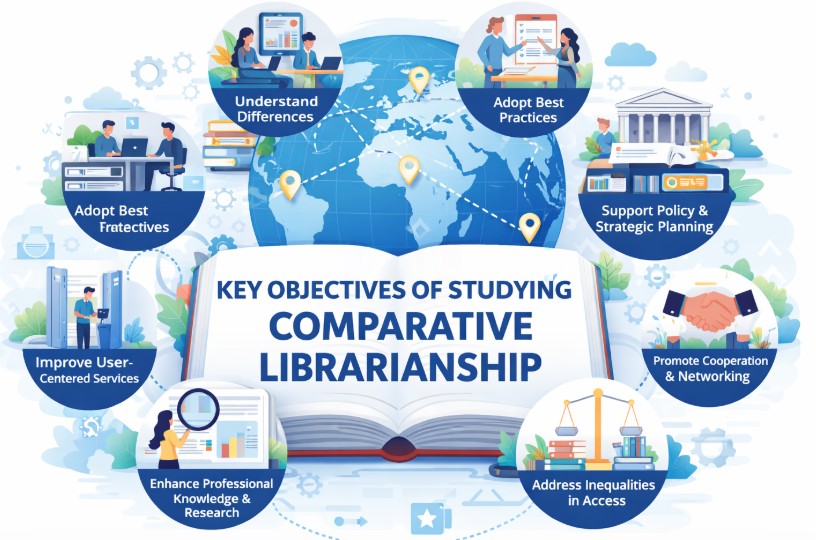
Comparative Librarianship is a specialized area within Library and Information Science that focuses on the systematic study and comparison of library systems, services, practices, and policies across different countries, regions, or cultural settings. Its main goal is to identify both similarities and differences among libraries to understand how social, economic, political, and technological factors influence their development and functioning. For example, comparing university libraries in Bangladesh with those in developed countries like the United States may reveal differences in access to digital resources, funding levels, and technological infrastructure. While many academic libraries in developed nations provide extensive access to online databases and automated services, libraries in developing countries may still be in the process of transitioning to full digital integration.
Comparative Librarianship also examines how libraries respond to user needs in various contexts. For instance, public libraries in Scandinavian countries often emphasize community engagement and lifelong learning programs, whereas libraries in South Asian contexts may focus more on academic support and access to textbooks. Additionally, the adoption of technologies such as RFID-based circulation systems, self-check kiosks, and remote access tools can vary widely. Some libraries have fully automated systems, while others are gradually implementing such innovations based on budget constraints and policy priorities.
This field is both analytical and practical, as it not only evaluates existing systems but also supports the improvement of local library services by adopting best practices from other contexts. For example, a university library in Bangladesh might implement remote access systems like OpenAthens after observing their successful use in international institutions, thereby enhancing off-campus access to electronic resources. In our increasingly interconnected world, Comparative Librarianship plays a vital role in promoting international cooperation, innovation, and the development of more effective, inclusive, and user-centered library services.
Importance of Comparative Librarianship in the Global Information Environment
Comparative Librarianship plays a crucial role in the global information environment by enabling libraries to learn from one another and adapt to rapidly changing technological, social, and educational needs. In today’s interconnected world, where information flows across borders through digital platforms, libraries are no longer isolated institutions; instead, they function as part of a global knowledge network. By comparing library systems, services, and policies across different countries, librarians can identify best practices and implement them in their own contexts. For example, many libraries in developing countries have adopted digital resource management systems and remote access tools after observing their effectiveness in institutions in Europe and North America, thereby improving access to scholarly information for users beyond physical library spaces.
Comparative Librarianship helps address disparities in information access by highlighting gaps between developed and developing library systems. Through such comparisons, policymakers and library professionals can design more inclusive strategies, such as expanding digital collections or introducing community-based services. For instance, while some countries have advanced digital libraries with AI-based search tools, others are still working toward basic automation; understanding these differences allows for targeted development and international support. It also promotes innovation, as libraries can experiment with new ideas, such as RFID-based circulation systems, open access initiatives, or user-centered service models based on successful global examples.
In addition, Comparative Librarianship strengthens international collaboration and standardization. Libraries across the world increasingly rely on shared cataloguing standards, metadata practices, and information exchange systems, which are often developed through comparative understanding. For example, participation in global databases and indexing services requires alignment with international standards, which libraries achieve by studying and adapting practices from other countries. Ultimately, Comparative Librarianship ensures that libraries remain relevant, efficient, and responsive in the global information environment by fostering continuous learning, cooperation, and the effective use of emerging technologies.