What is Entry?
In Library and Information Science (LIS), the term entry refers to the systematic record or heading under which the bibliographic details of a document are arranged and displayed in a library catalogue or database to facilitate identification, location, and retrieval of information resources. An entry represents a specific access point, such as an author’s name, the title of a work, a subject heading, or a corporate body, through which users can search for and locate materials in a library. It serves as a structured description of a document, prepared according to established cataloguing rules and standards, ensuring consistency and uniformity across library catalogues.
Traditionally, in a card catalogue system, an entry appeared on a separate catalogue card, such as a main entry card, an added entry card, or a subject entry card. For example, for a book titled “Introduction to Library Science” written by S. R. Ranganathan, the main entry would be made under the author’s name “Ranganathan, S. R.”, while added entries might be prepared under the title and relevant subject headings like “Library Science-Introduction.” Each entry would contain essential bibliographic information such as the author, title, edition, place of publication, publisher, year, and physical description, enabling users to identify the exact document available in the library.
In modern online catalogues (OPACs) and automated library systems, the concept of entry has evolved but remains fundamentally the same. Instead of physical cards, entries exist as digital records within bibliographic databases, often encoded in formats such as the MARC standard. For instance, when a user searches an OPAC by author, title, or subject, the system retrieves the corresponding entries that have been indexed under those access points. A single bibliographic record may generate multiple entries automatically, allowing users to approach the same document from different directions, such as author search, title keyword search, or subject browsing.
Importance of Entry as a Fundamental Element in Library Cataloguing
Entry is considered a fundamental element in library cataloguing because it forms the primary mechanism through which library materials are organized, identified, and accessed by users. In cataloging, an entry serves as a structured access point—such as author, title, subject, or corporate body—under which the bibliographic details of a document are systematically arranged. Without proper entries, a library catalogue would be merely a list of documents without any meaningful order, making it difficult for users to locate or identify the resources they need. Thus, the entry provides the basic framework that transforms bibliographic information into a usable retrieval tool.
One of the main reasons entry is fundamental is its role in ensuring effective information retrieval. Users approach the library catalogue with different search intentions: some know the author’s name, others remember only the title, while many search by subject. Entries enable a single document to be represented through multiple access points, allowing users to find the same resource via different search paths. For example, a book on digital libraries can be accessed through an author entry, a title entry, or a subject entry such as “Digital Libraries.” This multiplicity of entries increases the accessibility and usability of the catalogue.
Entry is also essential for maintaining consistency and standardization in library catalogues. Cataloguing rules and standards such as AACR2 and RDA provide guidelines for selecting and formulating entries so that similar materials are represented uniformly. Consistent entries prevent confusion caused by variations in author names, titles, or subject terms. For instance, standardized author entries ensure that all works by the same author are brought together in the catalogue, even if the author’s name appears in different forms in different publications. Furthermore, entry plays a crucial role in bibliographic control and the organization of resources. By systematically organizing documents under chosen entries, libraries can efficiently control and manage their collections. Entries facilitate the collocation of related works, distinguish between similar titles or authors, and provide clear identification of editions and formats. In both traditional card catalogs and modern online public access catalogs (OPACs), entry remains the backbone of catalog structure, even though the physical form has evolved.
Different Types of Entries Used in Library Science
In Library and Information Science, entries are the access points under which bibliographic records are organized in a library catalogue to help users identify and locate information resources. To accommodate diverse user search approaches, various types of entries are utilized. Each type serves a specific purpose in ensuring effective information retrieval.
1. Main Entry
The main entry is the principal entry under which the complete bibliographic record of a document is prepared. It usually provides the fullest description of the item and serves as the primary access point in the catalogue. Traditionally, the main entry is made under the author’s name; if no personal author exists, it may be made under a corporate body or title. For example, a book written by S. R. Ranganathan would have its main entry under “Ranganathan, S. R.” The main entry brings together all essential information about the document in one place.
2. Added Entry
An added entry is a supplementary access point provided in addition to the main entry. Added entries are made under the names of co-authors, editors, translators, titles, or series. Their purpose is to offer alternative ways for users to locate a document when they do not know the main entry. For instance, a book edited by one person but written by another may have added entries under the editor’s name and the title of the book.
3. Subject Entry
A subject entry represents the intellectual content of a document and is made under appropriate subject headings. It enables users to find materials on a particular topic, regardless of author or title. For example, a book on information literacy may have a subject entry under “Information Literacy.” Subject entries are especially important for thematic searches and academic research.
4. Title Entry
A title entry is made under the title of the document and is particularly useful when users remember only the title or when a work has no identifiable author. Title entries are common for anonymous works, reference books, or publications known primarily by their titles, such as encyclopedias or dictionaries.
5. Cross-Reference Entry
A cross-reference entry guides users from one term to another related or preferred term in the catalogue. It includes references such as see and see also. For example, a cross-reference may direct a user from “E-learning” to “Online Education.” Cross-reference entries help users navigate the catalogue more effectively and avoid dead ends.
6. Analytical Entry
An analytical entry is prepared for a part of a larger work, such as an article in a journal, a chapter in an edited book, or a paper in conference proceedings. It allows individual components of a work to be accessed independently. For example, a significant chapter on digital preservation in an edited volume may receive an analytical entry under its author or subject.
7. Series Entry
A series entry is made under the name of a series when a publication forms part of a series. This type of entry helps users locate all works published within the same series. For instance, books published under a series like “Library and Information Science Textbook Series” may have a series entry to collocate them.
In summary, the various types of entries (main, added, subject, title, cross-reference, analytical, and series entries) collectively provide multiple access points to library resources. Their combined use ensures that users can retrieve information efficiently, regardless of whether they search by author, title, subject, or other bibliographic elements.
Rules Governing the Preparation of Entries in Library Catalogues
The preparation of entries in library catalogues is governed by standardized cataloguing rules and principles to ensure uniformity, consistency, and effective information retrieval. These rules guide librarians in selecting the appropriate access points (such as author, title, or subject) and in formulating entries in a standardized form so that users can locate materials easily, regardless of the catalogue they consult. Without such governing rules, catalogues would become inconsistent and confusing, reducing their usefulness.
Traditionally, one of the most influential sets of rules governing entries has been the Anglo-American Cataloguing Rules (AACR and AACR2). AACR2 provided detailed instructions on how to determine the main entry, added entries, and cross-references, as well as how to record names of authors, corporate bodies, titles, editions, and publication details. For example, AACR2 specified that a work by a single personal author should generally be entered under the author’s name, while works by corporate bodies should be entered under the name of the responsible organization. These rules helped bring together all works by the same author under a uniform heading, ensuring consistency across catalogues.
In recent years, Resource Description and Access (RDA) has replaced AACR2 in many libraries and now plays a major role in governing the preparation of entries. RDA is based on conceptual models such as FRBR (Functional Requirements for Bibliographic Records) and focuses on user tasks—find, identify, select, and obtain. Under RDA, entries are created with greater emphasis on relationships between works, expressions, manifestations, and items. For instance, RDA allows more flexible and accurate representation of authors, editors, and related works, making catalogue entries more suitable for digital and online environments.
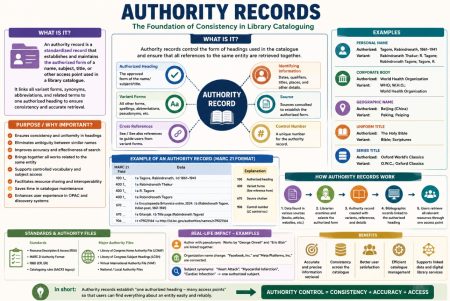
Apart from AACR2 and RDA, the preparation of entries is also influenced by cataloguing principles such as the principle of uniformity, consistency, and user convenience. Authority control rules ensure that names, subjects, and titles are used in a standardized form across the catalogue. For example, an author known by different name forms will have one authorized heading, with cross-references guiding users from variant forms to the correct entry. Subject entries are governed by standardized tools such as subject heading lists and classification schemes to maintain consistency.
In automated and online catalogues, machine-readable standards such as MARC (Machine-Readable Cataloging) further govern how entries are structured and encoded. While MARC does not decide what the entry should be, it defines how bibliographic data are recorded and displayed in library systems, ensuring interoperability and data sharing between libraries.
Importance of Correct Choice of Main Entry in Library Cataloguing
The correct choice of main entry is crucial in library cataloguing because it determines the primary access point under which a bibliographic record is organized and through which a document is chiefly identified in the catalogue. The main entry serves as the central reference for a resource, carrying the most complete bibliographic description and linking all related added entries and references. If the main entry is chosen incorrectly, the logical arrangement of records is disrupted, making it difficult for users to locate materials efficiently and undermining the overall effectiveness of the catalogue.
One of the key reasons the correct main entry is essential is its role in collocating works by the same author or corporate body. A properly selected main entry brings together all works of an author under a single, standardized heading, allowing users to see the full range of resources associated with that author. For example, if books written by the same author are inconsistently entered under different name forms or incorrect headings, users may not retrieve all relevant works in a single search. Correct main entry selection, supported by authority control, ensures consistency and completeness in retrieval.
The main entry also plays a significant role in ensuring accuracy and clarity in bibliographic identification. It helps distinguish between works with similar titles or multiple editions by clearly associating each work with its responsible author or body. For instance, textbooks with common titles such as Introduction to Management can be easily differentiated when correctly entered under their respective authors. An incorrect main entry may lead to confusion, misidentification of resources, or duplication of records in the catalogue.
Furthermore, the correct choice of main entry supports efficient cataloguing and system integrity, especially in automated library environments. Many cataloguing operations, such as record linking, authority file management, and data sharing between libraries, depend on the accuracy of the main entry. In online public access catalogues (OPACs), a well-chosen main entry ensures that search results are logically grouped and that relationships between works, authors, and subjects are correctly displayed. Errors in the main entry selection can propagate through shared databases, affecting multiple catalogues.
How Does Improper Entry Affect Library Users?
In Library and Information Science, entry is the foundation upon which library catalogues are built. Entries—such as author, title, subject, and added entries—serve as the main access points that connect users to library resources. A well-prepared entry ensures that users can easily identify, locate, and retrieve information. Conversely, improper entry-whether incorrect, inconsistent, incomplete, or poorly standardized-can significantly hinder the effectiveness of a library catalogue.
- Difficulty in Locating Information: One of the most immediate effects of improper entry is the difficulty users face in finding required materials. When author names, titles, or subject headings are incorrectly recorded or inconsistently formulated, users may not retrieve relevant results even though the resources exist in the library. For example, if an author’s name appears in multiple forms without proper authority control, a user searching under one form may miss several important works. This creates frustration and wastes valuable time, particularly for students and researchers working under deadlines.
- Incomplete and Inaccurate Search Results: Improper entry often leads to incomplete or inaccurate search outcomes. Missing added entries, incorrect subject headings, or poorly assigned main entries prevent users from accessing all relevant materials on a topic. A user searching by subject may retrieve only a few items, while many others remain hidden due to faulty entries. This negatively affects academic work, as users may unknowingly base their research on incomplete information.
- Confusion and Misidentification of Resources; Incorrect or unclear entries can also cause confusion and misidentification of library materials. Users may struggle to distinguish between works with similar titles, different editions, or multiple authors. For instance, textbooks with common titles may appear identical in the catalogue if entries are not properly constructed. This can lead users to select unsuitable or outdated materials, reducing the quality and reliability of their academic or research output.
- Loss of User Confidence in the Catalogue: Repeated failure to locate materials due to improper entry can result in a loss of trust in the library catalogue. Users may begin to assume that the library does not own relevant resources or that the catalogue system is unreliable. As a result, they may avoid using the catalogue independently and rely heavily on library staff for assistance. This undermines the purpose of the catalogue as a self-service discovery tool and reduces user satisfaction.
- Reduced Effectiveness of Online Catalogues: In modern automated library systems and OPACs, improper entry has an even broader impact. Online catalogues rely heavily on accurate metadata for keyword searching, filtering, and browsing. Incorrect entries limit search precision and reduce the effectiveness of advanced search features. Consequently, users may miss valuable resources that could support learning, teaching, and research, even though the library holds them.
Improper entry adversely affects library users by obstructing access to information, causing confusion, producing incomplete search results, and diminishing confidence in the library catalogue. Since entries are the primary link between users and library collections, their accuracy and consistency are crucial. Careful application of cataloguing rules, authority control, and regular catalogue maintenance are essential to prevent these problems. Ultimately, well-prepared entries enhance user satisfaction and ensure that the library fulfills its core mission of providing efficient and reliable access to information.
How Does Entry Support Subject Access in Libraries?
Entry plays a central role in supporting subject access in libraries by providing organized and systematic access points through which users can locate information based on topics or areas of knowledge. In Library and Information Science, subject access is primarily achieved through subject entries, which represent the intellectual content of documents rather than their authorship or titles. Many library users begin their search with a subject or research topic in mind, and well-prepared subject entries enable them to retrieve all relevant materials related to that topic from the library collection.
Subject entries support effective information organization by grouping together resources that deal with the same subject, even if they differ in author, format, or date of publication. Through careful subject analysis, cataloguers identify the main themes of a document and assign appropriate subject headings as entries. This ensures that books, journal articles, and digital resources on a similar topic can be accessed collectively. As a result, users are able to gain a comprehensive view of the available literature on a particular subject area.
Another important way entry supports subject access is through the use of standardized and controlled subject headings. Controlled vocabularies ensure consistency by using authorized terms for specific concepts and linking related or synonymous terms through cross-references. This helps users overcome differences in terminology and language. For example, materials discussing the same concept but using different expressions can still be retrieved under a single standardized subject entry, making subject searching more accurate and reliable.
Entry also enhances subject access by improving discovery and browsing in both traditional and digital library catalogues. In card catalogues, subject entries allowed users to browse all materials filed under a specific subject heading. In modern online public access catalogues (OPACs), subject entries support advanced searching, filtering, and browsing functions. Accurate subject entries ensure that users retrieve relevant results and are able to discover additional resources that may not appear in simple keyword or author searches.
Subject access supported by entry is particularly important for academic research and learning. Researchers often explore topics broadly before narrowing their focus, and subject entries allow them to trace related works, understand the scope of a subject, and identify authoritative resources. This is especially useful in interdisciplinary research, where relevant materials may be scattered across different fields but can be brought together through effective subject entries.
The success of subject access ultimately depends on the accuracy and consistency of entries. Proper application of cataloguing rules, subject heading lists, and authority control ensures that subject entries accurately reflect the content of documents. When entries are well-prepared and regularly maintained, users can rely on the catalogue as an effective tool for subject-based information retrieval. Thus, entry plays a vital role in enabling subject access in libraries by connecting users with relevant knowledge in a structured and user-friendly manner.