Introduction – What does a library catalogue help users do?
One student needs a specific book from a course reading list. Another is researching climate change in Bangladesh and wants to see what the library has on the topic. The library catalogue helps both students, even though they start with different questions. The first can search by title or author to find the assigned book, an example of a known-item search. The second can search by subject or keyword to discover relevant books, reports, and other materials.
Once the results appear, the catalogue helps readers decide what to use and how to get it. The author, edition, and publication year can help a student confirm that a record describes the book they need, while a summary or table of contents can help them judge whether it covers their topic. For a print book, the catalogue can show whether a copy is available and give the call number needed to locate it on the shelf. For an e-book, it can provide a link to read it online.
Cutter’s Three Objectives of a Library Catalogue
In Rules for a Printed Dictionary Catalogue (1876), Charles Ammi Cutter described three things a catalogue should help readers do. It should help them find a book from the information they already know, see what the library holds, and choose a book that suits their purpose.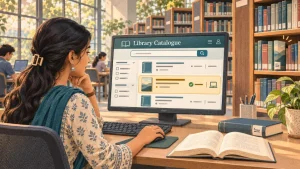
- Help the reader find a book: A catalogue should let readers begin with the author, title, or subject. These are access points, or ways of finding a catalogue record. A student looking for an assigned book can search by its title. A student who needs a book about coastal flooding in Bangladesh can search by subject even if they have no particular title in mind.
- Show what the library holds: A catalogue should bring together the library’s holdings by a particular author, on a particular subject, or of a particular kind, such as poetry or biographies. In cataloguing, bringing related records together is called collocation. A student might first find one book about coastal flooding, then use its subject heading to see what else the library holds on the topic.
- Help the reader choose a suitable book: A catalogue should provide enough information for readers to choose an edition or decide whether a book’s content and approach suit their needs. A student can check the edition statement to find the revised edition assigned in class. When choosing between two books on coastal flooding, the student might use the catalogue notes to distinguish a broad introduction from a detailed study of one region.
Five User Tasks in the Modern Online Catalogue
The IFLA Library Reference Model describes five tasks that users carry out when working with information about library resources: Find, Identify, Select, Obtain, and Explore (Riva et al., 2024, pp. 14). An Online Public Access Catalogue (OPAC) can support each of these tasks. Readers may carry out several tasks together or return to a previous task as their search develops.
- Find: The Find task involves searching for resources that match an information need. A user may search by title, author, keyword, or subject heading. For example, a student researching coastal flooding in Bangladesh can enter coastal flooding Bangladesh as keywords to find relevant books and reports.
- Identify: The Identify task involves determining what a catalogue record describes and distinguishing it from similar records. If two records have the same title, the student can check the author, edition statement, and publication year to determine whether they describe different books or different editions of the same book.
- Select: The Select task involves deciding whether a resource is suitable for a particular purpose. A reader may consider its subject coverage, language, format, or level of detail. For example, the student can compare tables of contents and choose a book that includes case studies of how coastal communities respond to flooding.
- Obtain: The Obtain task involves gaining access to the resource itself. For a printed book, the catalogue can show whether a copy is available and provide the location and call number needed to retrieve it. For an e-book, the catalogue may provide a link to the full text, which the student can open after signing in if required.
- Explore: The Explore task involves discovering resources by following connections in the catalogue. For example, the student can follow a linked subject heading in a book record to discover other works on flood management. These works may introduce a more focused research topic, such as community-based flood preparedness.
Functions of a Library Catalogue
A library catalogue helps readers discover the resources a library holds or makes available. It provides access points, such as titles, authors’ names, and subject headings, that users can search to retrieve catalogue records. A student who knows the title of an assigned textbook can look it up directly. A student researching coastal flooding in Bangladesh can begin with a keyword or subject search to discover relevant books and reports.
A catalogue also brings related resources together, a function known as collocation. Charles Ammi Cutter identified this function as a way to show what a library holds by a particular author, on a particular subject, or in a particular kind of literature (Cutter, 1876, p. 55). For example, two books may use different terms in their titles to describe coastal flooding. If both records use the same subject heading, a reader can retrieve them together through a subject search.
Catalogue records support both identification and selection. As the IFLA Library Reference Model explains, identifying a resource involves recognising what a record describes, while selecting a resource involves judging whether it meets the reader’s needs. A student can use the edition statement and publication year to distinguish two editions of a textbook. For a research assignment, a summary or table of contents can help the student choose a book that includes case studies from coastal Bangladesh.
The catalogue also helps readers locate and access resources. For a printed book, it can show which branch or collection holds a copy, whether that copy is available, and which call number to look for on the shelf. For an e-book, the record may link to the full text or to the platform through which the library provides access.
An Online Public Access Catalogue (OPAC) can support exploration by making relationships between resources visible. Readers can follow a linked subject heading, an author’s name, or a series title to discover related works. A student who begins with a broad search on coastal flooding might find studies on community warning systems and use those studies to develop a more focused research question.