The Role of Authority Records in Information Retrieval
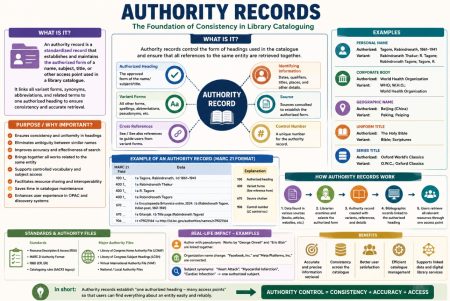
Authority records are essential for effective information retrieval, enabling users to find relevant resources accurately, consistently, and efficiently. In library catalogs, the names of authors, organizations, subjects, and titles often appear in various forms due to spelling variations, name changes, translations, abbreviations, or different cataloging practices. Without authority records, these variations can lead to related resources being scattered across multiple catalog entries, making it challenging for users to find complete and accurate information. Authority records address this issue by establishing a single authorized access point and linking all alternative forms to it.
One of the primary functions of authority records is to enhance search precision. They ensure that all resources associated with a particular entity can be retrieved under a standardized heading. For example, works authored by Muhammad Yunus may also be referenced as Mohammad Yunus or M. Yunus in various publications. An authority record designates one authorized form and links all variant names, allowing users to retrieve every relevant work, regardless of the search term used.
Authority records also improve search recall by consolidating records that might otherwise remain scattered. Take the famous detective character Sherlock Holmes, for instance. Numerous editions, translations, adaptations, and critical studies exist under slightly different titles and descriptions. Through authority control, these related resources can be linked to authorized headings, enabling users to discover a comprehensive collection of materials in a single search.
Another important function of authority records is distinguishing between entities with identical or similar names. Many authors share common names, which can lead to confusion in library catalogs. For example, there are several authors named A. Rahman or S. Ahmed. Authority records include distinguishing details such as birth year, profession, institutional affiliation, or unique identifiers to ensure that bibliographic records are accurately assigned to the correct individual. This prevents users from retrieving publications by different authors with similar names.
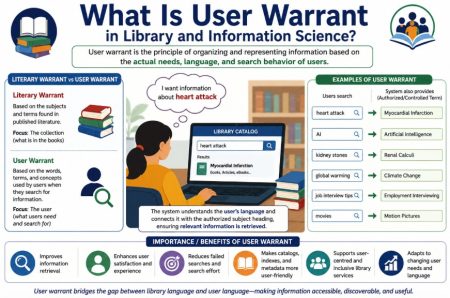
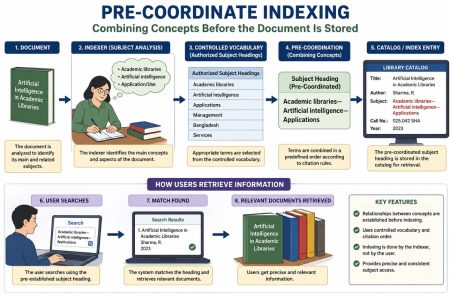
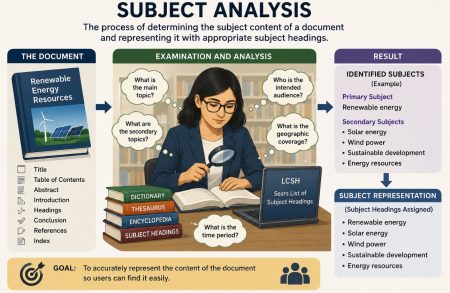
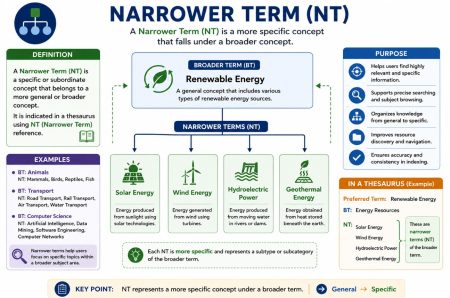
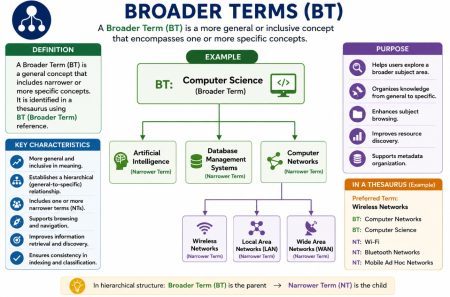
Authority records are also valuable for subject retrieval. Different users often search for the same concept using various terms. For instance, one person may search for “Global Warming,” while another looks for “Climate Change.” Authority records connect preferred and non-preferred subject terms through cross-references, guiding users to the authorized subject heading and ensuring that all relevant materials are retrieved. Similarly, a search for “Heart Attack” can direct users to the authorized medical subject “Myocardial Infarction,” enhancing access to scientific and medical literature.
Corporate entities also benefit from authority control. For example, publications issued by the International Federation of Library Associations and Institutions may simply refer to the organization as IFLA. By establishing a single authorized heading and linking the abbreviation as a variant form, authority records ensure that all publications by the organization are collected together. Beyond improving user searches, authority records enhance the overall quality and maintenance of library catalogs. By consistently using standardized headings, catalogers can avoid duplicate entries, simplify record maintenance, and ensure uniform metadata across collections. Libraries that adhere to standards such as Resource Description and Access (RDA), the MARC Authority Format, the Library of Congress Name Authority File (LCNAF), and the Library of Congress Subject Headings (LCSH) can also exchange authority data more efficiently, promoting collaboration and interoperability among library systems.
The significance of authority records extends to modern digital libraries, institutional repositories, and linked data environments. Persistent identifiers and standardized authority data allow information systems to connect related entities across multiple databases, improving metadata quality and enabling users to navigate seamlessly between authors, subjects, organizations, and associated resources.