What Is RFID Technology, and How Does It Work in a Library Environment?
Radio Frequency Identification (RFID) is an automated identification technology that uses radio waves to identify, track, and manage physical items without direct contact or line-of-sight scanning. In a library environment, RFID is primarily used to manage books and other library materials more efficiently by embedding a small RFID tag inside each item. This tag stores essential bibliographic and item-specific information, such as accession number or item ID, which can be read wirelessly by RFID readers.
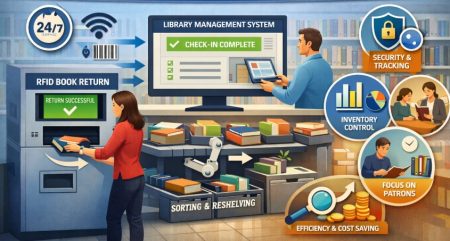
In practice, an RFID-enabled library operates through the coordinated use of RFID tags, readers, antennas, and library management software. When a user checks out or returns a book, RFID readers instantly scan the tag and communicate with the library management system to update the item’s status. Unlike barcodes, multiple RFID-tagged items can be read simultaneously, significantly reducing transaction time at circulation desks and enabling self-service borrowing and returning through self-check kiosks and book drop systems.
RFID technology also enhances inventory management and shelf control in libraries. Handheld RFID readers enable library staff to quickly verify stock, perform shelf reading, and locate items by scanning shelves without physically handling each book. Additionally, RFID security gates installed at library exits detect unauthorized removals, helping to prevent theft while maintaining smooth user movement.
Why Is RFID Considered an Important Technology for Modern Libraries?
Radio Frequency Identification (RFID) is considered an important technology for modern libraries because it significantly improves the efficiency, accuracy, and quality of library services. As libraries manage increasingly large and diverse collections while responding to higher user expectations for speed and convenience, RFID provides an effective solution that overcomes the limitations of traditional barcode-based systems.
One of the key reasons RFID is important is its role in automating circulation services. RFID enables self-check-in and self-check-out of multiple items at once, reducing queues at circulation desks and allowing users to complete transactions independently. Automated book drop systems further enhance this process by enabling users to return books outside regular service hours, ensuring continuous service availability and timely updating of circulation records.
RFID also strengthens inventory management and collection control. Using handheld RFID readers, library staff can quickly and accurately conduct stock verification, shelf reading, and item location without removing books from shelves. This results in more reliable catalog data, fewer misplaced items, and improved access to library resources for users.
Another major advantage of RFID technology is enhanced security. RFID-enabled security gates automatically detect materials that have not been properly issued, helping to reduce theft and accidental removal of library items. Unlike manual security checks, RFID-based security operates seamlessly without disrupting normal user movement, making it suitable for busy academic and public library environments.
In addition, RFID contributes to a better overall user experience and supports the development of smart library environments. Faster service delivery, reduced staff intervention, and improved resource availability make library use more convenient and user-friendly. At the same time, RFID allows library professionals to focus more on value-added services such as research assistance, user training, and information literacy programs.
The Main Components of an RFID System Used in Libraries
An RFID system in libraries is a combination of hardware and software components that work together to automate library operations, enhance security, and improve service efficiency. Each component has a distinct function, and understanding these components in detail helps libraries plan and operate RFID-enabled services effectively.
- RFID Tags: RFID tags are the core identification elements of an RFID library system. Each tag consists of a microchip and a small antenna and is usually placed inside the back cover of a book or attached to other library materials such as CDs or DVDs. The tag stores a unique identification number that corresponds to the item’s record in the library management system. Unlike barcodes, RFID tags do not require direct contact or visual alignment to be read, allowing multiple items to be detected simultaneously. This capability significantly speeds up circulation, inventory checks, and security monitoring while making them more accurate.
- RFID Readers: RFID readers are devices that communicate with RFID tags by emitting radio waves and receiving responses from the tags. In libraries, readers are installed at multiple service points, including circulation desks, self-check kiosks, book drop boxes, and security gates. Readers capture the tag data and send it to the library system for processing. Handheld RFID readers are also used by staff to scan shelves during inventory activities. The speed and accuracy of RFID readers enable real-time updates of item status, reducing errors and delays in library transactions.
- Antennas: Antennas are responsible for transmitting and receiving radio frequency signals between RFID tags and readers. They define the reading zone and ensure that tags are detected accurately within a specific range. In library environments, antennas are often integrated into self-check stations, security gates, and book drop units. Proper placement and configuration of antennas are essential to avoid missed reads or false detections, especially in high-traffic areas such as exits and circulation points.
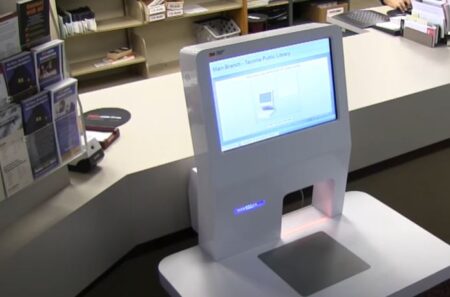
- Self-Check and Self-Return Stations: Self-check and self-return stations are user-facing components that allow library users to borrow and return materials independently. These stations combine RFID readers, antennas, and a user interface connected to the library management system. Users can place multiple books on the station at once, and the system processes all items simultaneously. Self-return stations and automated book drop boxes also update circulation records instantly, even outside regular service hours. These stations reduce staff workload and enhance user convenience.
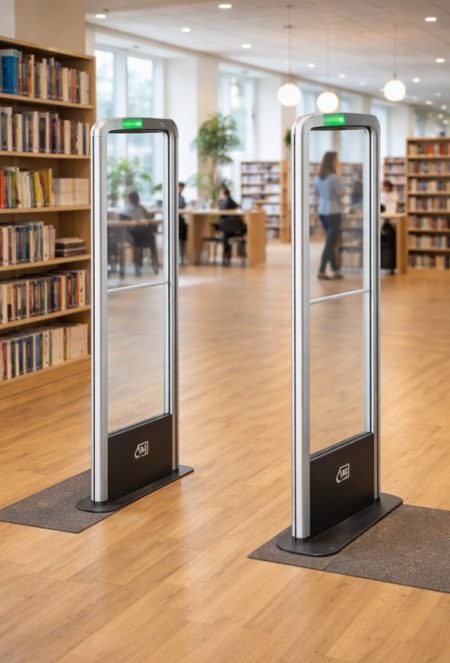
- RFID Security Gates: RFID security gates are installed at library exits to prevent unauthorized removal of materials. When an item passes through the gate, the system checks whether it has been properly issued. If not, the gate triggers an alarm or visual alert. RFID security gates operate seamlessly without requiring manual inspection of items, making them suitable for busy library environments. They help reduce theft and accidental losses while maintaining a welcoming and unobtrusive atmosphere for users.
- Handheld RFID Scanners: Handheld RFID scanners are portable devices used mainly for inventory management and shelf maintenance. Library staff can scan entire shelves quickly by moving the device along the rows of books, without removing items individually. These scanners can identify missing items, misplaced books, and items that belong to different sections. As a result, inventory checks that previously took weeks can often be completed in a few days, improving collection accuracy and availability.
- RFID Middleware: RFID middleware acts as the communication layer between RFID hardware and the library management system. It collects raw data from readers, filters duplicate or unnecessary reads, and ensures that only valid transactions are processed. Middleware also manages device coordination and error handling, making the overall system more reliable. Without middleware, the large volume of data generated by RFID readers could overwhelm the library system and reduce accuracy.
- Library Management System (LMS) Integration: Integration with the library management system is essential for the effective functioning of RFID technology. The LMS links RFID tag data with bibliographic records, user accounts, and circulation modules. When an RFID tag is read, the LMS updates the item’s status in real time, whether it is checked out, returned, or flagged for security. Seamless integration ensures consistency across all library services and enables accurate reporting, analytics, and decision-making.
Each component of an RFID system plays a critical role in modern library operations. RFID tags, readers, antennas, self-service stations, security gates, handheld scanners, middleware, and LMS integration work together to create an efficient, secure, and user-friendly library environment. By understanding these components in detail, libraries can better implement and manage RFID systems as part of their digital transformation and service modernization efforts.
What Are the Major Benefits of Using RFID Technology in Libraries?
RFID technology offers a wide range of benefits that significantly enhance both operational efficiency and service quality in modern libraries. Each benefit addresses specific challenges libraries face in managing growing collections and meeting evolving user expectations. The major benefits of RFID technology in libraries are explained in detail below.
- Faster and, Efficient Circulation: One of the most significant benefits of RFID technology is the speed it enables in circulation activities. Unlike barcode systems, RFID does not require line-of-sight scanning, allowing multiple items to be issued or returned simultaneously. This dramatically reduces transaction time at circulation desks and self-check stations. Faster circulation is especially beneficial during peak hours, enabling libraries to serve more users efficiently while minimizing queues and delays.
- Self-Service and User Convenience: RFID supports self-check and self-return systems that allow users to borrow and return materials independently. Users can complete transactions easily by placing multiple items on a self-check kiosk, without staff assistance. Automated book drop systems further enhance convenience by enabling returns outside regular service hours. These features empower users, improve satisfaction, and align library services with modern expectations for quick and autonomous access.
- Improved Inventory Management: RFID significantly improves inventory control by enabling fast and accurate stock verification. With handheld RFID scanners, library staff can scan entire shelves without removing individual books. This makes it easier to identify missing, misplaced, or incorrectly shelved items. As a result, inventory checks that once took weeks can now be completed in days, ensuring accurate catalog records and better availability of resources for users.
- Enhanced Security and Loss Prevention: RFID technology strengthens library security through automated detection systems. RFID-enabled security gates installed at exits can identify items that have not been properly checked out and trigger alerts instantly. This reduces the risk of theft and accidental removal of materials without disrupting user movement. Compared to traditional security methods, RFID provides a more reliable and unobtrusive solution for protecting valuable library collections.
- Reduced Staff Workload: By automating routine tasks such as circulation, inventory checking, and security monitoring, RFID significantly reduces the manual workload of library staff. Staff members spend less time on repetitive operational activities and can focus more on professional responsibilities such as research assistance, reference services, user training, and outreach programs. This leads to better staff utilization and improved overall service delivery.
- Accuracy and Reduction of Human Error: RFID systems minimize errors commonly associated with manual handling and barcode scanning. Automatic identification and real-time data updates reduce the chances of incorrect transactions, misplaced items, or inaccurate inventory records. Improved accuracy ensures consistency across library operations and enhances user trust in the reliability of library systems and catalogs.
- Support for Smart Library Services: RFID forms the technological foundation for smart library environments. By generating real-time data on circulation, usage patterns, and item movement, RFID supports advanced services such as automated returns, space optimization, and data-driven decision-making. It also integrates smoothly with other digital systems, enabling libraries to evolve into smart, technology-enabled knowledge centers.
RFID technology offers major benefits, including faster circulation, improved user convenience, accurate inventory management, enhanced security, reduced staff workload, minimized errors, and support for smart library services. By adopting RFID, libraries can modernize their operations, improve service quality, and effectively respond to users’ changing needs in an increasingly digital information environment.
How RFID Improves Service Efficiency and Staff Productivity in Libraries
Radio Frequency Identification (RFID) significantly improves service efficiency and staff productivity in libraries by automating routine operations and minimizing manual handling of library materials. In a traditional circulation system, issuing or returning a single book may take several minutes as staff scan barcodes, stamp dates, and update records. With RFID, multiple books can be issued or returned at once by simply placing them on an RFID-enabled pad. For example, during peak hours such as midterm or final exam periods, students can quickly borrow several textbooks in one transaction, reducing queues and saving valuable staff time.
RFID-based self-service systems further enhance efficiency by empowering users to manage their own borrowing and returns. For instance, a student can check out five books using a self-check kiosk in less than a minute without staff assistance. Similarly, RFID-enabled book drop boxes allow users to return materials even outside regular service hours. This reduces congestion at the circulation desk and allows staff to focus on higher-level services such as reference support, research consultations, and information literacy training.
Inventory management is another area where RFID dramatically improves productivity. Conducting a full inventory manually may take several days or even weeks in a large academic library. Using handheld RFID readers, staff can scan entire shelves quickly without removing books. For example, a staff member can identify missing or mis-shelved books while walking along the shelves, and the system immediately flags items that are out of place. This speeds up stock verification, improves catalogue accuracy, and reduces physical strain on staff.
RFID also strengthens library security and reduces material loss. RFID-enabled security gates automatically detect items that have not been properly issued. For example, if a book is accidentally taken out without being checked out, the security gate triggers an alert instantly. This automated process eliminates the need for manual bag checks or constant staff monitoring, creating a more user-friendly environment while maintaining collection safety.
Is RFID Suitable for All Types of Libraries?
Radio Frequency Identification (RFID) is widely recognized as a powerful technology for automating library operations, but its suitability varies depending on a library’s type, size, and objectives. While RFID offers significant benefits in efficiency, security, and user experience, it is not a one-size-fits-all solution for every library environment.
In large academic libraries, RFID is highly suitable given the scale of collections and high circulation volumes. Universities and research libraries often manage tens or hundreds of thousands of items and serve large user communities. RFID helps these libraries automate circulation, conduct fast inventory checks, reduce material loss, and support self-service models. The long-term operational benefits usually justify the initial investment in RFID infrastructure.
For public libraries, RFID is also well-suited, particularly in busy urban areas with high user traffic. Self-check kiosks, automated book returns, and security gates improve service speed and convenience for diverse user groups. Public libraries benefit from reduced queues and extended service availability, making RFID a valuable tool for improving community access to library resources.
In school libraries, RFID suitability depends on factors such as collection size, budget, and staffing. Large school libraries or school networks may find RFID useful for simplifying circulation and teaching students self-service habits. However, smaller school libraries with limited collections and low circulation volumes may find barcode systems more cost-effective and sufficient for their needs.
For special libraries—such as corporate, medical, law, or research institute libraries—the adoption of RFID depends on the nature of the collection and usage patterns. If the collection is highly valuable, frequently used, or requires strict access control, RFID can enhance security and tracking. However, special libraries with small, closed, or non-circulating collections may not gain significant benefits from full RFID implementation.
Budget and infrastructure are key considerations across all library types. RFID requires an initial investment in tags, readers, software integration, and staff training. Libraries with limited funding or technical support may find it challenging to implement and maintain RFID systems, even if the technology offers long-term advantages.