What Is an Accession Number in a Library?
An accession number in a library is a unique, sequential identifier assigned to each item—such as a book, journal, or other material—when it is added to the library’s collection. This number serves as a permanent record of the item’s entry and is typically recorded in the accession register as well as marked inside the item itself. For example, if a library acquires a new book today, it might assign it the accession number 10521, and the next item received will be assigned 10522, maintaining a continuous sequence. Even if the library purchases three copies of the same title, each copy will receive a different accession number—such as 10523, 10524, and 10525—so that every physical item can be tracked individually.
Unlike classification or call numbers, which indicate the subject and shelf location of a book (e.g., a book on library science may have a call number like 025.3 RAH), the accession number reflects the order of acquisition and is primarily used for administrative control. In practical terms, the accession number plays an essential role in circulation, stock verification, and auditing. For instance, during stock checks, if accession number 10450 is missing, library staff can quickly identify that a specific item has not been returned or may be lost. In modern library systems, accession numbers are often linked with barcodes or RFID tags—such as a barcode labeled 10521—which allows staff to efficiently issue or return books using self-check kiosks or scanners, while still preserving the accession number as the central identifier of the item in the library’s records.
How Does an Accession Number Differ from a Call Number?
An accession number and a call number serve two distinct but complementary purposes in library management, and understanding their differences is essential for both users and library professionals.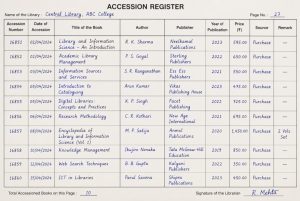
The accession number is a unique, sequential identifier assigned to each individual item when it is added to the library’s collection. This number reflects the order of acquisition and is primarily used for administrative control, record-keeping, stock verification, and auditing. For example, if a library acquires three copies of the same book, they may be assigned accession numbers like 15001, 15002, and 15003, allowing each physical copy to be tracked separately.
In contrast, the call number is a classification-based code that indicates the subject of the item and its specific location on the shelf. It is derived from a classification system, such as the Dewey Decimal Classification, and helps users locate materials within the library. For instance, a book on library management might have a call number like 025.3 RAH, where “025.3” represents the subject area, and “RAH” is typically derived from the author’s name. Unlike accession numbers, multiple copies of the same book usually share the same call number because they belong to the same subject category and are shelved together.
Why Is Each Accession Number Unique?
Each accession number in a library is unique because it serves as the individual identity of a specific item, ensuring accurate tracking, control, and accountability throughout the item’s lifecycle. When a new resource is added to the collection, it is assigned a number in a continuous sequence—such as 20001, 20002, 20003—and this number is never repeated or reused. This uniqueness is essential because even identical copies of the same book must be distinguished from one another. For example, if a library owns three copies of the same title, each copy will receive a different accession number, allowing staff to identify exactly which copy has been issued, returned, damaged, or lost.
The uniqueness of accession numbers also prevents confusion in circulation, stock verification, and auditing processes. If two items shared the same number, it would be impossible to determine which specific item is being referred to in the records. For instance, during stock checking, if accession number 20015 is missing, the library can immediately identify that one particular item is unaccounted for. In modern automated systems, this unique number is often linked with barcodes or RFID tags, enabling quick and error-free scanning. Therefore, the uniqueness of accession numbers ensures precision, reliability, and effective management of library resources, making it a fundamental principle in library administration.
Can Two Books Ever Share the Same Accession Number?
No, two books can never share the same accession number in a properly managed library system, because the accession number functions as a unique identifier for each individual item. It is assigned at the time of acquisition and represents the specific identity of that exact copy within the library’s collection. Even if a library acquires multiple copies of the same title, each copy must receive a different accession number—such as 30501, 30502, and 30503—so that they can be tracked separately.
If two books were given the same accession number, it would create serious confusion in circulation, record keeping, and stock verification. For example, if one copy is issued to a user and another remains on the shelf, the library system would not be able to distinguish which item is actually on loan. Similarly, during auditing, it would be impossible to determine whether a specific item is missing, returned, or misplaced. This would compromise the accuracy and reliability of library records.
Therefore, the rule of “one item, one accession number” is strictly followed in both manual and automated library systems. This ensures clear identification, efficient management, and accountability of every resource in the library collection.
Who Is Responsible for Assigning Accession Numbers in a Library?
In a library, the responsibility for assigning accession numbers typically lies with the technical processing section, particularly the acquisitions librarian or cataloging/processing staff. After a new item is received—whether through purchase, donation, or exchange—it goes through a series of preliminary steps such as verification, invoicing, and physical checking. Once these steps are completed, the item is formally entered into the accession register or library management system, and an accession number is assigned in a sequential order.
In many academic libraries, this task is carried out by trained library officers or assistants under the supervision of a professional librarian to ensure accuracy and consistency. For example, when a new batch of books arrives, the processing staff will record each item’s details (such as title, author, price, and source) and then assign accession numbers like 52011, 52012, and 52013 accordingly. In automated systems, the accession number may be generated by the software, but it is still the responsibility of the library staff to ensure it is correctly applied and linked to the right item.