Who Are the Primary Users of a Library?
Libraries are established to serve specific groups of people by providing access to information, knowledge, and learning resources. The individuals or groups for whom a library is primarily created and whose needs shape its services and collections are known as the primary users of a library. Understanding who these users are is essential for effective library planning, resource development, and service delivery.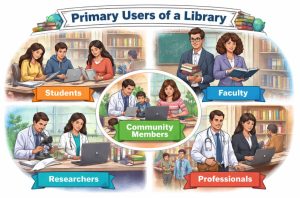
- Students as Primary Users: In academic and school libraries, students form the largest group of primary users. Undergraduate and postgraduate students rely on the library for textbooks, reference materials, journals, and digital resources to support their coursework, assignments, and research activities. Libraries also provide study spaces, internet access, and research assistance, all of which are designed mainly to meet students’ academic needs. As learning methods evolve, libraries increasingly support students through online databases, e-books, and virtual research services.
- Faculty Members and Teachers: Faculty members and teachers are another important group of primary users, particularly in academic libraries. They use library resources to prepare lectures, design curricula, conduct research, and publish scholarly work. Libraries support this group by subscribing to academic journals, research databases, and citation management tools, as well as by offering research consultation and scholarly communication services. The quality of library support directly influences teaching effectiveness and research productivity.
- Researchers and Scholars: Researchers and scholars are considered primary users in both academic and special libraries. Their information needs are often advanced and specialized, requiring access to peer-reviewed journals, theses, conference proceedings, and archival materials. Libraries play a crucial role in supporting research by providing access to high-quality resources, research data support, plagiarism detection tools, and guidance on publishing and citation practices.
- Community Members in Public Libraries: In public libraries, the primary users are members of the local community. This group includes school students, job seekers, lifelong learners, senior citizens, and general readers. Public libraries focus on providing inclusive services such as reading materials, children’s programs, digital literacy training, and access to government and employment information. The diversity of community needs makes public library users a broad but clearly defined primary user group.
- Professionals and Organizational Staff in Special Libraries: Special libraries, such as medical, law, corporate, or government libraries, primarily serve professionals and staff within specific organizations. Doctors, lawyers, engineers, researchers, and policy professionals depend on these libraries for accurate, up-to-date, and subject-specific information. Services in special libraries are highly targeted, emphasizing precision, timeliness, and relevance to professional practice.
With the growth of digital resources and remote access, the concept of primary users has expanded beyond physical library spaces. Many users now access library services online, including e-journals, institutional repositories, and virtual reference services. Despite this shift, primary users remain those whose educational, research, or professional needs are central to the library’s mission.
Why Is It Important to Identify the Primary Users of a Library?
Identifying the primary users of a library is essential for ensuring that library services, resources, and policies are aligned with the needs of the people the library is meant to serve. Libraries are service-oriented institutions, and their effectiveness largely depends on how well they understand their core user groups. Primary users-such as students, faculty members, researchers, professionals, or community members-shape the purpose and direction of a library. When these users are clearly identified, libraries can operate in a more focused, relevant, and user-centered manner.
A clear understanding of primary users supports the design of services that directly address their information needs and usage patterns. Different user groups seek information in different ways and for different purposes. By identifying who their main users are, libraries can develop appropriate services such as research assistance, information literacy programs, study spaces, and digital support systems that enhance users’ learning, teaching, and research experiences. This user-centered approach leads to higher satisfaction and more effective use of library services.
Identifying primary users also plays a crucial role in collection development and resource management. Since libraries often work within limited budgets, it is important to select resources that provide the greatest value to core users. Knowledge of primary users helps librarians choose relevant books, journals, databases, and digital materials that match users’ academic levels, subject interests, and preferred formats. As a result, library collections become more relevant, balanced, and well utilized. In addition, understanding primary users helps libraries develop practical and effective policies. Decisions related to loan periods, access privileges, opening hours, and remote access services can be shaped according to the needs and behavior of core users. Well-informed policies improve library operations, reduce user dissatisfaction, and create a more efficient and welcoming library environment.
The identification of primary users is also vital for guiding technology adoption and digital service development. As libraries increasingly provide online resources and virtual services, understanding users’ digital skills and access preferences becomes essential. Libraries can then invest in appropriate technologies such as discovery tools, institutional repositories, remote access platforms, and virtual reference services that genuinely support users’ academic and professional workflows.
Finally, identifying primary users strengthens library assessment, accountability, and long-term planning. Libraries can evaluate their performance more effectively by examining how well they meet the needs of their main user groups. User feedback, usage statistics, and service outcomes provide valuable evidence for institutional reporting, funding justification, and continuous improvement. Overall, recognizing and understanding primary users enables libraries to remain responsive, efficient, and relevant in a rapidly evolving information environment.