Types of Reference Service: From Quick Answers to In-Depth Research Support
A student wants to check the meaning of an unfamiliar term. Another needs help finding studies for a dissertation. Both approach the library for assistance, but their questions require different approaches. The first may be resolved through a brief lookup; the second may involve several resources and continuing discussion.
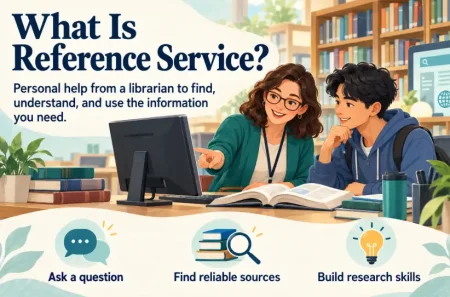
Reference service adapts to these different needs. It connects people with relevant information through a librarian’s knowledge, careful questioning, and guidance. Understanding its types helps users recognize the support available and helps libraries organize assistance around the questions people bring.
## Understanding the Two Main Types
A traditional classification associated with S. R. Ranganathan distinguishes **ready reference service** from **long-range reference service**. This offers a useful starting point for understanding how reference work varies in scope.[1]
Ready reference generally addresses specific factual questions. Long-range reference involves more extensive investigation. Although time is a useful indicator, the nature of the question, the resources required, and the depth of the search also matter.[2]
Alongside these main types, libraries offer specialized assistance, such as bibliographic support, research consultations, and readers’ advisory. These services overlap and are adapted to local needs rather than forming a single universal classification.
## 1. Ready Reference Service
Ready reference service, also called short-range reference service, helps users obtain specific information through a relatively brief search. The question is usually clearly defined, and a suitable source can provide a concise answer.
Typical questions include:
– “What does ISBN stand for?”
– “Who wrote *Pride and Prejudice*?”
– “In which year was this organization established?”
– “Where can I check the meaning of this technical term?”
The librarian may consult a dictionary, encyclopedia, handbook, directory, biographical source, or an organization’s official website. The choice depends on the question: a word’s meaning and an institution’s founding date call for different sources.[1]
### How It Works in Practice
Suppose a student encounters “bibliometrics” in an assignment. The librarian locates a suitable definition, explains it in accessible language, and identifies the source so the student can read further. If the student only needs the meaning, the enquiry may end there.
A brief answer still requires care. For example, a population figure needs a reference year and geographical coverage to be meaningful. The librarian checks that the answer fits the question rather than providing an isolated number.
Ready reference is useful when a small information gap interrupts someone’s reading, writing, or everyday activity. Resolving that gap helps the user continue with greater confidence.
## 2. Long-Range Reference Service
Long-range reference service addresses enquiries requiring sustained investigation, clarification, or consultation of several resources. The information may be scattered, highly specialized, historical, or difficult to identify. Assistance can involve follow-up discussions rather than a single exchange.[3]
Examples include:
– “How have university library services developed in Bangladesh?”
– “Which studies examine plagiarism awareness among university students?”
– “Where can I find historical evidence about changes in a local community?”
– “How can I locate research comparing approaches to digital literacy?”
### How It Works in Practice
Consider a postgraduate student investigating plagiarism awareness. The librarian first explores the scope: Which students? Which country or region? What period? Does the student need background reading or support developing a literature search?
Together, they identify concepts and possible search terms, such as “academic integrity,” “student plagiarism,” and “plagiarism awareness.” The librarian suggests suitable databases, demonstrates searches, and helps the student examine whether the results address the research question.
The work may continue through revised searches, citation tracing, and attempts to locate difficult-to-access publications. Where available, another library’s collection or a document delivery service may help.
### What the User Receives
The outcome might include relevant publications, a documented search strategy, suggested sources, or guidance on continuing the investigation. A complex enquiry may have several useful findings rather than one definitive answer.
Long-range assistance supports the user’s research decisions. The student or researcher continues to assess the evidence and develop their own argument. Any more extensive librarian involvement depends on the institution’s service arrangements.
## Ready Reference and Long-Range Reference Compared
| Aspect | Ready reference service | Long-range reference service |
|—|—|—|
| Main purpose | Resolve a specific factual enquiry | Investigate a broader or complex information need |
| Search scope | Usually a focused lookup | Often several searches and sources |
| Typical interaction | A brief exchange | A detailed consultation, sometimes with follow-up |
| Likely outcome | An answer with an appropriate source | Publications, search guidance, findings, or referrals |
| Example | Finding a term’s meaning | Exploring research about that concept |
These are practical distinctions, not rigid boundaries. A question that sounds simple can reveal a more complex need. Asking for the meaning of “digital literacy,” for example, may lead to a discussion about how researchers define and measure it.[2]
## Specialized Types of Reference Assistance
Specialized services describe particular purposes or activities within reference work. A single enquiry may involve several of them.
### 1. Bibliographic Assistance
Bibliographic assistance helps users identify publications and establish accurate details about them. A user may have an incomplete citation, an uncertain title, or a reference that is difficult to trace.
For example, a student might remember an author’s surname and part of an article title. The librarian can search catalogues, databases, and publisher records to identify the publication.
The assistance may also involve assembling a focused list of sources on a subject. Its value lies in helping users establish what a publication is and where it can be found.
### 2. Research Consultation and Literature Search Support
Research consultations provide focused assistance with a project’s information needs. They often fall within long-range reference service.
A librarian may help a researcher clarify concepts, select databases, combine keywords, use subject headings, or record a search process. For example, a broad search for “technology in education” might be refined to studies about digital tools in undergraduate classrooms.
A useful consultation also considers what the researcher has already tried. This allows the discussion to address a specific difficulty, such as irrelevant results, missing terminology, or limited coverage.
### 3. Instructional Reference Assistance
Instructional assistance helps users learn a skill while addressing an immediate question. A librarian might demonstrate how to apply database filters, interpret a catalogue record, or follow references to related studies.
Suppose a user asks why a search produces thousands of results. The librarian can explain how phrase searching or an additional concept changes the results, then invite the user to try.
This individual guidance develops through the enquiry. It differs from a scheduled workshop designed in advance for a wider group, although both contribute to learning.[4]
### 4. Readers’ Advisory
Readers’ advisory helps people discover reading materials suited to their interests and preferences. It is often provided alongside reference assistance.
A reader might ask for an accessible introduction to history, a mystery with a particular setting, or novels similar to a favorite book. The librarian explores what appeals to the reader—perhaps the subject, pace, tone, or level of difficulty—and suggests possibilities.
The aim is to offer informed choices that respect the reader’s interests. Readers’ advisory can support both fiction and nonfiction reading.[5]
### 5. Referral Service
Referral service connects users with another person, organization, or collection better placed to address their question.
For example, someone researching the history of a building may need records held by a municipal archive. A useful referral identifies the institution, explains why it may help, and provides an appropriate contact or enquiry route.
A referral keeps the search moving when local resources or expertise are insufficient. It can arise during either a quick enquiry or an extended investigation.
### 6. Citation and Reference Management Support
Citation support helps users understand how to acknowledge sources and locate appropriate style guidance. Questions may concern identifying citation elements, distinguishing a reference list from a bibliography, or interpreting a style example.
Where offered, assistance may also cover using reference management software to organize publications and prepare citations.
For instance, a student might ask why an imported record produces an incomplete reference. The librarian can help check whether essential details are missing and explain how to verify the output against the required style. The availability and depth of this support vary by library.
## How These Services Reach Users
Reference assistance can take place at a service desk, through an appointment, or remotely by email, telephone, chat, or video consultation. Remote reference describes how assistance is delivered; it can accommodate both quick questions and detailed research discussions.[4]
A chat enquiry might resolve a factual question immediately. A complex request may be better continued through an appointment or an email exchange that allows time for investigation. Libraries choose channels according to their staffing, resources, and users’ needs.
## Choosing the Right Level of Assistance
Users do not need to classify their questions before asking for help. The librarian uses a reference interview—a conversation about the enquiry—to understand what assistance would be useful.
Questions such as “What are you trying to find?”, “What have you searched already?”, and “How will you use the information?” help establish the scope. A deadline, preferred language, or need for a particular kind of evidence may also affect the approach.
The service can then develop as needed, from a factual lookup to instruction, research guidance, or referral.
## Conclusion: Matching Assistance to the Question
Ready reference and long-range reference provide a foundation for understanding the different demands of reference work. Specialized assistance adds support for particular tasks, including locating publications, improving searches, selecting reading, and managing citations.
Across these forms, effective service begins with understanding the person’s question. A brief enquiry deserves a dependable answer, while a complex investigation benefits from patient guidance and suitable resources. Knowing that this help is available can make the library a more approachable place to begin.
## Sources
1. [INFLIBNET Centre: Reference Service—Concept, Need, Types, Theories, Trends](https://ebooks.inflibnet.ac.in/lisp4/chapter/reference-service-concept-need-types-theories-trends/)
2. [INFLIBNET Centre: Academic Library Services](https://ebooks.inflibnet.ac.in/lisp11/chapter/academic-library-services/)
3. [Indira Gandhi National Open University: Information Services, Unit 8](https://www.egyankosh.ac.in/bitstream/123456789/35331/5/Unit-8.pdf)
4. [Reference and User Services Association: Definitions of Reference](https://www.ala.org/rusa/guidelines/definitionsreference)
5. [Reference and User Services Association: Professional Competencies for Reference and User Services Librarians](https://www.ala.org/rusa/resources/guidelines/professional)