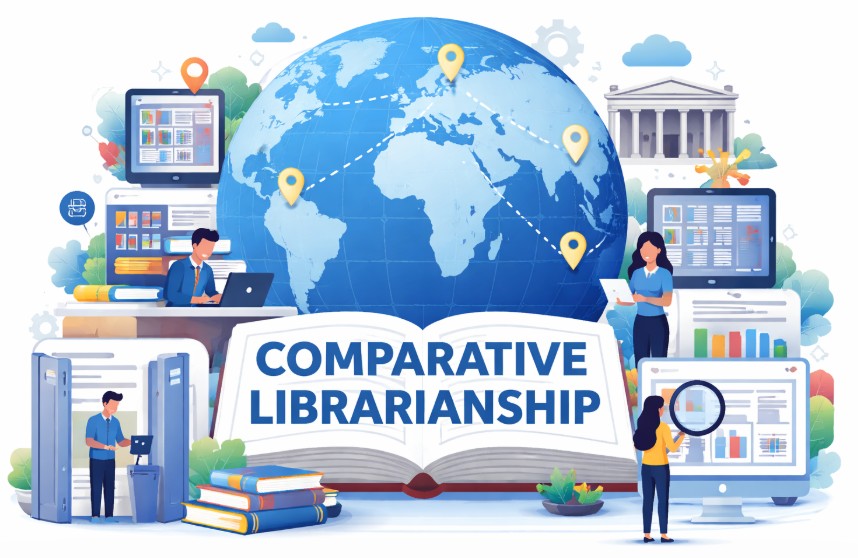
Comparative Librarianship is an important branch of Library and Information Science that focuses on the study and comparison of library systems, services, and practices across different countries, regions, or cultural contexts. It seeks to understand how various factors-such as social structure, economic conditions, educational systems, government policies, and technological development-influence the organization and functioning of libraries. By examining these differences and similarities, Comparative Librarianship provides a broader global perspective that goes beyond the limitations of a single national system. For example, while some countries have highly advanced digital libraries with extensive online resources and automation, others may still rely more on traditional, print-based services due to infrastructural or financial constraints.
This field is both analytical and practical in nature, as it not only studies existing systems but also helps improve library services by identifying and adapting best practices from around the world. In today’s global information environment, where knowledge sharing and digital access are increasingly important, Comparative Librarianship enables libraries to learn from one another, promote international cooperation, and respond effectively to changing user needs. It also supports research, policy-making, and innovation by providing insights into how different library models operate successfully in diverse environments.
Key Objectives of Studying Comparative Librarianship
Comparative Librarianship is a vital field within Library and Information Science that involves analyzing and comparing library systems, services, and practices across various countries and contexts. In today’s rapidly changing global information environment, studying Comparative Librarianship enables libraries to adapt, innovate, and enhance their services by learning from international experiences. The following points outline the key objectives of studying Comparative Librarianship in a clear and detailed manner.
- To Understand Differences and Similarities Among Library Systems: One of the main objectives of Comparative Librarianship is to analyze how library systems operate in different countries, highlighting both their similarities and differences. Libraries exist within specific social, cultural, economic, and political contexts that shape their structure and services. For instance, a university library in a developed country may offer extensive digital collections, advanced automation, and robust research support services. In contrast, a library in a developing country may focus on print resources and basic user services due to limited funding. By comparing these systems, librarians can gain a deeper understanding of how external factors influence library development, enabling them to evaluate their own practices within a global context.
- To Identify and Adopt Best Practices: Another important objective is to discover effective and innovative practices from other library systems and adapt them locally. Comparative Librarianship allows professionals to observe how successful libraries manage services such as digital access, user engagement, and resource organization. For instance, the widespread use of RFID technology for book circulation and security in many international libraries has encouraged other institutions to implement similar systems to improve efficiency. However, adopting best practices is not about copying blindly; it requires careful evaluation to ensure that these practices suit the local environment, user needs, and available resources.
- To Support Policy-Making and Strategic Planning: Comparative Librarianship provides valuable insights that help in developing sound library policies and long-term strategies. By studying how different countries approach issues like funding, staffing, collection development, and digital transformation, policymakers can make informed decisions. For example, analyzing how national libraries in developed countries handle digital preservation can guide the creation of policies in countries that are still developing their digital infrastructure. This objective ensures that library planning is not done in isolation but is informed by global experiences and standards.
- To Promote International Cooperation and Networking; In today’s interconnected world, libraries increasingly collaborate with one another across national boundaries. Comparative Librarianship encourages such cooperation by helping libraries understand international standards, systems, and practices. For example, participation in global databases, interlibrary loan systems, and resource-sharing networks requires libraries to align with international cataloguing and metadata standards. By studying other systems, libraries can effectively integrate into these global networks, enhancing access to information and fostering knowledge exchange.
- To Encourage Innovation and Technological Advancement: The study of Comparative Librarianship also promotes innovation by exposing libraries to new technologies and service models used worldwide. As libraries face challenges such as digital transformation and changing user expectations, they must continuously adapt and innovate. For instance, many libraries have introduced digital repositories, online reference services, and AI-based tools after observing their successful implementation in other countries. This objective ensures that libraries remain modern, relevant, and capable of meeting the evolving needs of users.
- To Address Inequalities in Information Access: A significant objective of Comparative Librarianship is to identify and reduce disparities in access to information between different regions. Comparing library systems reveals that not all users have equal access to resources, technology, or services. For example, while some countries provide extensive access to online databases and digital libraries, others struggle with limited internet connectivity and funding. Recognizing these inequalities allows governments, institutions, and international organizations to develop targeted strategies to improve access and promote information equity.
- To Enhance Professional Knowledge and Research: Comparative Librarianship contributes to the professional development of librarians and researchers by broadening their knowledge and perspectives. It encourages critical thinking and analytical skills, as professionals must evaluate different systems and understand the reasons behind their successes or limitations. For example, research studies comparing library services across countries can provide valuable insights into user behavior, service effectiveness, and technological adoption. This objective strengthens the academic and practical foundation of the library profession.
- To Improve User-Centered Library Services: Ultimately, all efforts in Comparative Librarianship aim to enhance the quality of services provided to users. By studying how different libraries meet user needs—such as offering flexible study spaces, digital access, or community programs—libraries can design more effective and user-friendly services. For instance, libraries that focus on user experience, accessibility, and personalized services often achieve higher user satisfaction. Learning from such examples helps libraries create inclusive and responsive environments that cater to diverse user groups.
The key objectives of studying Comparative Librarianship revolve around understanding global library systems, improving local practices, and fostering collaboration and innovation. By learning from diverse experiences and adapting best practices, libraries can become more efficient, inclusive, and responsive to user needs. In today’s interconnected world, Comparative Librarianship serves as a powerful tool for advancing library services and ensuring equitable access to information for all.