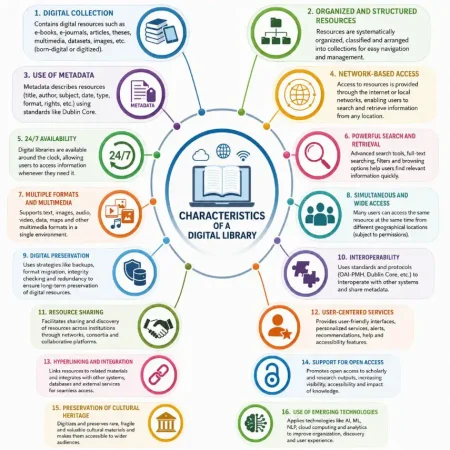
Digital libraries have revolutionized the way students and researchers access scholarly information by breaking the barriers of time, location, and physical availability. Unlike traditional libraries that rely on printed copies, digital libraries such as the Bangladesh INASP-PERI Consortium (BIPC), PubMed, IEEE Xplore, and JSTOR offer instant access to a vast collection of academic materials, including e-books, peer-reviewed journal articles, theses, dissertations, conference papers, and multimedia resources. Through advanced search tools, metadata tagging, and user-friendly interfaces, users can quickly locate relevant information from thousands of sources within seconds. For example, Google Scholar enables users to search across multiple disciplines and access open-access versions of scholarly works, while institutional repositories, such as DSpace, make university research outputs globally discoverable.
Moreover, many digital libraries integrate both open access repositories (such as Research4Life or the Directory of Open Access Journals – DOAJ) and subscription-based databases (like Elsevier ScienceDirect and Taylor & Francis Online), ensuring that learners and scholars can explore both free and licensed research materials through a single platform. They also promote inclusivity by offering 24/7 remote access via authentication systems such as OpenAthens, enabling off-campus users to retrieve materials anytime. By providing tools like Zotero, EndNote, or Mendeley for managing citations and references, digital libraries further support efficient and ethical research practices.
How Do Digital Libraries Enhance Access to Information for Students and Researchers?
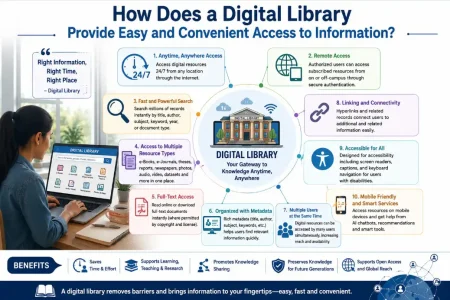
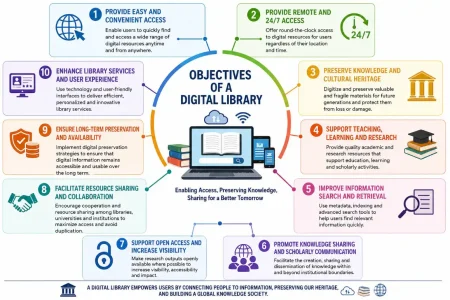
Digital libraries have transformed the academic landscape by providing students and researchers with instant, reliable, and equitable access to vast amounts of scholarly information. In the digital age, they serve as gateways to knowledge, combining technology and academia to deliver resources that transcend physical boundaries. Unlike traditional libraries, which are confined by space and operating hours, digital libraries allow users to explore a world of information at any time and from any location. They support both learning and research by offering a dynamic platform that houses millions of academic materials in various formats, fostering global collaboration and continuous learning.
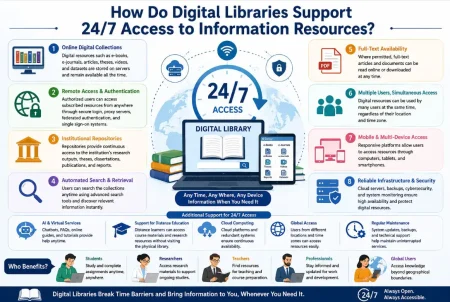
One of the most remarkable benefits of digital libraries is their 24/7 accessibility. Students and researchers can log in remotely through secure authentication systems such as OpenAthens or Shibboleth and access a wide range of resources without being limited by library hours. This flexibility is particularly useful for distance learners, part-time students, and international researchers who require academic materials at different times of the day. The ability to access information from anywhere promotes self-paced learning and ensures that research continues unhindered, regardless of geographical or time constraints.
Digital libraries also offer a vast range of scholarly resources, encompassing e-books, peer-reviewed journals, theses, dissertations, conference papers, and multimedia content. Renowned platforms such as IEEE Xplore, Elsevier ScienceDirect, SpringerLink, and Taylor & Francis Online host millions of academic works across diverse disciplines, providing researchers with both foundational and cutting-edge materials. This diversity allows users to explore interdisciplinary topics and access reliable, up-to-date information essential for high-quality research and innovation.
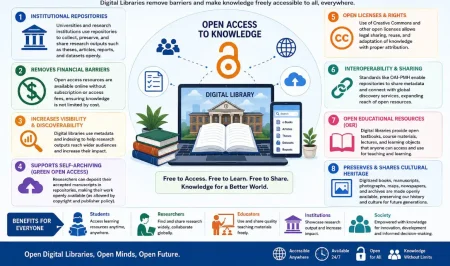
Another key contribution of digital libraries is their role in promoting open access and inclusivity. Open-access platforms, such as Research4Life, PubMed Central, and the Directory of Open Access Journals (DOAJ), make scholarly materials freely available to everyone, thereby breaking down financial and institutional barriers. This inclusivity ensures that students and researchers, especially in developing countries, can access global academic knowledge and participate in scholarly discussions. By removing paywalls and promoting free access, digital libraries create a more equitable academic environment that encourages learning and discovery for all.
The search and discovery features of digital libraries also enhance research efficiency. Advanced search tools, metadata tagging, keyword indexing, and full-text searching allow users to quickly locate relevant information from massive collections. Platforms like Google Scholar, WorldCat, and institutional DSpace repositories connect users to a network of databases and digital archives, helping them retrieve precise and credible sources with minimal effort. These tools save time, enhance accuracy, and streamline the process of locating specialized materials for academic writing and research.
Digital libraries further support researchers by offering integrated tools for citation and reference management. Applications like Zotero, Mendeley, and EndNote help users organize references, manage bibliographies, and generate citations automatically in various styles. This not only reduces the time spent on formatting but also promotes ethical academic practices by ensuring proper acknowledgment of sources. Moreover, the integration of cloud-based systems and repositories enables users to store and share research data securely, enhancing collaboration and productivity.
Collaboration is another vital aspect of digital libraries. Through institutional repositories and online sharing platforms, researchers can co-author papers, exchange data, and establish professional networks worldwide. These collaborative opportunities help generate new ideas, promote interdisciplinary studies, and accelerate the pace of academic progress. Additionally, the integration of digital libraries with Learning Management Systems (LMSs) such as Moodle, Canvas, or Blackboard enables faculty to embed digital resources directly into course materials, thereby enriching the teaching and learning experiences.
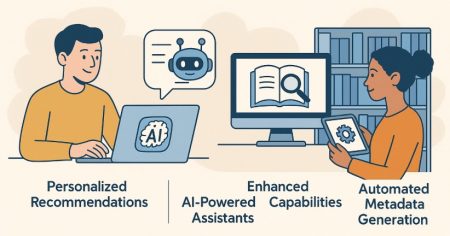
Modern digital libraries are designed with user-friendly interfaces that enhance accessibility and engagement. Many systems offer personalized dashboards, reading lists, and recommendation features based on users’ interests and search histories. Artificial intelligence-based suggestions enable researchers to discover new materials that align with their academic focus. Such personalization transforms the information-seeking experience into a more intuitive and enjoyable one, ensuring that users can easily find and manage the content they need.
Beyond formal education, digital libraries play a significant role in promoting lifelong learning. By hosting open educational resources, digital archives, and digitized historical collections, they enable individuals to continue learning throughout their lives. Professionals, independent scholars, and the general public can all benefit from this open access to knowledge, leading to a more informed and intellectually active society.