Cost-Benefit Analysis (CBA) is a systematic approach used to evaluate the economic feasibility and effectiveness of projects, services, or investments. In the context of libraries, CBA is an essential tool for decision-making, helping library administrators allocate limited resources effectively while maximizing the value provided to users. By comparing the costs of implementing a project or service against the anticipated benefits, CBA offers a clear and objective method for assessing whether the investment is worthwhile. This process involves identifying both tangible costs, such as financial outlays for equipment or staff, and intangible benefits, such as increased user satisfaction or enhanced community engagement.
As libraries increasingly face budget constraints and rising demand for diverse services, CBA helps ensure that every decision, from purchasing new technology to launching outreach programs, delivers measurable value. It serves as a critical guide for making informed, data-driven decisions that align with both short-term goals and long-term objectives. This comprehensive guide will explore how CBA is applied in library settings, discuss its key components, and provide practical insights into how libraries can implement this powerful tool to enhance their operations and services.
What is Cost-Benefit Analysis?
Cost-Benefit Analysis (CBA) is a financial evaluation method used to compare the costs and benefits associated with a particular project, decision, or investment. The goal of CBA is to determine whether the benefits derived from an initiative outweigh the costs, helping decision-makers identify the most economically efficient course of action.
In CBA, costs refer to all expenses associated with a project, including initial investments, operational costs, maintenance, and any indirect costs that may arise. On the other hand, benefits include tangible outcomes (such as increased revenue or reduced expenses) and intangible outcomes (like improved user satisfaction or enhanced community engagement).
The analysis involves calculating the total costs and total benefits, often in monetary terms, and then comparing them. The two key metrics commonly used are:
- Benefit-Cost Ratio (BCR): The ratio of benefits to costs. A BCR greater than 1 indicates that the benefits exceed the costs, making the project a good investment.
- Net Present Value (NPV): The difference between the present value of benefits and costs, considering the time value of money. A positive NPV indicates a worthwhile project.
CBA is widely used in various fields, including public policy, business, and, importantly, in library management, where it helps library administrators make informed decisions on resource allocation, service improvements, and project feasibility. It provides a clear, data-driven basis for deciding whether to proceed with or abandon a particular initiative.
Importance of Cost-Benefit Analysis (CBA) in Libraries
Cost-Benefit Analysis (CBA) is a crucial tool for libraries, particularly in an era where resources are often limited, and the demand for services continues to grow. Libraries must operate efficiently to maximize the impact of their offerings, and CBA provides a structured method to evaluate the economic viability of various projects, services, or investments. One of the primary advantages of CBA in libraries is its ability to help decision-makers allocate resources effectively. By comparing the costs involved in a project with the potential benefits, libraries can prioritize initiatives that deliver the most value to their users, whether through improved access to resources, enhanced technology, or expanded programs.
CBA also supports libraries in improving their services and ensuring that investments are justified. For example, when considering whether to adopt new technologies or expand physical spaces, libraries can use CBA to assess whether the financial outlay will result in measurable improvements, such as increased circulation, greater community engagement, or higher user satisfaction. This analysis helps avoid unnecessary expenditures on projects that may not yield sufficient benefits, ensuring that the library’s resources are used wisely.
CBA plays a significant role in long-term planning and sustainability. Libraries must plan for the future, taking into account not only current needs but also growth and changing community demographics. CBA helps libraries evaluate the long-term benefits of projects, ensuring they align with the institution’s overall strategic goals. In addition, the process of conducting a CBA makes it easier to justify decisions to stakeholders, such as board members or funding bodies. With a clear, data-backed rationale, libraries can effectively communicate the potential benefits of a project, increasing the likelihood of receiving support and funding.
Finally, CBA promotes accountability by providing a measurable way to assess the outcomes of a project or service once it has been implemented. Libraries can compare the actual benefits with the projected benefits to ensure that their decisions were effective and that resources were spent in the most efficient manner. If outcomes are not as expected, CBA helps identify areas for improvement and guides future decision-making. Overall, CBA empowers libraries to make informed, transparent, and strategic decisions that enhance their services, maximize their impact, and ensure the responsible use of public resources.
Steps in Conducting a Cost-Benefit Analysis for Libraries
Conducting a Cost-Benefit Analysis (CBA) for libraries involves several steps to ensure that both costs and benefits are properly identified, quantified, and compared. Here’s a breakdown of the key steps in the process:
- Identify the Project or Service: The first step in conducting a Cost-Benefit Analysis is to clearly define the project or service you wish to evaluate. Whether it’s implementing a new technology, launching a community outreach program, expanding library facilities, or offering new services, a clear understanding of what is being assessed is essential. Define the scope of the project, its objectives, and the outcomes you hope to achieve. This clarity ensures that both the costs and benefits can be accurately identified and measured.
- Determine Costs: The next step is to identify and quantify the costs associated with the project or service. These costs are typically divided into the following categories:
- Direct Costs: These are expenses that are directly related to the implementation of the project. For example, the purchase of new software, the cost of hiring additional staff, or the purchase of new books or resources.
- Indirect Costs: These are the hidden or secondary costs, such as utilities, administrative overheads, or the maintenance costs of any new equipment.
- One-time Costs: These are initial setup or investment costs, such as purchasing new technology or renovating library spaces.
- Recurring Costs: These include ongoing expenses that will continue over time, such as subscription fees, software updates, and staff salaries for continued program operation.
It’s important to be thorough in identifying all costs, both direct and indirect, as overlooking hidden costs can lead to inaccurate conclusions.
- Identify Benefits: Once the costs are determined, the next step is to identify the benefits that the library will gain from the project or service. Benefits can be both tangible and intangible:
- Tangible Benefits: These are outcomes that can be easily measured in monetary terms, such as increased membership, higher circulation of materials, revenue generation from new programs, or improved operational efficiency.
- Intangible Benefits: These benefits are harder to quantify but are still valuable, such as improved user satisfaction, increased community engagement, enhanced learning outcomes, or the library’s enhanced reputation in the community.
While tangible benefits can often be easier to quantify, it is essential to also consider the intangible outcomes that may contribute to the library’s long-term success.
- Quantify Costs and Benefits: The next step is to assign monetary values to both the costs and benefits. For tangible benefits, this can often be done through direct financial metrics, such as estimating how much additional revenue a new program might generate or how much time and money could be saved by implementing a more efficient system.
Intangible benefits are more challenging to quantify but can be estimated using a variety of methods. For example, you could conduct surveys to assess how much users value a new service, or you might use proxies based on similar programs or industry standards to estimate the economic value of increased community engagement or user satisfaction.
Quantifying both costs and benefits is essential to making a fair comparison and ultimately deciding whether the project is worth pursuing. - Calculate Net Benefits: Once you have quantified the costs and benefits, the next step is to calculate the Net Benefit. This is done by subtracting the total costs from the total benefits:
Net Benefit = Total Benefits − Total Costs
A positive Net Benefit indicates that the benefits outweigh the costs, making the project a good investment. Conversely, if the Net Benefit is negative, the costs outweigh the benefits, suggesting that the project may not be worth pursuing. - Calculate the Benefit-Cost Ratio (BCR): The Benefit-Cost Ratio (BCR) provides another important metric for evaluating the project. It is calculated by dividing the total benefits by the total costs:
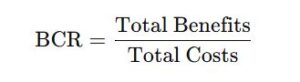
If the BCR is greater than 1, it indicates that the project provides more benefits than costs, making it a sound investment. If the BCR is less than 1, the project may not be cost-effective. - Consider the Time Value of Money: For long-term projects, it’s important to consider the time value of money. This means accounting for the fact that money today is worth more than the same amount in the future due to inflation and opportunity cost. To account for this, libraries can use methods like Net Present Value (NPV) or Discounted Cash Flow (DCF), which adjust future benefits and costs to their present value. This step is especially critical for projects that generate long-term benefits, such as capital investments in infrastructure or technology.
- Interpret Results and Make Decisions: After completing the calculations, it’s time to interpret the results and make a decision. A positive Net Benefit and a BCR greater than 1 are indicators that the project is likely to be a good investment. If the results are unfavorable, it may be necessary to reconsider the project, modify its scope, or explore alternative options.
- Review and Communicate Findings: Finally, it’s important to present the findings of the Cost-Benefit Analysis to key stakeholders, such as library boards, funders, or other decision-makers. Clear, data-backed explanations will help communicate the rationale behind the decision. It’s essential to include both quantitative results (such as Net Benefit and BCR) and qualitative justifications (like community impact or user satisfaction) to ensure stakeholders understand the full scope of the analysis.
Conducting a Cost-Benefit Analysis is a valuable process that allows libraries to make informed, objective decisions about where to invest their resources. By following these steps, libraries can ensure that they are prioritizing initiatives that provide the most value to their users and the community. Whether implementing new technologies, launching programs, or expanding services, a thorough CBA helps libraries make decisions that align with both their financial constraints and long-term strategic goals.
The Purpose of Conducting a Cost-Benefit Analysis for a Library
Libraries, as community-centered institutions, are entrusted with managing resources efficiently to serve the public. Given the growing demands for services, changing technological landscapes, and often constrained budgets, library administrators must make strategic decisions about where to allocate their resources. One of the most effective tools in making such decisions is Cost-Benefit Analysis (CBA). This systematic approach helps libraries evaluate whether the benefits of a project, service, or investment justify the associated costs. Here are the primary purposes of conducting CBA in a library setting:
- Efficient Resource Allocation: Libraries typically operate within strict financial limits, making it crucial to allocate their resources efficiently. Whether considering an upgrade to technology, expanding services, or initiating new programs, a Cost-Benefit Analysis allows library administrators to determine which initiatives will offer the greatest value for money. By calculating and comparing the costs and benefits of different options, CBA helps prioritize projects that promise the most significant return on investment. This ensures that every dollar spent contributes meaningfully to the library’s mission of providing excellent service to the community.
For instance, if a library is considering purchasing new software, CBA helps evaluate whether the upfront costs of acquisition and training are worth the expected benefits, such as improved efficiency, user satisfaction, and reduced operational costs. Without a clear understanding of the costs and benefits, libraries may risk investing in projects that don’t provide sufficient value. - Maximizing Value for Users: Beyond financial considerations, the ultimate goal of any library project is to enhance user experience and access to resources. A Cost-Benefit Analysis helps identify which projects or services will provide the most value to library patrons. Benefits such as improved access to information, increased circulation, better community engagement, or enhanced learning experiences are all critical factors that should be taken into account.
For example, if a library is considering expanding its e-library offerings, CBA can help assess whether the investment in digital infrastructure, content licenses, and staff training will yield benefits such as increased user satisfaction, more library users, or broader access to information for the community. This ensures that libraries are not just spending money but making decisions that align with their strategic goals of improving the quality of services and meeting user needs. - Supporting Informed Decision-Making: A fundamental purpose of conducting a Cost-Benefit Analysis is to support data-driven decision-making. Libraries often face multiple competing priorities and must choose which projects to pursue based on available resources. CBA provides a clear, objective framework for comparing the potential outcomes of various options. Quantifying both costs and benefits removes much of the guesswork from the decision-making process, enabling administrators to evaluate projects in terms of their economic feasibility and alignment with library goals.
Without CBA, decisions may be made based on subjective judgment or incomplete information, leading to missed opportunities or inefficient use of funds. For example, deciding whether to invest in new technology or enhance existing library services becomes easier when administrators can see how each choice impacts both costs and potential benefits. - Justifying Investments to Stakeholders: Libraries often need to secure approval or funding from external stakeholders, such as board members, local governments, or donors. In such cases, CBA serves as a powerful tool for justifying investments in new projects or services. By presenting a clear comparison of the costs and anticipated benefits, libraries can make a compelling case for why a particular initiative should move forward.
Whether it’s securing funding for a building renovation, a new program, or purchasing new technology, stakeholders are more likely to support initiatives that have been carefully evaluated and shown to provide value. CBA helps ensure that decisions are transparent, backed by data, and aligned with the library’s strategic objectives. This is particularly important at a time when libraries may be competing for limited funding and need to demonstrate the effectiveness of their proposed projects. - Evaluating Long-Term Impact: Libraries often invest in long-term projects, such as infrastructure development, staff training, or adopting new technologies. A key purpose of conducting a Cost-Benefit Analysis is to evaluate the long-term benefits of these investments. The impact of many library projects may not be immediately apparent, so it’s important to consider how benefits will accrue over time. For example, investing in a new integrated library system (ILS) or expanding a digital collection may have upfront costs but could lead to greater efficiency, higher patron engagement, and long-term cost savings in the future.
A CBA can incorporate the time value of money, discounting future benefits and costs to their present value, helping libraries assess whether the long-term gains justify the initial outlay. By considering long-term returns, CBA ensures that libraries make decisions that are beneficial in the short term and sustainable in the long run. - Ensuring Accountability: Accountability is another critical reason for conducting a Cost-Benefit Analysis. Once a project or service is implemented, libraries can use CBA to assess whether the actual outcomes align with the projected benefits. This evaluation process helps ensure that public funds and resources are used effectively. If a project does not deliver the anticipated benefits, CBA provides an opportunity to assess why the expected outcomes were not achieved, offering insights for improving future decision-making processes.
Furthermore, CBA fosters transparency by providing a clear justification for decisions, allowing library administrators to demonstrate to stakeholders that they are accountable for their financial decisions and are using resources responsibly.
The purpose of conducting a Cost-Benefit Analysis for a library is to make informed, strategic decisions that optimize resource use, maximize value for users, and ensure accountability in the allocation of funds. By quantifying both costs and benefits, CBA provides a clear, data-driven framework for evaluating projects and services, enabling libraries to prioritize initiatives that deliver the greatest impact. Whether for justifying new investments, planning for long-term growth, or ensuring the sustainability of services, CBA is an indispensable tool for library administrators aiming to make effective, transparent, and financially sound decisions.
How Can Libraries Use Cost-Benefit Analysis (CBA) to Justify Funding and Resource Allocation?
Libraries can use Cost-Benefit Analysis (CBA) as a powerful tool to justify funding and resource allocation by providing a clear, data-driven justification for proposed investments and expenditures. This approach helps library administrators present a compelling case to stakeholders—such as board members, government officials, donors, or the public—by demonstrating how resources will be used efficiently to generate measurable benefits. Here’s how libraries can use CBA to justify funding and resource allocation:
- Quantifying Benefits to Demonstrate Value: CBA allows libraries to quantify both tangible and intangible benefits. Tangible benefits might include increased membership, higher circulation of materials, or cost savings from more efficient processes. Intangible benefits could include enhanced user satisfaction, improved community engagement, or positive educational outcomes. By assigning monetary values to these benefits, libraries can demonstrate the direct and indirect value that a proposed project or service will bring to the community.
For example, if a library is requesting funds for a new e-library platform, a CBA can show that the increased access to digital resources will likely lead to higher patron engagement, more library usage, and a broader reach to underserved communities. The analysis provides a clearer picture of the return on investment, making it easier for stakeholders to see the potential impact. - Providing Data to Support Resource Allocation: Libraries must often make tough decisions about how to allocate limited resources, especially when considering competing priorities such as staff development, technology upgrades, or expanding services. CBA helps prioritize initiatives by comparing the costs of different options with their anticipated benefits. This enables library administrators to allocate resources to the projects that provide the most significant value relative to their costs.
For instance, when deciding whether to fund new technology, expand physical spaces, or offer additional programs, CBA allows libraries to compare the long-term benefits of each option. If one project demonstrates a higher benefit-to-cost ratio, it can be prioritized over others, ensuring resources are directed where they will have the greatest impact. - Demonstrating Long-Term Sustainability: Many library projects, such as infrastructure development or large-scale program expansions, involve upfront costs but offer long-term benefits. CBA can be used to calculate the Net Present Value (NPV) or Benefit-Cost Ratio (BCR), accounting for the time value of money. This process helps justify large investments by showing how the benefits will accumulate over time, even if the financial gains are not immediately apparent.
For example, if a library proposes an investment in an integrated library system (ILS) or a new digital repository, CBA can project the long-term benefits, such as greater efficiency, reduced operational costs, and improved user satisfaction, over a span of several years. This long-term perspective makes it easier for stakeholders to see the overall value of the investment, beyond just initial costs. - Highlighting Alignment with Strategic Goals: CBA can help demonstrate how a project aligns with the library’s broader strategic goals, such as improving user services, increasing access to resources, or fostering community engagement. Libraries often operate under the guidance of specific mission statements and goals, and CBA can show how funding for a particular project will contribute to achieving these objectives.
For instance, if a library is seeking funding for a new community outreach program, a CBA can show that the program will enhance the library’s role as a community hub, increase public access to learning resources, and improve the library’s reputation in the community. This alignment with strategic goals strengthens the case for funding, as stakeholders are more likely to support initiatives that further the library’s mission. - Providing Transparency and Accountability: One of the most important functions of CBA is its ability to provide transparency and accountability in decision-making. By documenting the costs, benefits, and calculations involved in a project, libraries can demonstrate that they are being responsible stewards of public or donated funds. This transparency is crucial for gaining trust and support from stakeholders.
When seeking funding from government bodies, for example, CBA helps library administrators present a well-supported rationale for why the requested funds are necessary and how they will be used effectively. This increases the likelihood of securing funding, as decision-makers can clearly see how the project aligns with their financial priorities and the library’s mission. - Supporting Evidence for Grant Applications: Many libraries apply for grants from foundations, government agencies, or other funding sources. CBA is an essential tool in grant applications because it provides evidence of the anticipated impact of a proposed project. A detailed Cost-Benefit Analysis can make grant proposals more competitive by clearly showing how the funds will be used and what outcomes are expected.
For example, a library applying for a grant to launch a new digital literacy program can use CBA to outline the program’s costs (e.g., software, staff training) and demonstrate the expected benefits (e.g., improved digital literacy in the community, increased access to educational resources). This strengthens the library’s proposal by presenting it as a well-planned and data-driven initiative. - Building Support for Public and Private Funding: CBA helps libraries build support for funding from both public and private sources. For libraries seeking funding from public entities like local governments, CBA demonstrates how the project aligns with community needs and how public funds will be spent wisely. For private donors or foundations, CBA can provide a clear picture of how their contributions will make a tangible impact, thereby increasing their likelihood of support.
In summary, libraries can use Cost-Benefit Analysis to justify funding and resource allocation by providing a clear, data-backed rationale for their decisions. By quantifying the costs and benefits of various initiatives, libraries can prioritize projects that offer the greatest return on investment, demonstrate alignment with strategic goals, and highlight the long-term value of their investments. Moreover, CBA ensures transparency and accountability, making it easier for libraries to gain support from stakeholders and secure the resources necessary to enhance their services and fulfill their mission.
How Do You Account for the Costs of New Library Programs or Services in a CBA?
Libraries are constantly evolving to meet the changing needs of their communities. Whether launching a new coding workshop, expanding digital collections, or creating community outreach programs, every new service or program comes with its costs. A Cost-Benefit Analysis (CBA) is a valuable tool for evaluating these costs against the potential benefits to ensure sustainable decision-making. Here’s a step-by-step approach to ensure comprehensive cost accounting:
- Step 1: Identify All Cost Categories
Before diving into numbers, it’s crucial to identify every type of cost associated with the new program. These costs can be categorized as:- Direct Costs: Direct costs are immediately tied to the implementation and operation of the program. Examples: Salaries for program staff, materials, promotional efforts, and program-specific equipment.
- Indirect Costs: Indirect costs are less obvious but equally important. Examples: Administrative support, increased utility usage, or the strain on existing resources.
- One-Time (Fixed) Costs: These costs occur during the initial setup phase and don’t recur. Examples: Purchasing equipment, renovating spaces, or setting up technology infrastructure.
- Recurring (Variable) Costs: These are ongoing costs that fluctuate depending on usage or participation. Examples: Subscription fees for digital platforms, consumables like art supplies, or utilities based on extended hours.
- Opportunity Costs: Opportunity costs represent the benefits forgone from alternative uses of resources. Example: Allocating staff and funds to a new program might mean scaling back on an existing initiative or delaying a facility upgrade.
- Non-Monetary Costs: While harder to quantify, these costs can significantly impact decision-making. Examples: Environmental impact, staff workload stress, or potential resistance from patrons to changes.
- Step 2: Quantify Costs
Once costs are identified, assign monetary values to each item. This may involve:- Market Research: Use current prices for materials, technology, and staff wages.
- Historical Data: Refer to previous programs to estimate similar costs.
- Shadow Pricing: Assign values to intangible costs, such as the value of staff time or space usage.
For example, if you are introducing a digital literacy program, the costs might include $3,000 for instructor wages, $5,000 for computers, and $1,000 for promotional materials.
- Step 3: Break Costs Into Timeframes
Programs often have costs spread over time. Divide these into:- Short-Term Costs: One-time expenditures such as initial training or equipment purchase.
- Long-Term Costs: Recurring expenses like maintenance, staffing, and subscriptions.
Discounting future costs to their present value using a discount rate is essential for accurately comparing costs over time.
- Step 4: Allocate Costs to Stakeholders
Understand who bears the costs of the program. Consider:- Library Budget: How much of the library’s funds will be used for staff, equipment, or materials?
- Patrons: Will participants pay a fee or need to bring materials?
- External Partners: Will sponsors or community organizations share the costs?
This helps transparently distribute the financial responsibility.
- Step 5: Consider Risks and Uncertainty
Uncertainties, such as fluctuating participation rates or unexpected expenses, can affect the overall cost. Conduct a sensitivity analysis to account for these variables, such as:- Changes in material costs.
- Lower-than-expected program attendance.
- Potential technology upgrades are needed sooner than anticipated.
Example of Cost Breakdown
For a hypothetical new library coding workshop for teens, the cost breakdown might look like this:
| Category | Details | Estimated Cost |
|---|---|---|
| Direct Costs | Instructor salary (10 hours/month), program kits, marketing materials | $2,500/month |
| Indirect Costs | Administrative support, increased energy use | $500/month |
| Fixed Costs | Purchase of laptops (10 units), software licenses | $15,000 |
| Variable Costs | Refreshments, additional supplies per session | $200/session |
| Opportunity Costs | Potential reduction in staff availability for other programs | $3,000 |
Accounting for the costs of new library programs or services in a CBA involves identifying, categorizing, and quantifying all relevant expenses. By considering both tangible and intangible factors, as well as initial and recurring costs, libraries can make informed decisions about whether to proceed with new initiatives. Transparent and thorough cost analysis ensures that resources are allocated effectively and aligns with the library’s mission to serve its community.
How Do You Determine the Net Present Value (NPV) of Library Projects Using CBA?
Determining the Net Present Value (NPV) of library projects using Cost-Benefit Analysis (CBA) is a structured process that evaluates whether the financial benefits of a project outweigh its costs over time. NPV accounts for the time value of money, ensuring that future benefits and costs are appropriately discounted to their present value.
Here’s how to determine the NPV of a library project step by step:
Step 1: Identify Costs and Benefits
- Costs: Identify all costs associated with the library project, which may include:
- Initial (Capital) Costs: Equipment, technology, infrastructure upgrades, or construction.
- Recurring Costs: Staff salaries, utilities, maintenance, and program expenses.
- Indirect Costs: Opportunity costs, environmental impacts, or administrative overhead.
- Benefits: Identify measurable benefits from the project, such as:
- Tangible Benefits: Increased circulation, savings for patrons, or higher event attendance.
- Intangible Benefits: Community engagement, literacy improvement, or enhanced cultural access.
Step 2: Assign Monetary Values
Quantify all costs and benefits in monetary terms. Use:
- Market Values: For tangible items (e.g., book prices, equipment costs).
- Survey Data: For benefits like patron savings or willingness-to-pay estimates.
- Shadow Pricing: For intangible costs and benefits, like environmental savings or improved literacy.
Step 3: Establish the Time Horizon
Determine the project’s lifespan or the period over which costs and benefits will be analyzed. Typical time horizons for library projects might be 5, 10, or 20 years, depending on the project’s nature.
Step 4: Choose a Discount Rate
Select a discount rate to reflect the time value of money. The discount rate accounts for inflation, opportunity cost, and risk. In public sector projects like libraries, typical rates range from 3% to 7%.
Step 5: Discount Future Costs and Benefits to Present Value
Use the discount rate to calculate the present value (PV) of future costs and benefits:

Step 6: Calculate the Net Present Value (NPV)
The NPV is the difference between the total discounted benefits and total discounted costs:
NPV=Total Present Value of Benefits−Total Present Value of Costs
- A positive NPV (NPV>0) indicates that the project’s benefits outweigh its costs and is financially viable.
- A negative NPV (NPV<0) suggests that costs exceed benefits, making the project less desirable.
Step 7: Perform Sensitivity Analysis
Given uncertainties in costs, benefits, and discount rates, perform a sensitivity analysis:
- Test the NPV using different discount rates (e.g., 3%, 5%, 7%).
- Adjust assumptions about costs and benefits to assess the robustness of the results.
Example: NPV of a Library Digital Expansion Project
Let’s say a library wants to implement a new digital program with the following:
- Costs:
- Initial Setup (Year 0): $50,000
- Annual Maintenance (Years 1–5): $10,000/year
- Benefits:
- Patron Savings (Years 1–5): $20,000/year
- Discount Rate: 5%
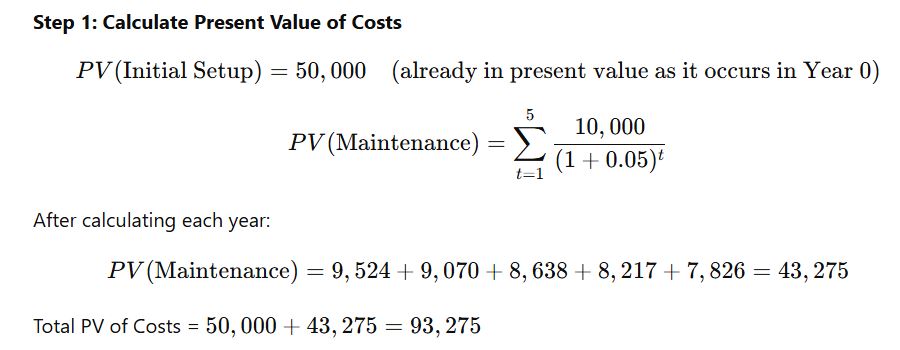
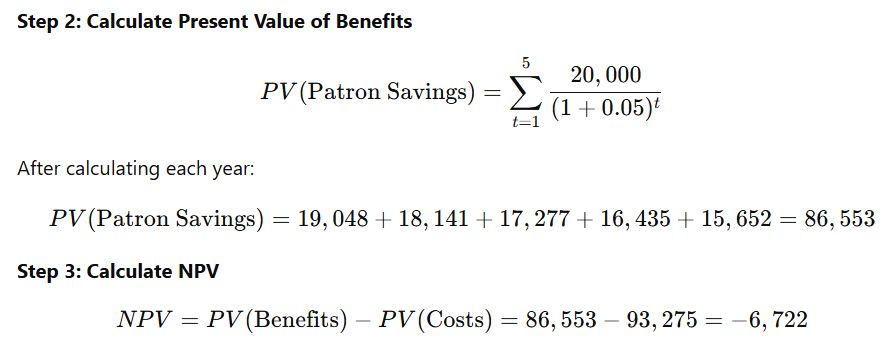
In this example, the project has a negative NPV, suggesting it may not be financially viable without adjusting costs, increasing benefits, or choosing a lower discount rate.
Calculating the NPV of library projects using CBA provides a clear picture of their financial feasibility. By discounting future costs and benefits to their present value and performing sensitivity analyses, libraries can make informed decisions about resource allocation. This systematic approach ensures that projects deliver maximum value to the community while aligning with financial sustainability goals.
Key Formulas Used in Calculating Cost-Benefit Analysis (CBA) in Libraries
Cost-Benefit Analysis (CBA) is a critical tool for libraries to evaluate the economic viability of projects, programs, or services. It involves quantifying costs and benefits in monetary terms and comparing them to determine whether the investment is worthwhile. Here are the key formulas used in CBA calculations:
- Net Present Value (NPV): The Net Present Value (NPV) calculates the difference between the present value of benefits and the present value of costs over a specified time horizon.
 Where:
- : Benefits in year
- : Costs in year
- : Discount rate (time value of money)
- : Year of analysis (from 0 to )
- : Total time horizon of the project
- Interpretation: If > 0, the project’s benefits exceed its costs, making it viable.
- Benefit-Cost Ratio (BCR): The Benefit-Cost Ratio compares the total discounted benefits to the total discounted costs.
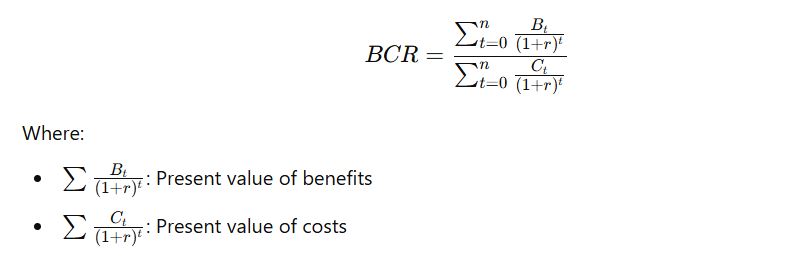
- Interpretation:
- > 1: Benefits outweigh costs (favorable project).
- < 1: Costs outweigh benefits (unfavorable project).
- Interpretation:
- Present Value (PV): The Present Value formula is used to discount future costs or benefits to their value in today’s terms.
 Where:
- Future Value: Cost or benefit in a future year
- : Discount rate
- : Number of years into the future
- Application: Libraries use PV to evaluate the value of recurring costs (e.g., annual program expenses) or future benefits (e.g., patron savings) over time.
- Annualized Cost: Annualized cost is the equivalent yearly cost of a one-time investment, distributed over its useful life.
 Where:
- : Initial cost of the project
- : Discount rate
- : Useful life of the investment in years
- Application: Used to compare recurring and one-time costs on an annual basis, such as evaluating equipment purchases versus subscription-based software.
-
Payback Period: The Payback Period calculates the time required for the benefits to recover the initial investment costs.

Where:
Initial Investment: Upfront cost of the project
Annual Net Benefit: Yearly benefit after deducting recurring costs
Interpretation: A shorter payback period indicates quicker recovery of costs, making the project more attractive. -
Opportunity Cost: Opportunity cost represents the value of the next best alternative forgone when resources are allocated to a specific project.
Opportunity Cost = Value of Best Alternative Use − Value of Chosen Use
Application: Helps libraries assess trade-offs, such as investing in new technology versus expanding staff. - Incremental Cost-Effectiveness Ratio (ICER): ICER is used to compare two or more projects or services to determine which delivers better value for money.
 Interpretation: A lower ICER indicates greater cost-effectiveness.
- Return on Investment (ROI): Return on Investment measures the net benefit as a percentage of the total investment cost.
 Where:
Net Benefits=Total Benefits−Total Costs
Interpretation: Higher ROI values indicate better financial performance of the project. -
Sensitivity Analysis: Sensitivity analysis tests how changes in key variables (e.g., discount rate, costs, or benefits) affect the outcome of the CBA.
ΔNPV = NPV (Base Case) − NPV (Scenario Change)
Application: Used to assess the impact of uncertainties, such as fluctuating costs or varying participation rates in library programs.
By using these formulas, libraries can conduct a thorough Cost-Benefit Analysis to evaluate the financial and social impacts of their projects. Whether it’s calculating the NPV of a new digital resource program, comparing projects using BCR, or assessing payback periods, these tools enable libraries to make data-driven decisions that maximize their value to the community.
References:
- Mittal, R.L. (1963, June). Acquisition of serials in Indian university libraries. Indian Librarian, 18, 25.
- Ravat, P.P. & Kumar, T. (2002). Encyclopedic Dictionary of Library and Information Technology (Vol. II). New Delhi: Crest Publishing House.