Historical Context
The Five Laws of Library Science, proposed by S. R. Ranganathan in 1931, were developed against a specific historical backdrop characterized by the limitations of early libraries, the influence of Western librarianship, and the increasing demand for accessible knowledge in society. In the early twentieth century, particularly in colonial India, libraries were predominantly closed-access institutions, treating books as valuable items to be preserved rather than as resources to be actively used. Users had limited freedom to browse collections, and access was often restricted to a select group of scholars or elites. This restrictive environment led Ranganathan to challenge traditional practices and advocate for a more user-oriented approach, clearly reflected in his First Law: “Books are for use.”
At the same time, Ranganathan was influenced by modern library practices in the West, particularly during his training in the United Kingdom. There, organizations like the Library Association promoted open access, efficient cataloguing, and reader-centered services. These ideas, combined with the global expansion of public libraries supported by philanthropists such as Andrew Carnegie, emphasized equal access to information and the democratization of knowledge. Such developments inspired the principles behind the Second and Third Laws, which focus on connecting every reader with the right book and ensuring that every book reaches its appropriate reader.
The lack of standardization and professional organization in many Indian libraries during that time highlighted the need for systematic classification and efficient information retrieval. Ranganathan addressed this by introducing scientific methods of library organization and emphasizing the importance of saving users’ time, which became the foundation of the Fourth Law. Additionally, the early twentieth century saw rapid growth in education, publishing, and information production, transforming libraries from static repositories into dynamic institutions that required continuous expansion and adaptation. This transformation is encapsulated in the Fifth Law: “The library is a growing organism,” which acknowledges the evolving nature of library services, collections, and infrastructure.
Five Laws of Library Science
The Five Laws of Library Science, proposed by S. R. Ranganathan in 1931, serve as the foundational philosophy and practical guide for modern librarianship. These laws are not just theoretical concepts; they offer a comprehensive framework for providing effective, user-centered library services. Each law represents a shift in perspective: from a focus on preservation to one on access, from collection-centered to user-centered services, and from static systems to dynamic, evolving institutions. A thorough understanding of each law emphasizes its lasting importance in both traditional and digital library settings.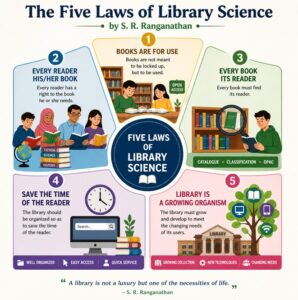
- Books are for Use: The first law of library science highlights that the primary purpose of a library is to encourage active use of its resources by readers. Historically, libraries served as repositories where books were kept under strict control, limiting access for users. Ranganathan challenged this idea, arguing that the true value of a book lies in its use rather than just its preservation. This principle contributed to the adoption of open-access systems, allowing users to browse shelves freely and eliminating unnecessary restrictions like complicated borrowing procedures. In today’s context, this law goes beyond physical books to encompass digital resources, ensuring that e-books, online journals, and databases are easily accessible. Libraries now prioritize improving accessibility through user-friendly interfaces, extended service hours, and remote access technologies, thereby maximizing the utilization of their collections.
- Every Reader His/Her Book: The second law emphasizes the importance of addressing the diverse information needs of all users. Libraries serve a wide variety of patrons, including students, researchers, professionals, and general readers, each with their own unique interests and requirements. This principle promotes inclusivity and equality, ensuring that no user is denied access to relevant information.
To put this principle into practice, libraries should develop diverse collections that encompass various subjects, languages, and formats. Additionally, offering services such as reference assistance, information literacy training, and personalized research support can help users find materials that meet their needs.
In the digital age, this law is reflected in the availability of customized search tools, recommendation systems, and accessible formats for users with disabilities. Ultimately, it underscores the responsibility of libraries to serve as facilitators of knowledge for everyone in society. - Every Book Its Reader: While the second law focuses on users, the third law emphasizes that every item in the library should be discoverable and accessible to the appropriate audience. No resource should remain unused due to poor organization or lack of visibility. This law underscores the importance of systematic cataloging, classification, and indexing, which enable users to efficiently locate relevant materials. It also encourages libraries to actively promote their collections through book displays, reading lists, and digital platforms. In modern libraries, tools such as Online Public Access Catalogs (OPAC), discovery services, and metadata systems play a crucial role in connecting users with resources. This law ensures that the full potential of the library’s collection is realized by bridging the gap between information resources and users.
- Save the Time of the Reader: The fourth law emphasizes the importance of efficiency and convenience in library services. Ranganathan acknowledged that users value their time, so libraries should be designed to minimize the effort needed to find and access information. This includes organizing collections logically, providing clear signage, and developing intuitive catalogs and search systems.
With advancements in technology, libraries have adopted various tools such as automated circulation systems, RFID-based services, and advanced search engines to enhance user experiences. Well-trained library staff and responsive reference services also play a vital role in reducing delays and confusion. In digital environments, fast-loading databases, accurate search results, and user-friendly interfaces further support this law. By prioritizing efficiency, libraries not only improve user satisfaction but also encourage continued use of their services. - Library is a Growing Organism: The fifth law emphasizes that a library is not a static institution but a dynamic entity that must continuously evolve. As knowledge expands and user needs change, libraries need to adapt by updating their collections, services, and technologies. This growth goes beyond just physical expansion; it also includes the development of digital resources, new service models, and innovative tools such as artificial intelligence and data analytics. Additionally, libraries must invest in staff development to keep up with emerging trends and technologies. This law underscores the importance of flexibility in infrastructure, policies, and management practices, ensuring that libraries remain relevant in a rapidly changing information landscape. It reflects a forward-looking vision where libraries are viewed as living systems that grow, adapt, and respond to the needs of their communities.
The Five Laws of Library Science provide a timeless and adaptable framework that continues to guide the development of library services worldwide. By emphasizing accessibility, inclusivity, discoverability, efficiency, and growth, these laws ensure that libraries remain essential institutions for knowledge sharing and learning. Even in the era of digital transformation, their principles are reflected in modern innovations, proving their enduring relevance and universal applicability.
Origin of the Five Laws of Library Science
The Five Laws of Library Science were proposed by S. R. Ranganathan, an eminent Indian librarian and mathematician, in 1931. He introduced these principles in his landmark book “The Five Laws of Library Science,” where he presented a revolutionary, user-centered approach to library services. His laws shifted the focus from mere preservation of books to ensuring accessibility, usability, and continuous growth of libraries, laying the foundation for modern librarianship worldwide.
Why the Five Laws of Library Science Are Considered Fundamental
The Five Laws of Library Science, formulated by S. R. Ranganathan in 1931, are fundamental because they provide a universal and enduring framework for organizing and delivering library services. These laws marked a significant shift in librarianship, moving the focus from book-centered practices to user-centered services, emphasizing accessibility, inclusivity, and efficiency. At a time when libraries were primarily viewed as repositories of books, Ranganathan’s principles redefined their purpose as active institutions dedicated to connecting users with information. Each law addresses a core aspect of library functioning—ensuring that resources are utilized effectively, meeting diverse user needs, promoting the discoverability of materials, saving users’ time, and supporting continuous growth and adaptation.
What makes these laws particularly important is their flexibility and timeless relevance. Although they were developed in the early twentieth century, their core ideas remain applicable to modern digital libraries, online databases, and emerging technologies such as artificial intelligence. For instance, the principle of saving the reader’s time is reflected today in advanced search systems and user-friendly interfaces, while the concept of the library as a growing organism aligns with the ongoing expansion of digital resources and services. Furthermore, these laws serve as a philosophical foundation for library policies, collection development, classification systems, and user services, guiding both theoretical understanding and practical decision-making in librarianship.
In essence, the Five Laws are considered fundamental because they encapsulate the core mission of libraries: to facilitate efficient and equitable access to knowledge while remaining adaptable to changing information environments. Their simplicity, clarity, and applicability across different types of libraries ensure that they continue to guide library professionals in creating effective, user-focused services in an ever-evolving world.
Main Objective of the Five Laws of Library Science
The Five Laws of Library Science, proposed by S. R. Ranganathan in 1931, are widely regarded as the foundation of modern librarianship. Each law addresses a specific aspect of library service, but collectively they share a common goal: to ensure that libraries function as efficient, user-centered, and dynamic institutions that effectively connect people with information. The primary objective of these laws is not merely to organize books but to create a system where knowledge is accessible, usable, and meaningful for all users.
- A Shift from Storage to Service: Before these laws were introduced, libraries were often viewed as places for preserving books rather than facilitating their use. Ranganathan’s principles transformed this traditional perspective by emphasizing that the true value of a library lies in how effectively its resources are utilized. The goal, therefore, is to shift libraries from being passive repositories to active service centers where users can easily access and utilize information. This transformation ensures that libraries play a vital role in education, research, and intellectual development.
- Ensuring Maximum Use of Resources: A central aim of the Five Laws is to maximize the utilization of library resources. Books, journals, and digital materials should not remain unused on shelves or in databases. Instead, libraries must create systems that encourage access and discovery. This involves removing barriers such as restricted access, poor organization, and a lack of awareness. By doing so, libraries ensure that every resource contributes to knowledge creation and learning.
- Fulfilling Diverse User Needs: Another key objective is to address the diverse needs of users. Libraries serve individuals with varying backgrounds, interests, and levels of expertise. The Five Laws promote inclusivity by ensuring that every user can find relevant information. This requires developing diverse collections, offering multiple formats (print, digital, and audiovisual), and providing personalized services such as research support and information literacy training. In this way, libraries become inclusive spaces that support all members of society.
- Promoting Efficiency and Saving Time: Efficiency is a crucial element of the Five Laws. The goal is to design library systems that save users’ time, allowing them to find information quickly and easily. This involves proper cataloging, classification, and the use of modern technologies such as online catalogs, automated systems, and digital search tools. By minimizing delays and simplifying access, libraries enhance user satisfaction and encourage continued engagement with their services.
- Supporting Continuous Growth and Adaptation: The Five Laws also stress that libraries must be dynamic and adaptable. The aim is to ensure that libraries grow in response to changes in technology, user expectations, and information formats. This growth includes expanding collections, adopting digital resources, and integrating innovative tools such as artificial intelligence and online platforms. By continuously evolving, libraries remain relevant and capable of meeting the challenges of the modern information environment.
- Balancing Users and Resources: At its core, the main objective of the Five Laws is to create a balanced relationship between users and information resources. Libraries must ensure that every reader finds suitable materials and that every resource reaches its intended audience. This balance is achieved through effective organization, user-focused services, and continuous improvement of library systems.
In summary, the main objective of the Five Laws of Library Science is to guide libraries in becoming accessible, inclusive, efficient, and evolving centers of knowledge. These principles extend beyond the simple management of books to emphasize the importance of serving users and facilitating the effective use of information. Even in the digital age, the goal remains the same: to ensure that libraries continue to support learning, research, and the free flow of knowledge in society.
Acknowledgement:
- Barner, K. (n.d.). The Library is a Growing Organism: Ranganathan’s Fifth Law of Library Science and the Academic Library in the Digital Era.
- Cochrane, P. A. (1992). Information Technology in Libraries and Ranganathan’s Five Laws of Library Science. 42(3), 235–241. https://doi.org/10.1515/libr.1992.42.3.235
- Gorman, M. (1998). The Five Laws of Library Science: Then & Now. School Library Journal, 44(7), 20–23.
- Hjørland, B. (2000). Library and information science: Practice, theory, and philosophical basis. Information Processing & Management, 36(3), 501–531. https://doi.org/10.1016/S0306-4573(99)00038-2
- Leiter, R. A. (2003). Reflections on Ranganathan’s Five Laws of Library Science. Law Library Journal, 95, 411.
Thanks sir
Sir Punjabi ch pdf pls