How Does a Digital Library Provide Easy and Convenient Access to Information?
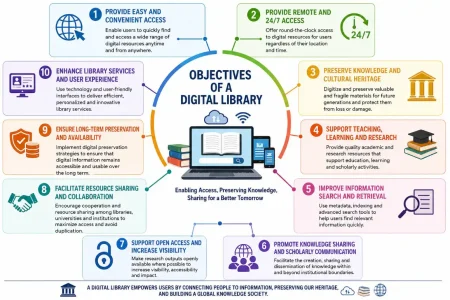
One of the primary objectives of a digital library is to provide easy, fast, and convenient access to information. In a traditional library, users often must visit in person, search through the catalogue, locate materials on shelves, and use them during specific hours of operation. A digital library alleviates many of these limitations by offering electronic access to organized digital resources via computers, smartphones, tablets, and other internet-connected devices. Depending on copyright and licensing conditions, users can access e-books, journal articles, theses and dissertations, research reports, manuscripts, photographs, audiovisual materials, institutional publications, and numerous other resources from almost anywhere.
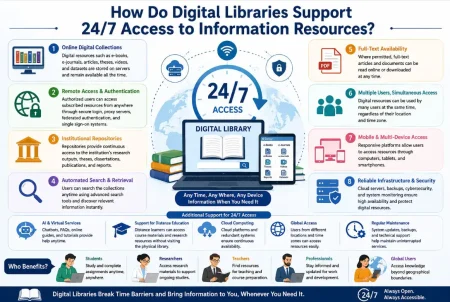
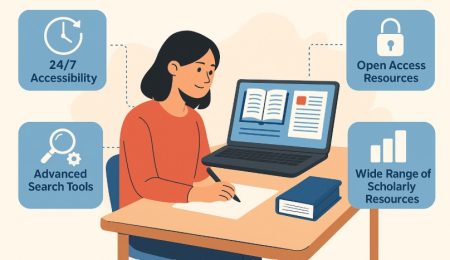
- Access to Information Anytime and Anywhere: Digital libraries greatly reduce geographical and time-related barriers to accessing information. Many digital collections are available 24 hours a day, seven days a week, enabling users to search for and use resources outside of normal library hours. This is especially beneficial for distance learners, researchers, working professionals, and students who may not have the opportunity to visit a physical library regularly.
For instance, a university student working on an assignment at night can search an institutional repository for relevant theses or research papers without waiting for the library to open the next morning. Similarly, a researcher living far from a university campus can access openly available repository materials remotely. For subscribed resources, authorized users can also receive off-campus access through institutional authentication systems. - Fast and Powerful Search Facilities: Digital libraries significantly improve the ease of accessing information by offering advanced search and retrieval features. Instead of manually browsing through physical bookshelves, users can quickly search through thousands or even millions of digital records in just seconds. These systems typically allow searches based on various criteria, such as title, author, subject, keywords, publication year, document type, and other metadata.
For example, a researcher interested in artificial intelligence can enter relevant keywords into the search box of a digital library. The system can then retrieve a diverse selection of materials, including journal articles, theses, conference papers, reports, and other related content. Users can further refine their search results by applying filters for publication date, author, subject, or resource type. This streamlined process saves a significant amount of time and enables users to find relevant information more efficiently. - Access to Different Types of Digital Resources: Digital libraries go beyond just housing electronic books; they can aggregate a variety of information resources within one digital space. Depending on the library’s purpose, the collections may include e-books, e-journals, theses, dissertations, research papers, conference proceedings, institutional reports, newspapers, photographs, maps, manuscripts, datasets, audio recordings, videos, and digitized archival materials.
For instance, a digital collection focused on a country’s history might feature digitized newspapers, historical photographs, maps, government documents, manuscripts, and audio recordings. This allows researchers to access these materials through a single digital platform, rather than having to visit multiple physical locations. - Full-Text Access to Information: Where copyright and licensing conditions allow, digital libraries can provide immediate full-text access to documents. After finding a relevant record, users may be able to read the document online or obtain an electronic copy without waiting for the physical item.
For instance, an institutional repository may provide the full text of a university thesis in PDF format. A researcher who discovers the thesis through a web search or the repository’s search interface can immediately read it online. Open digital libraries such as Project Gutenberg similarly provide full-text access to many public-domain books.
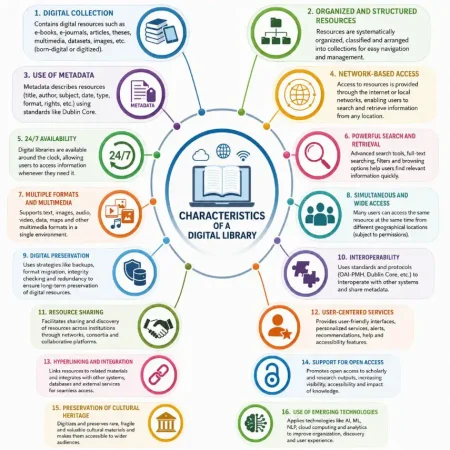
However, not every digital library resource is necessarily available in full text. Copyright restrictions, publisher agreements, embargo periods, and subscription licenses may limit access to certain materials. In such cases, a digital library may provide metadata, abstracts, or links to authorized access points. - Organized Information Through Metadata: Digital libraries use metadata to describe and organize their resources. Metadata may include information such as the title, author, subject, keywords, publication date, language, resource type, abstract, and identifier of a digital item. Proper metadata makes digital resources easier to discover and retrieve.
For example, if a university repository contains thousands of theses, metadata allows a user to search specifically for theses from a particular department, author, year, or subject area. Without properly structured metadata, locating a specific document within a large digital collection would be much more difficult.
Metadata standards and consistent description, therefore, play an essential role in making digital information organized, searchable, and discoverable. - Multiple Users Can Access Resources: Physical library materials often have limitations regarding simultaneous use. If a library owns only one printed copy of a book, normally only one borrower can have that copy at a particular time. Digital resources can provide greater flexibility, although simultaneous access depends on copyright and licensing arrangements.
Open-access documents can generally be viewed by many users at the same time. Some licensed e-books and databases also permit multiple simultaneous users, while others restrict access according to the institution’s subscription agreement.
For example, an openly available thesis in an institutional repository can be accessed by researchers in different countries at the same time. This greatly increases the reach and usability of scholarly information compared with a single physical copy kept on a library shelf. - Remote Access to Subscribed Electronic Resources: Academic digital library services frequently include access to subscribed databases, e-journals, and e-books. Institutions may use authentication technologies to allow authorized users to access these resources when they are outside the campus network.
For example, a university library may subscribe to databases containing thousands of scholarly journals. Through an institutional remote-access service, eligible students and faculty members can authenticate themselves from home and use subscribed content according to the relevant license. This extends access to scholarly information beyond the physical campus. - Linking and Interconnecting Information: Digital libraries can connect related resources through hyperlinks, identifiers, metadata, and reference relationships. A user viewing one record may be directed to related documents, other works by the same author, different versions of a publication, or external scholarly resources.
For example, an institutional repository record for a journal article may contain the article’s DOI, links to the author’s other publications, subject terms, and related research outputs. These connections allow users to move from one piece of information to another more easily and support broader exploration of a research topic. - Supporting Users with Disabilities: Well-designed digital libraries can also improve information accessibility for users with disabilities. Accessible websites can support screen readers, keyboard navigation, adjustable text sizes, sufficient contrast, alternative text for images, captions for multimedia, and other assistive technologies.
For example, a visually impaired student may use screen-reading software to navigate an accessible digital repository and listen to textual information. Searchable and properly structured electronic documents can also be easier to use with assistive technologies than inaccessible scanned images.
Therefore, accessibility should be considered an important part of providing equitable and convenient digital library services. - Access Through Different Devices: Modern digital libraries are increasingly designed to work across desktop computers, laptops, tablets, and smartphones. Responsive web design allows the interface to adapt to different screen sizes, enabling users to search collections and access resources using whichever device is most convenient.
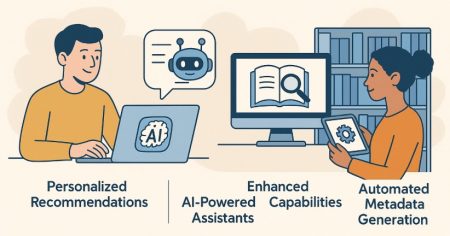
For example, a student traveling by bus may use a smartphone to search a university repository, save details of a useful research article, and later access the document on a laptop. Mobile-friendly access makes digital library services more flexible and better suited to contemporary information-seeking behavior. - Integration with Modern Technologies: Emerging technologies are further improving access to digital library information. Artificial intelligence, natural language processing, semantic search, recommendation systems, and AI-powered chatbots can help users navigate large digital collections and discover relevant resources.
For example, an AI-powered library chatbot may answer questions such as “Where can I find electronic theses?” or “How can I access online journals from home?” and direct the user to the appropriate digital service. Recommendation systems may suggest resources related to a document that a user is currently viewing.
Such technologies can make digital libraries more interactive and user-friendly, although they should complement rather than replace reliable metadata, professional information organization, and librarian support.
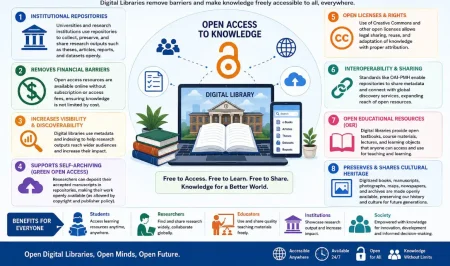
A digital library offers easy and convenient access to information by combining remote availability, powerful search capabilities, organized metadata, full-text access (where permitted), diverse digital collections, device compatibility, accessibility features, and modern information technologies. It enables users to discover and use information without being entirely dependent on a traditional library’s physical location or opening hours.
Most importantly, convenient digital access goes beyond merely placing documents online. An effective digital library must ensure that information is well-organized, searchable, discoverable, accessible, reliable, and user-friendly. By reducing geographical and temporal barriers, digital libraries efficiently connect users with relevant information, making them an essential component of modern education, research, and knowledge sharing.