The Advantages of Using a Traditional Library
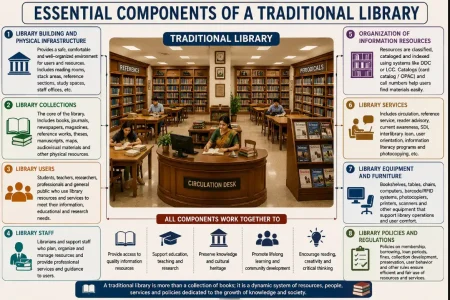
Traditional libraries provide numerous benefits that make them essential institutions for education, research, and lifelong learning. One of their greatest strengths is that they offer access to reliable and authoritative information. Unlike many online sources, library collections are carefully selected, evaluated, and organized by professional librarians to ensure their accuracy, credibility, and relevance. Users can access a wide variety of printed resources, including textbooks, scholarly journals, reference books, newspapers, magazines, government publications, theses, dissertations, manuscripts, and rare books. For example, an engineering student may consult printed textbooks and IEEE conference proceedings in a university library, while a history researcher may examine rare manuscripts or archival documents preserved in a national library. Institutions like the North South University Library, the University of Dhaka Library, and the National Library of Bangladesh provide extensive collections that support academic study and scholarly research, ensuring that users have access to high-quality information published by reputable academic institutions and publishers.
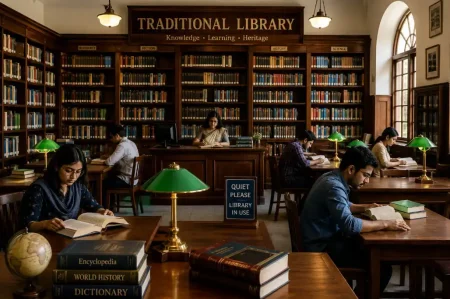
Another significant advantage of traditional libraries is the quiet and conducive learning environment they provide. Reading rooms, silent study areas, and research spaces allow users to study without the distractions commonly associated with smartphones, social media, and online notifications. Many students preparing for university examinations prefer studying in library reading rooms because the peaceful atmosphere enhances their concentration and productivity. Additionally, traditional libraries offer personalized assistance from professional librarians, who help users locate books, identify suitable reference sources, develop effective search strategies, and evaluate the credibility of information. For instance, a librarian may guide a postgraduate student in finding printed journals, statistical reports, or reference books needed for a research thesis. Librarians also conduct information literacy workshops that teach users how to search for, evaluate, and ethically use information.
Traditional libraries also play a crucial role in preserving cultural heritage and historical records. They maintain rare books, manuscripts, archives, local history collections, photographs, maps, newspapers, and government documents under appropriate preservation conditions to ensure their long-term availability. For example, the National Library of Bangladesh preserves important publications produced in the country, while the British Library safeguards historical manuscripts, such as the Magna Carta, and numerous rare books of international significance. University libraries often maintain institutional archives that contain dissertations, faculty publications, and historical records documenting the development of the institution. These preservation efforts ensure that valuable intellectual and cultural resources remain accessible for future generations.
Traditional libraries promote equal access to information by allowing individuals from diverse economic and social backgrounds to use expensive books and scholarly materials without the need to purchase them. A student who cannot afford costly medical or engineering textbooks can borrow them from an academic library, while members of the public can freely access educational and recreational materials through public libraries. This helps reduce educational inequalities and promotes lifelong learning. Additionally, traditional libraries encourage reading habits, intellectual growth, and community engagement. Browsing library shelves often enables users to discover books and subjects beyond their original interests. For example, a reader searching for a history book may also find related works on archaeology, politics, or culture located on nearby shelves. Libraries also organize book fairs, exhibitions, author talks, reading competitions, storytelling sessions for children, workshops, and literacy campaigns that enhance community participation and promote a culture of reading.
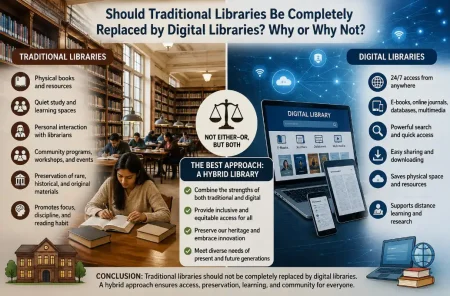
Although digital technologies have expanded access to electronic information, traditional libraries continue to offer unique benefits that cannot be fully replicated online. Their carefully curated collections, authentic printed materials, professional librarian support, quiet study environments, and commitment to preserving cultural heritage make them essential institutions for education and research. By providing reliable information, encouraging independent learning, supporting scholarly research, and fostering community engagement, traditional libraries play a vital role in the intellectual, cultural, and social development of individuals and society.