What Is an RFID Gate in a Library?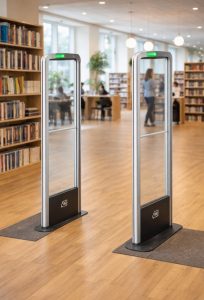
An RFID gate in a library is an electronic security and monitoring system installed at library entrances or exits to protect library materials and ensure proper circulation. RFID (Radio Frequency Identification) technology uses small RFID tags embedded inside books, journals, theses, and multimedia items. These tags store unique identification data that can be read wirelessly by RFID readers embedded in the gate antennas. When a user walks through the gate carrying library materials, the system automatically checks the status of each item against the library’s circulation database.
The core purpose of an RFID gate is to prevent unauthorized removal of library resources. For example, if a student forgets to issue a book at the circulation desk or self-check machine and tries to leave the library, the RFID gate immediately triggers an alarm. This alerts library staff so the issue can be resolved on the spot. On the other hand, when a book is properly issued, the RFID tag is automatically updated in the system, allowing the user to pass through the gate without any interruption.
RFID gates also improve efficiency by allowing multiple items to be detected simultaneously. For instance, a user carrying three or four issued books can walk through the gate in one step, whereas traditional barcode systems would require each item to be scanned individually. Similarly, during peak hours—such as before exams—RFID gates help manage heavy user traffic smoothly, preventing queues at exits. Beyond security, RFID gates support automated and self-service library environments. For example, when used alongside RFID self-check kiosks, users can independently borrow or return books, and the RFID gate ensures that only correctly processed items leave the library. In addition, RFID gates help protect special or high-demand collections by reducing the risk of accidental or intentional removal.
In modern academic libraries, RFID gates contribute to a secure, efficient, and user-friendly library experience. By combining automatic identification, real-time circulation verification, and fast throughput, RFID gates safeguard shared resources while supporting smooth daily library operations for both users and staff.
Why Do Libraries Use RFID Security Gates?
Libraries use RFID security gates to protect their collections, improve circulation efficiency, and ensure responsible use of shared resources. One of the primary reasons for installing RFID gates is to prevent unauthorized removal of library materials. Each book or media item contains an RFID tag that communicates with the gate system. When an item that has not been properly issued passes through the gate, the system immediately triggers an alarm, alerting library staff. This helps reduce accidental book losses, misplaced items, and intentional theft, especially in large or busy academic libraries.
Another important reason libraries adopt RFID security gates is to streamline circulation and reduce manual workload. Unlike traditional security methods that require staff to check items individually, RFID gates operate automatically and can detect multiple books simultaneously. For example, a student carrying several properly issued books can walk through the gate without stopping, while the system silently verifies their status in the background. This automation allows library staff to focus more on user support, research assistance, and other value-added services rather than routine security checks.
RFID security gates also contribute to a user-friendly and modern library environment. They integrate seamlessly with RFID self-check and return systems, enabling faster borrowing and smoother entry and exit during peak hours. At the same time, RFID gates maintain user privacy, as they do not store or display personal information—only item identification data is read.
Where Are RFID Gates Usually Installed in a Library?
RFID gates in libraries are usually installed at strategic entry and exit points to effectively monitor the movement of library materials without disrupting user flow. The most common location is near the main entrance or exit of the library, where all users must pass when leaving the library space. This placement ensures that any book or media item exiting the library is automatically checked by the system to confirm whether it has been properly issued at the circulation desk or via the self-check machine.
In larger or multi-level libraries, RFID gates may also be installed at secondary exits, such as side doors or floor-specific access points, to prevent materials from being taken out through alternative routes. For example, if a library has multiple floors with independent exits, RFID gates are often positioned at each exit to provide comprehensive coverage. In some academic libraries, gates are placed near controlled access areas, such as special collections sections or high-demand reading rooms, to add an extra layer of security for valuable resources.
Is the RFID Gate Part of the Library’s Circulation System?
Yes, an RFID gate is an integral part of the library’s circulation system, working closely with other RFID-enabled services such as self-check machines and circulation desks. While the RFID gate itself does not issue or return books, it continuously communicates with the library management system to verify the circulation status of each item. When a book is properly checked out, its RFID tag is updated in the system, allowing it to pass through the gate without triggering an alarm.
The RFID gate functions as a real-time verification checkpoint within the circulation workflow. For example, when a user borrows a book using a self-check kiosk, the system changes the item’s status to “issued.” As the user exits the library, the RFID gate reads the tag and confirms that the item is authorized to leave the premises. If a book has not been issued or has an incorrect status, the gate immediately alerts staff, helping prevent circulation errors and material loss.
Are RFID Gates Safe for Users and Library Materials?
Yes, RFID gates are safe for both users and library materials and are widely used in libraries around the world without posing health or safety risks. RFID gates operate using low-power radio frequency signals, which are similar to those used in everyday technologies such as Wi-Fi routers, access cards, and contactless payment systems. These signals are non-ionizing, meaning they do not harm the human body, and users can walk through RFID gates—including students, staff, and visitors—without any physical contact or exposure concerns.
From the perspective of library materials, RFID gates are also completely safe. The RFID tags embedded inside books and other resources are passive and durable, designed specifically for long-term use in libraries. For example, books can pass through RFID gates thousands of times without any damage to their pages, bindings, or stored information. The radio signals do not affect printed text, images, or digital media such as CDs and DVDs. In addition, RFID gates are designed with user comfort and accessibility in mind. They do not interfere with mobile phones, laptops, or personal belongings, and they do not store or display any personal user data—only item identification information is read.
How Does a Library RFID Gate Work?
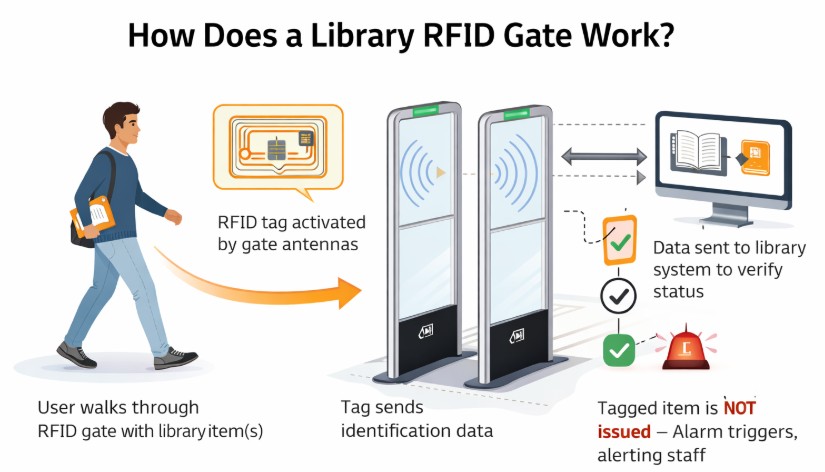
An RFID gate in a library works by automatically detecting RFID-tagged library materials as users pass through the entrance or exit and verifying their circulation status in real time. Each library item—such as a book, journal, or DVD—contains a small RFID tag that stores a unique identification number. This tag does not need a battery; it is activated when it comes within the range of the RFID gate’s antennas.
When a user walks through the RFID gate, the antennas within it emit low-power radio-frequency signals. These signals activate the RFID tags inside the library materials, causing them to transmit their identification data back to the gate. The gate then communicates with the library’s circulation system to check whether each item has been properly issued, returned, or is restricted from leaving the library.
If the system confirms that all items are validly issued, the user can exit the library without any interruption. However, if one or more items have not been checked out correctly, the RFID gate immediately triggers an audio and/or visual alarm to alert library staff. For example, if a student accidentally forgets to issue a book at the self-check machine, the gate will detect the unissued item and raise an alert. In this way, RFID gates ensure fast, accurate, and automated monitoring of library materials while allowing smooth, convenient user movement.
How Does the RFID Gate Detect Borrowed and Unborrowed Books?
An RFID gate detects borrowed and unborrowed books by reading the RFID tag embedded in each library item and checking its circulation status in the library management system. Every RFID tag contains a unique identification number that links the physical item to its digital record in the library’s circulation database. This record stores important status information, such as whether the item is currently issued, returned, restricted to in-library use, or missing.
When a user walks through the RFID gate, the gate’s antennas emit low-power radio signals that activate nearby RFID tags. The tags respond by transmitting their identification data back to the gate. The system then automatically compares this data with the circulation system in real time. If the book has been properly borrowed, its status is marked as “issued,” and the gate allows the user to pass through without any alert.
If the book has not been borrowed or has an incorrect status, the RFID gate immediately triggers an alarm. For example, if a student forgets to issue a book at a self-check kiosk or circulation desk, the item’s RFID tag still shows it as “available” or “in-library use only.” When this unborrowed book passes through the gate, the mismatch between the tag’s status and exit authorization causes the alarm to sound. In this way, RFID gates provide fast, accurate, and automatic detection of both borrowed and unborrowed books while maintaining smooth library operations.
Does the RFID Gate Work Automatically Without Staff Intervention?
Yes, the RFID gate works automatically without direct staff intervention during normal library operations. Once the system is properly configured and integrated with the library’s circulation system, the RFID gate continuously monitors all tagged library materials passing through the entrance or exit. It automatically reads RFID tags, verifies item status, and makes instant decisions—allowing issued items to pass freely while identifying unissued or restricted materials.
In everyday use, library staff do not need to manually check books at the gate. For example, when a student borrows a book using a self-check machine or the circulation desk, the system updates the item’s status to “issued.” As the student exits the library, the RFID gate automatically recognizes the valid status and remains silent. If a book has not been properly issued, the gate triggers an alarm on its own, alerting staff only when attention is needed. While staff intervention is not required for routine operation, library personnel still play an important role in system oversight and user assistance. They respond to alarms, help resolve circulation errors, and ensure the RFID equipment is functioning correctly.
Benefits of Using RFID Gates in Libraries
RFID (Radio Frequency Identification) gates have become a key component of modern library infrastructure. By integrating security, automation, and circulation management into a single system, RFID gates offer multiple benefits that enhance both library operations and user experience. The main benefits of using RFID gates in libraries are discussed below.
- Enhanced Security of Library Collections: RFID gates significantly strengthen security by automatically monitoring all tagged materials as they pass through exit points. Each item’s RFID tag is checked against the circulation system in real time. If an item has not been properly issued, the gate immediately triggers an alarm.
This prevents both accidental removals (such as users forgetting to check out a book) and intentional theft. Unlike traditional security systems, RFID gates are highly accurate and difficult to bypass, making them especially valuable in large academic libraries with open access collections. - Automated and Accurate Circulation Control: RFID gates are directly integrated with the library management system, ensuring real-time synchronization between physical items and digital records. When a book is issued or returned, its RFID tag status is updated instantly.
As a result, the gate can accurately distinguish between borrowed, returned, and in-library-use-only materials. This automation minimizes circulation errors, reduces disputes over missing books, and helps maintain clean, reliable circulation data for inventory and reporting purposes. - Faster User Movement and Reduced Exit Congestion: One of the key operational advantages of RFID gates is their ability to read multiple items simultaneously. Users do not need to stop, pause, or scan books individually when exiting the library.
During peak periods—such as exam seasons or assignment deadlines—this feature dramatically reduces queues at exits. Smooth movement improves user satisfaction and ensures that security checks do not become a bottleneck in busy library environments. - Strong Support for Self-Service Library Models: RFID gates are essential for enabling self-check and self-return services. When users borrow books through self-service kiosks, the RFID system automatically updates the item’s status. The RFID gate then acts as a final verification point.
This allows libraries to operate extended hours, reduce dependency on service desks, and promote independent use of library services. In effect, RFID gates make 24/7 or partially unmanned library services safer and more feasible. - Improved Staff Efficiency and Workload Reduction: By automating exit-level security checks, RFID gates eliminate the need for staff to manually inspect books. Library personnel are only required to intervene when an alarm sounds.
This reduces repetitive tasks and frees staff time for higher-value activities such as user education, research consultations, digital literacy training, and collection development. Over time, this leads to better service quality and staff satisfaction. - User-Friendly, Safe, and Non-Intrusive Experience: RFID gates are designed to be non-disruptive. For properly issued items, users pass through silently without delays or questioning. The system does not collect personal data; it reads only item-level information, ensuring user privacy. Additionally, RFID gates use low-power radio signals that are safe for people, books, and electronic devices. This creates a secure environment without making users feel monitored or uncomfortable.
In summary, RFID gates provide far more than basic security. They enhance collection protection, operational efficiency, automation, staff productivity, and user convenience. By integrating seamlessly with circulation systems and self-service technologies, RFID gates help libraries operate smarter, faster, and more securely—making them a cornerstone of modern library management.