
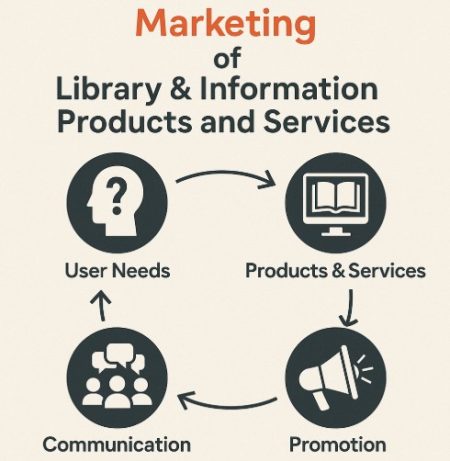
Marketing of information products and services in university libraries refers to the planned and systematic efforts made by libraries to promote their collections, digital resources, and specialized services to their target audience-students, faculty, researchers, and the wider academic community. In today’s information-rich environment, where users often turn first to easily accessible online platforms like Google Scholar or ResearchGate, libraries must actively showcase their unique value and relevance. For example, a university library subscribing to Scopus, Web of Science, or JSTOR needs to ensure that students and faculty are not only aware of these resources but also trained to use them effectively.
Marketing goes beyond simply advertising resources; it involves identifying user needs, segmenting audiences, designing appropriate services, and communicating their benefits effectively. For instance, orientation programs for first-year students can highlight essential services like borrowing policies, e-resource access, and plagiarism-checking tools such as Turnitin. Similarly, targeted workshops for faculty members may focus on citation management software like EndNote or Zotero to support their research needs.
Libraries also employ modern strategies such as social media campaigns, online newsletters, and digital signage to increase awareness and engagement. For example, posting short tutorial videos on YouTube or sharing infographics on Facebook about how to access e-resources remotely can attract significant attention. At North South University Library, services like RFID-based self-check machines or remote access through OpenAthens can be promoted as examples of user-friendly innovations. By marketing their services effectively, libraries bridge the gap between their investments in expensive databases, digital repositories, and technology-driven services, and the actual usage by the academic community. This ensures that resources such as institutional repositories are not underutilized but instead become integral to student learning and faculty research.
Marketing of Information Products and Services in University Libraries
In university libraries, marketing of information products and services is not just about advertising the availability of resources-it is a comprehensive approach to understanding users’ needs, tailoring services, and effectively communicating the value that the library provides. Information products include tangible and intangible resources such as textbooks, journals, theses, e-books, and databases like Scopus or JSTOR. Services, on the other hand, cover areas such as reference assistance, library orientations, research support, training workshops, citation management, and remote access systems. The goal of marketing in this context is to ensure that these products and services reach the right audience and are actively used to enhance learning and research outcomes.
Unlike commercial marketing, which is driven primarily by profit motives, library marketing is user-centered and mission-driven. It emphasizes creating awareness, fostering user satisfaction, and building long-term engagement with the academic community. For example, when a library invests in costly databases, it must design outreach campaigns—through faculty collaborations, email newsletters, or social media announcements-to inform students and researchers of their benefits. Without marketing, these resources often remain underutilized, reducing their value to both the library and the institution. Moreover, marketing involves strategic planning and segmentation. Libraries must recognize that first-year students, postgraduate researchers, and faculty members have different needs. While undergraduates may require training on basic catalogue searches and plagiarism awareness, faculty may benefit more from workshops on impact metrics, open access publishing, or the institutional repository. By targeting groups with tailored messages and services, libraries increase relevance and strengthen relationships with their users.
Another important aspect of marketing in university libraries is branding and visibility. In a time when students often default to Google or other online platforms, libraries must position themselves as trusted gateways to credible, scholarly information. This can be achieved through modern tools like digital signage inside the library, virtual tours, video tutorials on YouTube, and interactive posts on platforms like Facebook or LinkedIn. For instance, sharing success stories where students improved their thesis quality after library workshops can serve as a powerful promotional tool.
Why Marketing is Important for University Libraries in Today’s Digital and Competitive Academic Environment
In today’s rapidly evolving academic landscape, university libraries face increasing challenges in maintaining their relevance and ensuring user engagement. With the widespread availability of digital platforms, open access resources, and alternative information providers, students and faculty now have multiple channels for accessing scholarly materials. This makes marketing an essential function for university libraries, allowing them to showcase their value, differentiate their services, and sustain their central role in academic success. Marketing enhances visibility and awareness of library resources, many of which remain underutilized due to lack of promotion. For example, costly subscriptions to databases like Scopus or plagiarism detection tools such as Turnitin require targeted campaigns, orientations, and training sessions to ensure that users understand their benefits and applications.
In a competitive digital environment, where tools like Google Scholar and ResearchGate are widely used, marketing helps libraries emphasize their unique strengths—credibility, curated collections, and personalized support. Highlighting these advantages positions libraries as trusted providers of authoritative information, ensuring that users continue to see them as essential despite the abundance of free alternatives. At the same time, marketing contributes directly to academic success and research productivity by connecting users to the right resources and services. Workshops on citation management software like EndNote or Zotero, or campaigns promoting the institutional repository, help researchers publish in high-impact journals while also boosting the visibility of the university’s scholarly output.
Marketing also strengthens the relationship between libraries and their diverse user groups by tailoring services to specific needs. Undergraduate students may benefit from campaigns on plagiarism prevention, while postgraduate researchers and faculty require advanced training on data management, research impact, or open access publishing. By showing attentiveness to these varied demands, libraries build trust and long-term engagement. Moreover, marketing provides a way to justify investments by demonstrating usage statistics, success stories, and evidence of impact to university administrators. When libraries effectively promote their resources and report increased downloads, participation, or research outcomes, they can secure continued funding and institutional support.
Finally, marketing prepares libraries to adapt to future trends such as blended learning, virtual classrooms, and AI-driven research tools. Promoting innovative services like RFID-based circulation systems, remote access platforms such as OpenAthens, or virtual reference desks shows that libraries are evolving with technological changes and aligning with the university’s digital transformation goals. Ultimately, in today’s competitive academic environment, marketing is no longer an optional task for university libraries but a necessity. It ensures that libraries remain dynamic, user-centered hubs of teaching, learning, and research, reinforcing their indispensable role within higher education.
How Marketing Helps Libraries Demonstrate Their Value to Students, Faculty, and Administrators
Marketing plays a crucial role in enabling libraries to clearly communicate their relevance and impact within the academic community. For students, marketing highlights how library services-such as access to e-resources, plagiarism detection tools, study spaces, and research skill workshops-directly support their learning and academic success. By promoting these services through orientations, social media updates, and targeted campaigns, libraries ensure that students recognize the library as more than just a place to borrow books, but as an essential partner in their educational journey. For faculty, marketing demonstrates how the library contributes to teaching and research excellence by offering tools like citation management software, access to global scholarly databases, and research visibility through institutional repositories. These efforts underscore the library’s role in enhancing faculty productivity and academic output. For administrators, marketing provides measurable evidence of the library’s impact through usage statistics, success stories, and outcomes that justify investments in subscriptions, technology, and staffing. By actively showcasing achievements and aligning services with institutional goals, libraries prove that they are not passive storehouses of information but dynamic, value-driven hubs that advance the university’s mission of education, research, and innovation.
Marketing Strategies for University Libraries to Promote Information Products and Services Effectively
University libraries are no longer confined to being quiet spaces filled with bookshelves and study desks. They have evolved into dynamic hubs of information, offering a wide range of products and services such as e-journals, databases, institutional repositories, plagiarism detection tools, and research consultation programs. However, despite these advancements, many of these resources remain underutilized due to a lack of awareness among users. In today’s digital and competitive academic environment, marketing has become a necessity for university libraries to ensure their offerings are visible, accessible, and valued by students, faculty, and administrators.
- User-Centered Outreach Programs: A successful marketing strategy begins with understanding the diverse needs of library users. Undergraduate students, postgraduate researchers, and faculty members require different forms of support, and outreach programs should reflect these distinctions. For instance, first-year students can benefit from orientation programs that introduce them to the library’s catalog system, borrowing policies, and plagiarism prevention tools like Turnitin. On the other hand, postgraduate students and faculty may need specialized workshops on advanced search techniques, citation management software such as EndNote or Zotero, or guidance on research impact assessment using Scopus. By tailoring outreach programs to specific groups, libraries can ensure that their services remain relevant and engaging.
- Leveraging Digital Platforms and Social Media: Digital platforms have become indispensable tools for reaching the academic community. Social media channels such as Facebook, Instagram, and LinkedIn can be used to share updates on new arrivals, promote workshops, and highlight special services. Libraries can also create YouTube tutorials that provide step-by-step guidance on using databases like JSTOR or PubMed. Email newsletters and library blogs serve as additional avenues for continuous communication, ensuring that users stay informed about updates, training sessions, or research support opportunities. For example, a short video on how to access e-resources remotely via OpenAthens can attract both current students and faculty, increasing the visibility and use of digital services.
- Faculty Collaboration and Academic Partnerships: Faculty members play an influential role in shaping student engagement with academic resources. Libraries can strengthen their marketing efforts by collaborating closely with faculty, encouraging them to integrate library resources into course requirements. For example, professors may assign literature reviews that require the use of Scopus or Web of Science, prompting students to explore these databases. Embedding librarians into academic departments or collaborating on curriculum design also enhances the library’s role as a partner in research and teaching. Such collaborations not only boost awareness of resources but also reinforce the perception of the library as an integral part of the academic process.
- On-Campus Promotions and Events: Physical visibility remains an effective strategy for promoting library resources. Events such as book fairs, research week celebrations, and exhibitions of rare collections attract attention and highlight the library’s contributions beyond routine services. Promotional posters, banners, and digital displays within the campus can remind students and faculty about ongoing workshops, RFID-based self-check systems, or extended opening hours during exam seasons. For example, during final examinations, a library could display reminders about quiet study zones and highlight access to e-resources that support last-minute research. These activities create awareness while also integrating the library into campus life.
- Utilizing Technology and Innovation: Modern technologies offer both improved services and marketing opportunities. Features like RFID-enabled self-check machines, book-drop systems, and remote access platforms such as OpenAthens can be promoted as user-friendly innovations that save time and increase convenience. Demonstrations of these technologies during orientations or through interactive kiosks help users understand and adopt them quickly. Additionally, libraries can use analytics to monitor usage trends and identify underutilized resources, enabling targeted promotional campaigns. For instance, if a database shows low engagement, a focused training session or digital campaign can improve its visibility.
- Storytelling and Success Showcasing: One of the most persuasive forms of marketing is storytelling. Sharing success stories of students and faculty who benefited from library resources makes the impact tangible. For example, highlighting how a student improved their thesis by using plagiarism detection tools or how faculty increased their research visibility through the institutional repository can serve as powerful testimonials. Publishing these stories on social media, newsletters, or university websites not only builds trust but also inspires others to make greater use of library resources.
- Branding and Identity Development: Libraries must also establish a clear brand identity within the university. A strong visual identity-, taglines, consistent color schemes in promotional materials-creates recognition and trust. For instance, branding campaigns like “Your Gateway to Knowledge” or “Powered by NSU Library” can make services more memorable and foster a sense of belonging among users.
Marketing strategies in university libraries must be proactive, multifaceted, and user-centered. By implementing outreach programs, leveraging digital platforms, collaborating with faculty, organizing campus events, utilizing technology, and showcasing success stories, libraries can significantly enhance the visibility and use of their products and services. More importantly, these strategies allow libraries to demonstrate their value as essential partners in education and research, ensuring they remain vibrant, innovative, and indispensable in today’s academic environment.
Using Social Media Platforms to Reach Wider Audiences in University Libraries
Social media has become one of the most powerful tools for university libraries to connect with their academic communities and beyond. By using platforms such as Facebook, Instagram, Twitter (X), LinkedIn, and YouTube, libraries can share updates, promote resources, and engage with users in real time. These platforms allow libraries to showcase new arrivals, announce training workshops, highlight subscription databases, and even provide quick research tips. For example, a library can post a short tutorial video on YouTube about how to access JSTOR remotely, or create an Instagram reel demonstrating how to use RFID self-check machines. Social media also enables interactive engagement through polls, quizzes, and live Q&A sessions, which not only increase visibility but also build a sense of community among users. Libraries can leverage LinkedIn to highlight faculty research published in the institutional repository, while Twitter (X) can be used for quick updates on service changes or event announcements. By consistently creating engaging, user-friendly content and aligning it with the academic calendar-such as promoting e-resources before exam season-libraries can expand their reach, ensure better usage of services, and position themselves as dynamic, student-centered spaces in the digital era.
Effective Promotional Tools for Library Marketing
In the era of digital transformation, university libraries must actively promote their information products and services to ensure visibility and usage. While resources such as e-journals, databases, and institutional repositories are valuable, they often remain underutilized unless users are made aware of them. To bridge this gap, libraries can employ a combination of traditional and digital promotional tools. Posters, newsletters, email campaigns, and webinars are among the most effective tools for marketing library services, each serving distinct purposes and reaching different segments of the academic community.
- Posters and Digital Displays: Posters have long been a staple of library promotion, but in modern contexts, they can be enhanced with creative design and strategic placement. Posters placed at library entrances, study areas, and high-traffic campus locations can draw attention to new resources, upcoming workshops, or seasonal campaigns, such as extended hours during exam season. For example, a poster advertising training on citation management software like EndNote or Zotero can encourage student participation. Digital signage, displayed on screens within the library or across the campus, provides an even more dynamic way to promote services, offering rotating content and multimedia features that capture user attention more effectively than static posters.
- Newsletters: Newsletters, whether printed or digital, provide a consistent channel for libraries to communicate with their users. They allow libraries to share updates about new subscriptions, highlight faculty publications, showcase student success stories, and announce upcoming events. A monthly digital newsletter, for example, could include a “Resource of the Month” section to promote underused databases or a “Faculty Spotlight” highlighting research supported by the library. Newsletters also serve as archival records of library activities, offering administrators tangible evidence of the library’s contributions.
- Email Campaigns: Email campaigns are direct and personalized promotional tools that allow libraries to reach users quickly and efficiently. Targeted emails can be sent to specific groups, such as first-year students receiving orientation information, or faculty being informed about new research support services. Libraries can also use email reminders to notify users of resource trials, workshops, or deadlines for book renewals. For instance, an email campaign announcing free access to a trial database like Web of Science can increase engagement and feedback before the library decides on permanent subscription. The success of email campaigns lies in concise, engaging messages with clear calls to action, such as links to event registration or video tutorials.
- Webinars and Virtual Workshops: In a digital-first environment, webinars and virtual workshops are among the most impactful tools for promoting and delivering library services. They allow libraries to provide live training on topics such as database searching, plagiarism prevention, or research impact measurement. Webinars not only promote services but also demonstrate the library’s commitment to supporting users in flexible and convenient formats. For example, a webinar on how to use Scopus effectively for literature reviews can attract both students and faculty, increasing awareness of the resource. Recordings of webinars can also be uploaded to the library’s YouTube channel or website, extending their reach and serving as reusable promotional content.
- Integrating Tools for Greater Impact: While each tool is effective on its own, the greatest impact comes from integrating them into a comprehensive marketing strategy. For instance, a new database could be promoted through a poster campaign on campus, detailed in a monthly newsletter, introduced via a targeted email, and supported with a live webinar demonstration. This multi-channel approach ensures that the message reaches diverse audiences and maximizes user engagement.
Promotional tools such as posters, newsletters, email campaigns, and webinars are essential in bridging the gap between library resources and user awareness. Posters capture immediate attention on campus, newsletters provide regular updates, email campaigns offer direct communication, and webinars deliver interactive, value-added training. Together, they form a powerful toolkit for university libraries to ensure that their information products and services are effectively marketed, widely known, and actively used. By adopting these tools strategically, libraries reinforce their role as vital partners in academic success and research advancement.
Collaboration Between Libraries and Faculty to Promote Information Literacy Services
Collaboration with faculty members is one of the most effective ways libraries can promote information literacy services, as faculty directly shape the academic experiences of students. By working together, librarians and faculty can integrate essential research and information skills into the curriculum in meaningful ways. For example, librarians can collaborate with faculty teaching first-year writing courses to design assignments that require students to search the library’s OPAC and use e-books or journal databases, helping them practice locating and evaluating reliable sources early in their academic journey. Faculty in science or engineering programs might invite librarians to conduct specialized sessions on how to use subject-specific databases such as IEEE Xplore or PubMed, ensuring students are equipped to navigate discipline-focused information landscapes. Similarly, librarians can work with business faculty to provide training on accessing market research databases like ProQuest or EBSCO Business Source. When faculty embed library workshops directly into their courses, students perceive information literacy not as an optional skill but as an integral part of their academic success. Faculty endorsements also lend credibility to library services, motivating students to actively participate. Through these partnerships, libraries extend the reach of their services, promote academic integrity, and equip students with lifelong research skills.
Challenges University Libraries Face in Marketing Their Information Products and Services
University libraries provide an array of information products and services ranging from e-journals, subscription databases, institutional repositories, and plagiarism detection tools to research consultations, workshops, and modern facilities like RFID-based circulation systems. Despite these offerings, many resources are underutilized because libraries face numerous challenges in effectively marketing them to students, faculty, and administrators. Below is a detailed discussion of the key barriers that hinder library marketing efforts.
- Limited Awareness Among Users: A persistent challenge for libraries is that many users are simply unaware of what is available to them. Students often assume that freely accessible sources such as Google Scholar or Wikipedia are sufficient for academic work, overlooking specialized resources like JSTOR, Web of Science, or Scopus that the library invests in heavily. For example, a university may spend thousands of dollars annually on a subscription database, yet usage statistics may remain low because students do not know it exists or how to use it. Without effective awareness campaigns-through orientations, posters, or social media promotions—these resources risk being ignored, diminishing the return on investment.
- Budgetary and Staffing Constraints: Marketing requires both financial and human resources. Libraries must invest in promotional materials, digital campaigns, and sometimes even dedicated marketing staff. However, most university libraries operate under limited budgets that prioritize acquisitions over outreach. This results in marketing being treated as secondary rather than essential. In addition, library staff are often stretched thin, handling circulation, cataloging, and research support, leaving little time for designing campaigns. For example, a library may want to run a series of webinars promoting its institutional repository but cannot allocate staff hours or technical support to make it happen.
- Resistance to Change and Lack of Marketing Culture: Traditionally, libraries have been viewed as service providers where users seek resources on their own. This passive model has created a culture in which marketing is not seen as a core responsibility. In some institutions, librarians themselves may resist marketing activities, believing that “the resources speak for themselves.” For instance, librarians may hesitate to promote services on social media, fearing it detracts from the library’s scholarly image. This lack of a marketing mindset prevents libraries from adopting user-centered promotional strategies, branding techniques, or innovative outreach campaigns that could enhance visibility.
- Diverse and Fragmented User Needs: University libraries serve a highly diverse population, and marketing strategies must address varied needs simultaneously. Undergraduates may require introductory training on catalog searches, referencing, and plagiarism prevention, while faculty may prioritize advanced features of citation management software, access to impact metrics, or research visibility through institutional repositories. Designing a single marketing campaign that appeals to all groups is nearly impossible. For example, promoting “library workshops” in general terms may not attract many participants, but segmenting the campaign into specific offerings-such as “Citation Basics for First-Year Students” and “Advanced Publishing Strategies for Faculty”-requires more planning, staff effort, and time.
- Competition from Alternative Information Sources: The convenience of online platforms such as Google Scholar, ResearchGate, Academia.edu, or even AI-powered tools poses a significant challenge to library marketing. Students and faculty often default to these sources because they are accessible and user-friendly, even if they lack depth or reliability. Convincing users to turn to library resources instead requires marketing campaigns that emphasize credibility, authority, and comprehensive access. For example, a student may not realize that a quick search on Google Scholar provides only abstracts, whereas the library subscription gives full-text access to the same article. Without effective marketing, users may continue favoring less reliable alternatives.
- Rapid Technological Changes: The information landscape evolves rapidly, and libraries must adapt their marketing strategies to keep pace. New tools and access systems, such as OpenAthens for remote authentication, plagiarism detection upgrades, or institutional repository platforms, require regular promotion to ensure users know how to use them. The challenge lies in continuously updating promotional materials, training users, and staying ahead of technological developments. For example, when a library shifts from IP-based access to remote login systems, students who are unaware of the change may mistakenly believe they have lost access, unless timely marketing campaigns communicate the transition.
- Measuring the Impact of Marketing Efforts: In commercial contexts, marketing success is often measured through sales, but libraries must rely on more complex indicators such as database usage statistics, workshop attendance, or improvements in student research output. Collecting and analyzing these data requires specialized skills and tools that many libraries lack. For instance, while libraries may track how many people attended a plagiarism awareness webinar, they may struggle to measure whether it actually reduced cases of academic dishonesty. Without clear metrics, it becomes difficult for libraries to justify marketing investments to administrators.
Marketing information products and services in university libraries is critical, but it is not without challenges. Limited awareness, budgetary and staffing constraints, cultural resistance to marketing, diverse user needs, competition from alternative sources, rapid technological changes, and difficulties in measuring impact all create barriers to success. To overcome these challenges, libraries must foster a marketing culture, seek institutional support, adopt innovative and user-centered strategies, and invest in training staff with communication and data analysis skills. Only by addressing these issues can university libraries ensure their resources are visible, valued, and fully integrated into the academic life of their institutions.
Future Trends Influencing the Marketing of University Library Resources and Services
As higher education continues to evolve, university libraries must adapt their strategies not only in the delivery of resources and services but also in the ways they promote them. The future of library marketing will be shaped by technological innovations, changing user expectations, and the increasingly competitive academic environment. To remain visible and relevant, libraries must anticipate these trends and incorporate them into their outreach efforts.
- Increased Use of Data Analytics and Personalization: One of the most significant future trends is the use of data analytics to inform marketing strategies. Libraries can analyze usage statistics, search patterns, and feedback data to better understand user preferences and behaviors. This will allow for personalized marketing, where students and faculty receive targeted recommendations based on their field of study or past resource usage. For example, a science student could receive a tailored email promoting PubMed or IEEE Xplore, while a business faculty member might be informed about ProQuest or EBSCO Business Source. Such personalization makes marketing campaigns more effective and user-centered.
- Expansion of Social Media and Multimedia Marketing: Social media will continue to be a dominant channel for marketing library services. However, future trends point toward greater use of multimedia formats such as Instagram reels, TikTok videos, podcasts, and interactive infographics. Libraries may create short, engaging videos that demonstrate how to access e-resources remotely or share student testimonials about how a workshop improved their research skills. Visual and interactive storytelling will become more important in capturing the attention of digitally native students.
- Integration of Artificial Intelligence (AI) and Chatbots: AI-driven tools and chatbots are already being introduced in many libraries to answer basic queries, guide users to resources, and provide real-time assistance. In the future, these tools will also play a role in marketing by sending personalized notifications, recommending relevant databases, or promoting upcoming events. For example, an AI chatbot on the library website could remind students about upcoming information literacy workshops or suggest relevant e-books for their research topic.
- Emphasis on Mobile-First Marketing: With students and faculty increasingly accessing information through smartphones, mobile-first marketing will become essential. Libraries will need to optimize their promotional content for mobile devices, ensuring newsletters, event reminders, and database tutorials are easily accessible on smaller screens. Mobile apps or push notifications from the library system may remind users of due dates, promote new services, or alert them to trial access of new databases.
- Virtual and Augmented Reality (VR/AR) Experiences: As immersive technologies become more mainstream, libraries may use virtual or augmented reality to market their spaces and services. A virtual tour of the library can be promoted online to help new students familiarize themselves with study zones, special collections, or self-checkout systems before visiting in person. Similarly, AR features in library mobile apps could highlight resources when a user scans a shelf or a poster. This form of marketing not only engages users but also creates memorable experiences that build stronger connections to the library.
- Greater Focus on Open Access and Institutional Visibility: The global shift toward open access publishing will influence how libraries market their resources. Libraries will increasingly promote their institutional repositories, faculty publications, and student research to demonstrate the university’s contribution to global knowledge. Marketing campaigns may highlight how depositing in open access platforms enhances visibility and citation impact, appealing to both faculty and administrators who are concerned with rankings and research influence.
- Building Community Through Engagement Campaigns: Future library marketing will focus not only on promoting services but also on building community. Campaigns will emphasize collaborative learning spaces, peer support networks, and partnerships with student organizations. For example, libraries may launch co-branded campaigns with academic departments or student clubs to promote research competitions, hackathons, or literacy week celebrations. By aligning with academic and cultural events, libraries can market themselves as central to the university’s intellectual and social life.
The future of marketing in university libraries will be shaped by personalization, multimedia engagement, artificial intelligence, mobile-first strategies, immersive technologies, open access promotion, and community-driven campaigns. Libraries that embrace these trends will not only expand the reach of their resources and services but also strengthen their role as innovative, student-centered institutions. By anticipating and adapting to these changes, university libraries can ensure their continued relevance and visibility in the evolving academic landscape.

1 Comment
This is so helpful. Thank you so much. Regards
Camy okoro