Library Resource-Sharing Networks
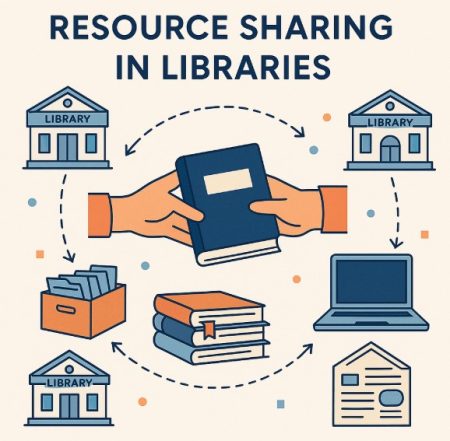
Library resource-sharing networks are collaborative systems through which libraries cooperate to provide broader access to information resources beyond their individual collections. Instead of functioning in isolation, libraries connect through formal or informal networks to share books, journals, digital content, and specialized services. These networks are designed to maximize the availability and efficient use of resources, ensuring that users can access materials that may not be physically or digitally available in their own institution. For example, if a student at one university needs a rare book that is not available locally, the library can request it from another institution through an interlibrary loan service, allowing the user to access the material without traveling.
Traditionally, resource sharing was limited to physical exchanges such as interlibrary loans, but in the digital age, it has expanded to include electronic databases, institutional repositories, and collaborative platforms. Systems like OCLC WorldCat enable libraries worldwide to contribute to a shared catalogue, making it easy to locate materials across thousands of libraries. For instance, a researcher can search WorldCat to identify which library holds a specific journal or thesis and then request access through their own institution. Similarly, tools such as OpenAthens allow users to access subscribed e-resources remotely. A practical example is a university student accessing databases like SpringerLink or IEEE Xplore from home using institutional login credentials, without needing to be physically present on campus.
In many regions, structured library networks and consortia further strengthen resource sharing. For example, INFLIBNET supports academic libraries in India by facilitating access to shared electronic resources and union catalogs. Another example is national or regional consortia where universities jointly subscribe to expensive databases, reducing individual costs while expanding access. These collaborative efforts demonstrate how resource-sharing networks not only improve availability but also promote cost-effectiveness and collective growth.
Why Are Resource-Sharing Networks Essential in Modern Library Systems?
Library resource-sharing networks are collaborative systems through which libraries cooperate to provide broader access to information resources beyond their individual collections. Instead of functioning in isolation, libraries connect through formal or informal networks to share books, journals, digital content, and specialized services. These networks are designed to maximize the availability and efficient use of resources, ensuring that users can access materials that may not be physically or digitally available in their own institution. For example, a student at a private university in Bangladesh may need a specialized research book that is not available in their campus library; through a resource-sharing network or interlibrary loan arrangement, that material can be sourced from another participating library.
Traditionally, resource sharing focused on physical exchanges such as interlibrary loans, but in the digital age it has expanded significantly. Systems like OCLC WorldCat enable libraries worldwide to contribute to and search a shared catalog, allowing users to locate resources across thousands of institutions. For instance, a researcher can identify where a rare thesis or journal is held and request access through their own library. Similarly, authentication systems such as OpenAthens allow seamless remote access to subscribed databases. A practical example is a student accessing SpringerLink or IEEE Xplore from home using institutional credentials, without needing to visit the library physically.
In Bangladesh, collaborative initiatives such as the Librarians’ Information Consortium of Bangladesh (LICOB) play an important role in strengthening resource sharing among academic and research libraries. LICOB facilitates joint subscriptions to electronic resources, training programs, and professional collaboration, helping libraries reduce costs while expanding access to high-quality scholarly content. Similarly, the University Digital Library (UDL) Consortium supports access to a wide range of digital resources for member universities, enabling students and researchers to benefit from shared collections and online databases. For example, through such consortia, universities can collectively access international journals that would otherwise be too expensive for a single institution to afford.
Beyond Bangladesh, international examples further highlight the importance of these networks. The INFLIBNET Centre in India enables universities to share e-resources and union catalogs, while global cooperative systems allow institutions to participate in large-scale knowledge exchange. These examples demonstrate how resource-sharing networks operate at local, national, and international levels to enhance access and collaboration.
Types of Library Resource-Sharing Networks (Local, National, and International)
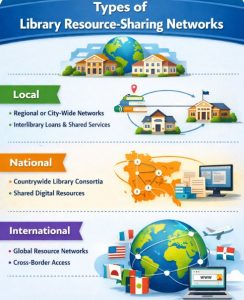 Library resource-sharing networks can be broadly categorized into three main types—local, national, and international—based on their scope, scale of collaboration, and the range of resources they provide. Each type plays a distinct role in enhancing access to information and strengthening cooperation among libraries.
- Local resource-sharing networks operate within a limited geographic area, such as a city, district, or a group of nearby institutions. These networks typically involve universities, colleges, public libraries, or specialized libraries that collaborate to share physical and digital resources. For example, several university libraries within the same city may establish an agreement to lend books to each other’s users or allow on-site access to collections. In Bangladesh, informal collaborations among nearby academic libraries often function as local networks, enabling quicker interlibrary loans and direct user access. These networks are particularly effective because of their proximity, which allows faster delivery of materials and stronger interpersonal coordination among library staff.
- National resource-sharing networks extend collaboration across an entire country and are usually more structured and formally organized. They often operate through consortia, government initiatives, or national-level organizations. In Bangladesh, the Librarians’ Information Consortium of Bangladesh (LICOB) is a key example, facilitating shared access to electronic resources and professional collaboration among member libraries. Similarly, the University Digital Library (UDL) Consortium enables universities to collectively access digital content and databases. Another well-known example is INFLIBNET in India, which supports resource sharing through union catalogs and e-resource programs. These national networks significantly reduce costs and ensure equitable access to scholarly materials across institutions.
- International resource-sharing networks operate on a global scale, connecting libraries across different countries and regions. These networks rely heavily on advanced technologies and standardized systems to facilitate seamless sharing of information. A prominent example is OCLC WorldCat, which allows libraries worldwide to contribute to and access a massive shared catalog of resources. Through such platforms, a researcher in one country can identify and request materials held in libraries across the globe. Additionally, systems like OpenAthens support international access to digital resources by enabling secure, remote authentication. These global networks are especially valuable for accessing rare, specialized, or highly advanced research materials that may not be available within a single country.
In summary, local, national, and international resource-sharing networks collectively create a layered and interconnected system of collaboration. While local networks offer speed and convenience, national networks provide structured and cost-effective access, and international networks ensure global reach and comprehensive resource availability. Together, they form the backbone of modern library cooperation in the digital age.