When a Quick Answer Needs a Second Look
Imagine a student asking a library’s generative AI chatbot for articles on a research topic. Within seconds, the chatbot provides a neatly organized reading list. The student feels ready to begin-until one of the articles cannot be found. Is the citation incorrect? Does the library lack access? Or does the article exist at all? Resolving the problem requires someone who can investigate the sources, understand the assignment, and guide the student’s next steps. This is one situation in which a librarian’s intervention becomes essential.
AI chatbots can offer a convenient starting point for library inquiries. Depending on their design and access to reliable information, they can explain borrowing procedures, direct users to databases, and answer questions about library services. However, reference work also involves understanding what users mean, clarifying what they need, evaluating evidence, and helping them use information effectively. A question that initially appears straightforward may develop into a complex research inquiry. Users may also need personal assistance when they encounter confusing instructions, language barriers, sensitive concerns, or repeated unsuccessful searches.
For Library and Information Science (LIS) students and teachers, recognizing when to involve a human is an important part of understanding responsible chatbot use. A helpful service needs clear arrangements for identifying uncertainty, checking questionable answers, and connecting users with appropriate staff. This article explores where chatbots can support reference services, the situations that call for human judgment, and the practical steps libraries can take to make that handover effective. Throughout, the focus remains on helping users obtain trustworthy information and develop the confidence to continue their research.
Understanding Chatbots at the Reference Desk
A chatbot is a software application that communicates with users through a conversational interface, usually by text and sometimes by voice. In a library, it may appear as a chat window on the website, offering assistance with services, resources, or research inquiries. However, chatbots differ in how they interpret questions, obtain information, and produce answers. Understanding these differences helps users and librarians judge what assistance a particular system can provide.
- Scripted and FAQ chatbots respond using predefined rules, menus, or prepared answers. For example, a library could configure a chatbot to recognize questions about borrowing and display the relevant circulation policy. These systems can handle predictable inquiries, but questions outside their programmed coverage may lead to an irrelevant answer or a fallback message. Some systems use AI to recognize the user’s intention while still returning a prepared response; using AI does not necessarily mean generating new text.
- Generative AI chatbots create responses dynamically, commonly using large language models trained on substantial amounts of data. They can respond to varied wording, explain concepts, and suggest possible approaches to a question. In a library setting, a student might ask such a system to explain peer review or suggest keywords for a research topic. However, a convincing response can contain incorrect information or invented references. The ability to generate an answer does not establish that the answer has been verified.
- Generative chatbots connected to library sources combine text generation with information retrieval. One approach, called retrieval-augmented generation (RAG), retrieves relevant material from a connected collection of sources before generating a response. A library could use this approach to draw answers from its service guidelines, policy documents, and research guides. This is an approach to supporting a generative chatbot, rather than a completely separate category. It can improve the relevance of responses and provide links to supporting material, although errors remain possible. Its usefulness also depends on keeping the underlying sources accurate and current.
Users should also distinguish chatbots from human-operated live chat. A chat window may connect directly to a librarian or another trained staff member. For example, the University of Illinois Urbana-Champaign Library describes its “Ask a Librarian” chat as a connection to library faculty or staff. Libraries should make the identity of the responding service clear so users understand whether they are receiving automated assistance or communicating with a person.
Where Chatbots Can Support Library Users
Library users often need help taking the next step: finding a resource, understanding a procedure, or choosing where to begin searching. A chatbot can provide a convenient starting point for these inquiries when it draws on accurate, regularly maintained information. The following examples illustrate tasks that libraries can configure chatbots to support.
- Answering routine questions: Chatbots can provide prepared answers about opening hours, borrowing limits, renewal procedures, membership requirements, and contact details. For example, a student asking, “How many books can I borrow?” could receive the relevant policy and a link to the official webpage. Exceptions and individual account disputes would require staff assistance.
- Guiding users to books and other resources: A chatbot can direct users to the library catalogue and explain how to search by title, author, or subject. It can also explain how to interpret a call number or locate a collection. Providing current information about a specific book’s availability requires a connection to the catalogue or circulation system.
- Explaining access to electronic resources: Users may need guidance on accessing subscribed databases, electronic journals, or e-books. A chatbot can share approved instructions for on-campus and remote access, link to login pages, and identify the appropriate support contact. It should guide users through official access routes without asking them to disclose passwords in the conversation.
- Helping users begin a research search: A generative AI chatbot can suggest initial keywords, related terms, or ways to divide a broad topic into searchable concepts. For instance, “social media and students” could be explored through concepts such as academic performance, information behaviour, or digital wellbeing. These suggestions provide starting points that users can test and refine in scholarly databases.
- Introducing research and referencing tools: Chatbots can point users to tutorials on database searching, reference management software, and citation practices. They can explain introductory concepts, such as the difference between an in-text citation and a reference-list entry. Detailed guidance should direct users to authoritative style resources and the requirements of their assignments.
- Connecting users with library services: A chatbot can help users find research consultation appointments, information literacy workshops, interlibrary loan instructions, or accessibility support. Where the chatbot remains available outside staffed service hours, it can provide published guidance and explain how to submit an inquiry for follow-up.
Each of these applications needs a clear boundary between providing general guidance and resolving an individual inquiry. A visible option to contact library staff allows users to continue when the automated assistance is insufficient.
Why the Reference Interview Still Matters
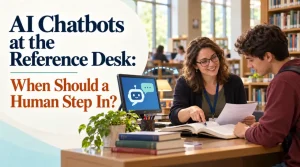 A library user’s first question may reveal only part of their information need. Someone asking for “books on education” might be preparing a classroom presentation, investigating a particular teaching method, or beginning a postgraduate literature review. The reference interview is a purposeful conversation that helps the librarian and user clarify the inquiry, understand its context, and identify suitable information. RUSA’s guidelines emphasize establishing this understanding before addressing the request.
Consider a hypothetical student who asks, “Can you help me find articles about AI in libraries?” A chatbot might suggest keywords or direct the student to a database. A librarian can develop the inquiry through questions such as:
- Which library activity interests you-reference services, cataloguing, or information literacy?
- What does your assignment require you to investigate?
- What have you searched for so far, and where are you encountering difficulties?
- Are there particular dates, languages, or types of evidence you need?
The conversation might reveal that the student is examining whether library chatbots provide accessible services for users with disabilities. This changes the search considerably: broad material about AI adoption may offer background, while studies of chatbot accessibility and user experience become more relevant. Clarification gives the search a purpose and helps establish what would count as a useful result.
The interview also creates opportunities for learning. A librarian can explain why a database was selected, demonstrate how search terms affect results, and help the student evaluate the evidence retrieved. Checking whether those results meet the student’s needs allows both participants to revise the search together. RUSA identifies collaborative searching, information evaluation, and confirmation that the inquiry has been addressed as important reference-service practices.
Generative AI chatbots can ask follow-up questions and support this process. Human involvement remains important when an inquiry requires deeper interpretation, source verification, or professional judgment. The reference interview also provides a setting for discussing AI-generated information: a librarian can help users examine a chatbot’s claims, trace supporting sources, and recognize uncertainty. ALA’s AI guidance specifically encourages incorporating these evaluation skills into the reference interview.
When Should a Human Step In?
Imagine a student telling a library chatbot, “I need help with my references.” The chatbot explains how to format a reference list, while the student is struggling to find the articles mentioned in an assignment. The response may be clearly written, but the conversation has missed the problem. This is a useful moment for a librarian to step in, ask a few focused questions, and establish what help the student needs. Clarifying the inquiry is a central part of effective reference work.
An answer also needs human attention when its supporting evidence is uncertain. A chatbot may recommend an article with a convincing title, author, and publication date, yet the user cannot locate it. Generative AI can produce inaccurate or invented information, so a polished response deserves the same scrutiny as any other unverified claim. A librarian can investigate whether the reference contains a simple error, points to a publication with different details, or describes a source that does not exist.
Some inquiries require a longer conversation and specialist knowledge from the beginning. A student planning a systematic literature search may need help defining the scope, selecting databases, and documenting a search strategy. Someone comparing conflicting studies may need guidance on evaluating their methods and evidence. These situations call for a librarian who can work through the task with the user and involve a subject specialist where necessary.
Privacy can also change how an inquiry should be handled. A question about a disputed charge or a borrowing record may require access to confidential information and authority to review an individual case. Where that task falls outside the chatbot’s approved functions, the conversation should move to an appropriate staff channel. Libraries need clear arrangements for protecting personal information and reviewing decisions that affect users.
The consequences of an incorrect answer matter, too. Questions connected to medical, legal, or financial decisions require careful source selection and clear professional boundaries. A librarian can help the user locate authoritative information and identify relevant specialist services. Human involvement includes recognizing when the inquiry requires expertise beyond the library’s own capacity. Sometimes the obstacle is the interaction itself. A user may struggle with the chatbot’s language, find its instructions confusing, or encounter an accessibility barrier. Repeated unsuccessful exchanges should prompt an offer of staff assistance. A librarian can ask how the person would prefer to communicate and help arrange a suitable alternative.
A direct request to speak with a person should always provide a route to human support. Users should be able to find that option easily, even when their question appears straightforward. If staff are unavailable, the chatbot should explain service hours and offer a clear way to submit the inquiry or arrange follow-up.
What a Good Handover Looks Like
When a user moves from a chatbot to a librarian, the conversation should continue with a clear purpose. The user needs to understand why staff assistance would help, how to reach the appropriate person, and what will happen next. A successful handover makes that transition straightforward.
The chatbot should begin by explaining the situation in plain language. For example, if a student cannot locate several recommended articles, it might say, “These references need further checking. Would you like help contacting a librarian?” The available options should match the library’s actual services, such as live chat, email, a telephone number, or a research consultation appointment.
With the user’s agreement, a brief summary can help the librarian continue the inquiry. It might explain what the student is researching, which references remain unresolved, and what searches have already been attempted. Before sharing a summary or transcript, the service should explain what information will be transferred and allow the user to decide what to include. Only relevant details should be passed on through an approved channel. This approach supports the privacy and data-minimization principles emphasized in ALA’s AI guidance.
The librarian should then confirm the unresolved question with the user. A transferred summary provides a starting point, but the person may have additional details or corrections. Any chatbot-generated references or explanations should be clearly identified so the librarian knows which information still needs verification. The librarian can then investigate the problem, explain the findings, and agree on suitable next steps.
Staff availability also needs to be communicated honestly. If immediate assistance is unavailable, the chatbot should display current service hours and explain how to submit an inquiry. Any stated response time should reflect the library’s published service arrangements. Users should know whether their request has been submitted successfully and how they can follow it up.
The handover continues until the user receives useful assistance or an appropriate referral. Before closing the inquiry, the librarian should check whether the information need has been met and explain how to seek further help. RUSA’s guidelines identify this confirmation, along with referral and clear contact options, as important parts of completing a reference interaction.
What LIS Students Should Learn-and Teachers Can Demonstrate
LIS students need practice deciding whether a chatbot’s response is useful, trustworthy, and sufficient for a particular inquiry. This involves understanding the user’s question, checking the evidence behind an answer, and recognizing when a librarian should become involved. Teachers can develop these skills through classroom activities that connect chatbot use with familiar reference-service responsibilities.
A useful exercise begins with a chatbot-generated answer containing several references. Students can locate the publications through catalogues, scholarly databases, or publishers’ websites, then compare the original sources with the claims made in the response. Finding a publication is only the first step: students also need to establish whether it supports the answer and suits the user’s purpose. This exercise puts the verification skills emphasized in ALA’s AI guidance into practice.
Teachers can also demonstrate how a reference interview changes an inquiry. Give students a broad request, such as “I need information about online learning,” and ask them to develop follow-up questions. A role-play can gradually reveal the assignment requirements, educational context, preferred sources, and searches already attempted. Students can then explain how those details would influence their search strategy. RUSA’s guidelines provide a foundation for practicing clarification, collaborative searching, and evaluation.
Another activity can focus on the decision to involve a person. Students might examine fictional conversations involving an unresolved citation, repeated misunderstanding, or a request to speak with a librarian. They can identify the point where intervention would help, justify their decision, and write a short handover message. Practicing the accompanying inquiry summary encourages students to distinguish the user’s statements from the chatbot’s suggestions.
Privacy, bias, and accessibility should also enter the discussion. Using fictional inquiries, teachers can ask students to consider which details are necessary to share, whose perspectives appear in an answer, and whether the language and interface meet the user’s needs. These questions connect AI literacy with the professional responsibilities of protecting privacy and supporting equitable access.
Assessment can focus on the evidence students use to justify their decisions. A short reflective submission could explain which claims they verified, what questions they would ask next, why they would continue or refer the inquiry, and how they would communicate that decision respectfully to the user.
How Libraries Can Evaluate the Service
Libraries can evaluate a chatbot by following the inquiry from the user’s first question to its eventual resolution. Response time provides one useful measure, alongside accuracy, successful referrals, accessibility, and the staff effort required to maintain the service. Evaluation should reflect the tasks the chatbot is intended to support.
A practical starting point is a set of representative inquiries. These might include questions about borrowing, database access, research topics, and situations requiring staff assistance. Librarians can check whether responses are correct, current, relevant, and supported by appropriate sources. Where an answer includes references, reviewers should examine whether the publications exist and support the claims made. Testing should also include unclear questions and requests outside the chatbot’s intended scope.
Libraries should establish what counts as a resolved inquiry. A conversation ending does not necessarily show that the user received useful help. A brief, optional feedback question can ask whether the response enabled the person to continue. Reviewing this feedback alongside answer accuracy provides a fuller picture of service quality. Confirming that the user’s information need has been met is also an established part of RUSA’s reference-service guidance.
The handover process deserves separate attention. Libraries can examine whether the chatbot recognizes inquiries needing human involvement, whether users successfully reach staff, and how long they wait. Reviewing missed referrals and unnecessary transfers can reveal where the service needs adjustment. Referral rates need careful interpretation: an appropriate transfer may represent a successful outcome for a complex inquiry.
Evaluation should also include people with different language preferences, levels of digital confidence, and accessibility requirements. Their experiences can reveal confusing instructions, unsuitable wording, or barriers that routine testing overlooks. When reviewing conversations, libraries should use only the information necessary for evaluation, protect identifying details, and apply clear access and retention arrangements. ALA’s AI guidance emphasizes privacy, accessibility, and ongoing human oversight.
Staff experience provides another useful measure. Libraries can compare time spent answering routine questions with the time required to update content, verify responses, and resolve chatbot-related problems. Regular reviews can then turn findings into specific changes: correcting an outdated policy, improving a referral message, or limiting a function that repeatedly produces unreliable answers. Those changes should be checked again using the inquiries that exposed the problem.
Conclusion:
AI chatbots can help library users navigate services, find starting points for research, and obtain answers to routine questions. Their usefulness depends on reliable information, regular evaluation, and clear arrangements for involving library staff. Throughout the interaction, users should be able to recognize the limits of automated assistance and find a straightforward route to a librarian.
For the student who cannot locate a chatbot-recommended article, human involvement can turn confusion into a learning opportunity. A librarian can investigate the reference, clarify the research need, and demonstrate how to verify sources. That conversation helps resolve the immediate problem while developing skills the student can use independently.
For LIS students and teachers, these situations show why reference interviewing, source evaluation, ethical awareness, and thoughtful referral remain essential professional skills. Teaching chatbot use should give students opportunities to practice each of them. Libraries, in turn, need to support staff with the time, training, and authority to review automated responses and intervene when necessary.
Keeping human judgment accessible means making personal assistance a visible, dependable part of the service. Users should know who can help, how to reach them, and what to expect next. A successful reference service enables people to move forward with information they can understand, evaluate, and use.