
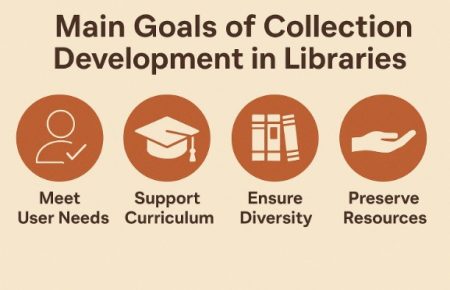
Library collection development is a systematic and strategic process through which libraries build, maintain, and improve their collections to meet the diverse informational, educational, and research needs of their users. It goes far beyond simply acquiring books; it involves selecting, evaluating, and organizing a balanced mix of print, digital, and multimedia resources that reflect the mission of the library and the priorities of its parent institution. For example, an academic library serving engineering students will prioritize acquiring textbooks, research journals, and databases like IEEE Xplore, while a public library may emphasize fiction, children’s literature, and community-interest magazines.
Collection development also requires understanding the needs of different user groups, keeping up with emerging knowledge trends, and ensuring equitable access to both traditional and electronic resources. Policies and guidelines usually shape this process to make it consistent, transparent, and sustainable. For instance, many libraries maintain a “Collection Development Policy” that clearly outlines how resources are selected and which criteria, such as relevance, authority, and cost, are prioritized.
At the same time, practical aspects such as budgeting, licensing, weeding out outdated materials, and evaluating usage are vital to maintaining a relevant and up-to-date collection. For example, university libraries often use citation and usage statistics from databases like Scopus or JSTOR to decide whether to renew expensive journal subscriptions. Similarly, school libraries may weed out outdated science books that no longer align with current knowledge.
In today’s digital age, collection development has evolved to include electronic databases, open access materials, and collaborative resource-sharing initiatives. A good example is Research4Life, which provides free or low-cost access to global scientific literature in developing countries, supporting academic libraries in building strong digital collections. These practices make collection development an ongoing and dynamic activity that ensures libraries remain reliable knowledge hubs for their communities.
Major Components of Library Collection Development
Library collection development is a cornerstone of effective library management, ensuring that resources remain relevant, balanced, and aligned with the needs of users. It is not a one-time activity but rather a continuous process of planning, acquiring, evaluating, and maintaining materials. The major components of collection development provide a structured framework that guides librarians in making informed decisions about what to include, retain, or remove from the library’s holdings.
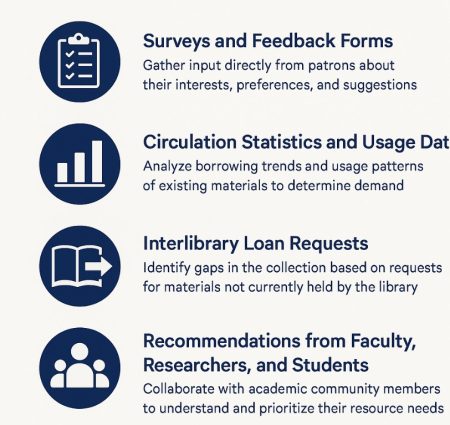
- Needs Assessment: The foundation of any effective collection development process lies in accurately identifying the needs of the community served by the library. A library is only as valuable as its ability to provide information that supports its users’ academic, research, or recreational requirements. Needs assessment involves conducting surveys, interviews, analyzing course curricula, and monitoring usage statistics to understand what resources users are actually demanding. For example, in a medical university library, high demand for updated anatomy textbooks, pharmacology journals, and databases like PubMed would dictate acquisition priorities. In contrast, a public library located in a small community may prioritize local history collections, fiction, and children’s storybooks to better serve its users. Without a clear understanding of user needs, collection development risks becoming irrelevant or misaligned with its objectives.
- Collection Development Policy: A collection development policy acts as a formal framework that guides librarians in making consistent, transparent, and objective decisions. It defines the principles, priorities, and scope of the collection by setting out selection criteria, subject coverage, types of formats, and even language preferences. Policies also address ethical concerns, such as intellectual freedom, censorship issues, and inclusive representation of diverse voices. For example, an academic library may explicitly state in its policy that electronic resources will be prioritized to support online learners. A well-documented policy not only provides direction to current librarians but also ensures continuity when staff changes occur, making it an essential component of professional library practice.
- Selection of Materials: Selection is one of the most critical and visible aspects of collection development. It involves choosing resources that are credible, authoritative, and relevant to the mission of the library. Librarians rely on multiple sources to make informed decisions, such as book reviews, publishers’ catalogs, faculty recommendations, subject bibliographies, and scholarly databases. For example, an academic librarian selecting resources for a business program may prioritize journals indexed in Scopus or Web of Science, while a school librarian may turn to educational boards’ recommended reading lists. Selection is not only about choosing the newest resources but also about ensuring a balanced collection that meets the needs of diverse user groups and perspectives.
- Acquisition: Acquisition is the process of procuring the materials that have been selected. This can involve purchasing books, subscribing to journals, licensing e-resources, or even accepting donations. It also requires negotiating with vendors, managing orders, and handling logistics such as cataloging and processing. In today’s digital world, acquisition extends to negotiating access to electronic databases and e-journal packages through library consortia. For instance, many universities in Bangladesh access international e-resources at a lower cost through consortia like UDL and LiCoB. The acquisition process requires efficiency, transparency, and often close collaboration with finance departments to ensure timely procurement.
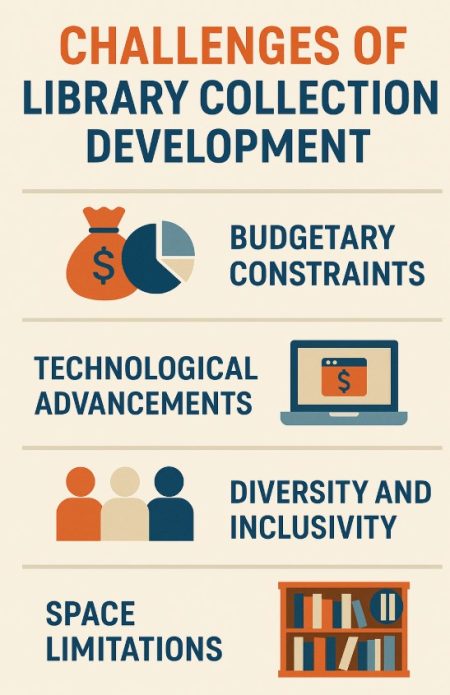
- Budgeting and Financial Planning: Collection development cannot be carried out effectively without careful financial planning. Budget allocation plays a decisive role in determining the size, scope, and quality of a library’s collection. Librarians must balance user needs with financial limitations by prioritizing resources and making difficult decisions about what to include or exclude. For example, a university library might dedicate a larger portion of its budget to renewing high-cost subscriptions to essential databases such as Elsevier or IEEE Xplore while cutting down on low-usage periodicals. In smaller libraries, limited budgets may mean relying more heavily on free and open access resources. Effective budgeting ensures that libraries maximize value while maintaining a balanced and relevant collection.
- Evaluation of Collection: Evaluation is a continuous process that helps librarians determine whether the existing collection is meeting the current needs of users. It involves examining circulation records, usage statistics, citation reports, and direct user feedback to assess the effectiveness of resources. For example, if a digital resource shows consistently low download rates over several years, it may be discontinued, while highly used resources may be expanded. In academic libraries, evaluation may also involve aligning resources with newly introduced academic programs or research initiatives. Systematic evaluation ensures that the collection stays dynamic, responsive, and relevant to both present and future needs.
- Weeding and Deselection: Weeding, also called deselection, is the process of systematically removing outdated, damaged, or irrelevant materials from the collection. This is not merely about creating space but also about maintaining the quality and usefulness of the collection. For example, outdated science textbooks that contain obsolete theories must be replaced with newer editions, while duplicate copies of rarely used books may be removed. Public libraries may also weed out books that are in poor condition or no longer in demand. However, libraries often retain rare or historically significant works even if they are outdated, preserving them for archival purposes. Weeding keeps collections fresh, accurate, and aligned with user needs.
- Resource Sharing and Consortia: No single library can meet all the needs of its users independently, which makes resource sharing and participation in consortia essential components of collection development. Resource sharing allows libraries to pool resources and provide broader access at reduced costs. For example, university libraries often participate in interlibrary loan systems or join national and international consortia to access databases they could not afford individually. In Bangladesh, consortia like UDL and Research4Life help academic libraries gain access to thousands of international journals and e-books at affordable prices. This collaborative approach expands the scope and depth of collections while optimizing budgetary resources.
- Preservation and Conservation: Preservation focuses on protecting library resources from physical damage, environmental factors, and technological obsolescence, while conservation involves restoring and maintaining fragile materials. This component is vital for ensuring the longevity of both physical and digital resources. For example, libraries holding rare manuscripts or fragile historical documents often digitize them to prevent further wear while simultaneously making them accessible to a global audience. Similarly, digital preservation involves creating backups and ensuring file formats remain accessible over time. Preservation safeguards the intellectual and cultural heritage housed within libraries, making it accessible to both present and future generations.
- Integration of Digital Resources: In the 21st century, digital resources have become an indispensable part of library collections. E-journals, e-books, online databases, institutional repositories, and open access resources complement traditional print collections and extend access beyond the physical boundaries of the library. For example, academic libraries now provide access to digital platforms like JSTOR, SpringerLink, or Emerald Insight, which are crucial for research and learning. Institutional repositories using software like DSpace also play a role by archiving theses, dissertations, and faculty publications. The integration of digital resources ensures convenience, global accessibility, and alignment with evolving user expectations.
The major components of library collection development-needs assessment, policy formulation, selection, acquisition, budgeting, evaluation, weeding, resource sharing, preservation, and digital integration-form a comprehensive framework that keeps libraries vibrant and user-centered. Each component is interdependent, ensuring that libraries not only collect resources but also manage them effectively for long-term sustainability. By carefully implementing these components, libraries transform themselves from passive book repositories into dynamic knowledge hubs that empower education, research, and lifelong learning.
Why Selection is Considered a Core Component of Collection Development
Library collection development is a comprehensive process that involves several interrelated activities such as needs assessment, policy formulation, acquisition, evaluation, and preservation. Among these, selection is regarded as the core component because it determines the very quality, relevance, and usefulness of the library’s holdings. Without careful and informed selection, other components of collection development would lack direction and purpose.
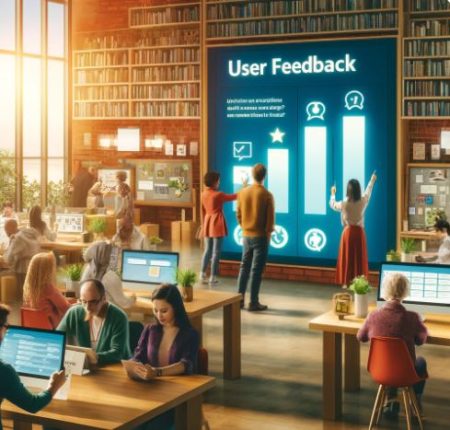
Selection is the process that defines what kind of materials enter the library’s collection. It sets the intellectual tone and scope of the library by determining which subjects, formats, and perspectives will be represented. For example, a law library that carefully selects legislation records, law reports, and legal commentaries builds a specialized identity that directly supports legal education and practice. Without a strong selection process, libraries risk becoming unfocused or irrelevant to their communities. At the same time, the primary purpose of any library is to serve the informational, educational, and recreational needs of its users, and selection ensures that the materials acquired directly address these needs. Librarians use feedback from faculty, students, researchers, or the general public to select items that are most useful. For instance, if student surveys reveal a demand for updated reference books in computer science, careful selection of the latest editions ensures that the library remains a trusted academic partner. Thus, selection acts as a bridge between user needs and the resources provided.
Another important aspect of selection is its role in ensuring the credibility and quality of the collection. Librarians apply criteria such as relevance, accuracy, timeliness, cost, and author credibility when deciding what to include. For example, in medical libraries, preference is given to peer-reviewed journals like The Lancet or New England Journal of Medicine, which ensures that the information provided is reliable and beneficial for research and practice. Poor selection, on the other hand, could flood the library with irrelevant or low-quality materials, undermining its academic or social mission. Selection also helps maintain a balance between depth and breadth of resources. A well-developed collection provides specialized materials for advanced researchers while also offering general works for beginners. In a university library, selecting both introductory economics textbooks and advanced research monographs ensures that resources cater to undergraduates as well as Ph.D. scholars. Such a balance can only be achieved through thoughtful and systematic selection.
Since library budgets are always limited, careful selection also ensures the efficient use of financial resources. It allows librarians to prioritize acquisitions that will have the most impact on users while avoiding unnecessary or duplicate purchases. For example, instead of acquiring multiple subscriptions to similar journals, a library may select one core database like JSTOR, which offers wide coverage across disciplines. In this way, selection ensures maximum value for every unit of currency spent, making it the most cost-effective component of collection development. Selection also plays a key role in aligning the library’s collection with the mission of its parent institution. Libraries exist to support institutional goals and academic programs, and the materials they select directly reflect these priorities. For instance, a university that introduces a new program in environmental science will rely on its library to select relevant books, journals, and databases on sustainability and climate change. In this way, selection directly contributes to institutional success by equipping users with the resources needed to achieve their objectives.
Finally, selection is central because it allows libraries to adapt to the changing information environment. With the rise of digital publishing, open access resources, and multimedia formats, selection has become more complex yet more vital. Librarians must decide how to balance print and digital, whether to prioritize e-journals over physical copies, and how to integrate institutional repositories. Selecting an e-book package that provides unlimited multi-user access, for instance, can greatly support distance learners. This adaptability ensures that the library’s collection remains dynamic and relevant in a rapidly evolving digital age.
How Collection Development Differs from Collection Management
Libraries are dynamic institutions that continuously evolve to meet the changing needs of their users. To function effectively, they rely on two interrelated but distinct processes: collection development and collection management. Although these terms are often used interchangeably, they represent different aspects of building and maintaining library resources. Understanding their differences is essential for librarians, administrators, and researchers to ensure that libraries provide both relevant and sustainable access to information.
Collection development refers to the process of building and shaping the library’s collection. It focuses on activities such as assessing user needs, formulating policies, selecting materials, acquiring resources, and ensuring the initial growth of the collection. In essence, it is concerned with the planning and acquisition of resources that align with the goals of the library and the needs of its community. For example, when a university introduces a new program in artificial intelligence, the library engages in collection development by purchasing textbooks, subscribing to relevant journals, and providing access to databases like IEEE Xplore or ACM Digital Library. Thus, collection development sets the foundation for what materials the library will hold and how well it will serve its academic or community mission.
On the other hand, collection management refers to the maintenance, evaluation, and long-term sustainability of the library’s resources. It focuses on how the collection is organized, preserved, evaluated, and updated to remain useful and relevant over time. Activities such as weeding (removing outdated or damaged materials), usage analysis, preservation of rare or fragile resources, budgeting for renewals, and balancing digital and print collections are all part of collection management. For instance, a library may decide to discontinue a low-usage journal subscription to allocate funds for a heavily used database, or it may digitize fragile manuscripts to ensure long-term access. In this sense, collection management ensures the ongoing vitality of the collection after it has been developed.
The primary difference lies in their scope and orientation: collection development is proactive and future-focused, while collection management is reactive and maintenance-focused. Development is about “what to add” to the collection, while management is about “what to retain, update, or discard.” Another distinction is that development often occurs at the initial stages of building a collection or when new programs and user needs emerge, whereas management is a continuous process that ensures the sustainability and relevance of the existing resources.
Despite these differences, collection development and collection management are deeply interconnected. Effective selection and acquisition during development make management easier, while continuous evaluation during management informs future development decisions. For example, circulation statistics gathered during collection management may highlight gaps in the collection, guiding librarians in future development choices. Together, they form a cyclical process where development brings in new resources, and management ensures those resources remain useful and accessible.




2 Comments
nice PDF
I am so grateful that am learning a lot of new things regarding library.
But I’m just kindly requesting if you could provide me an example of an writeup for ‘Collection Development Policy’ as to which I can get a better knowledge of as to how I can create one for my library.
Thank you