
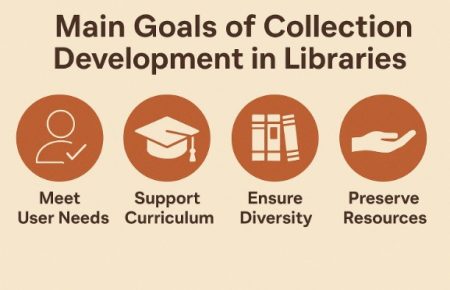
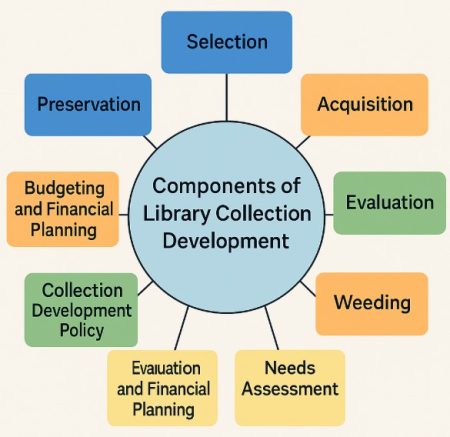
Collection development is one of the most vital functions of a library, as it ensures that the library’s resources remain relevant, balanced, and useful to its community of users. It refers to the systematic process of selecting, acquiring, organizing, evaluating, and maintaining library materials in a variety of formats such as books, journals, e-books, databases, and multimedia resources. For example, an academic library may purchase subject-specific textbooks for undergraduate courses, subscribe to databases like Scopus or JSTOR for research, and acquire e-books to support distance learners. The primary goal of collection development is to build a collection that meets the academic, research, professional, and recreational needs of users while reflecting the mission and objectives of the institution the library serves.
Over the years, the scope of collection development has expanded from focusing mainly on print materials to incorporating digital resources, open access content, and subscription-based online databases. For instance, university libraries increasingly include open-access repositories and research data collections to support global scholarly communication. Modern approaches emphasize user-centered and evidence-based decision-making, where circulation statistics, surveys, and user feedback guide acquisitions. For example, many libraries adopt demand-driven acquisition (DDA) models in which e-books are purchased only when a user requests or frequently accesses them, ensuring cost-effective and need-based growth.
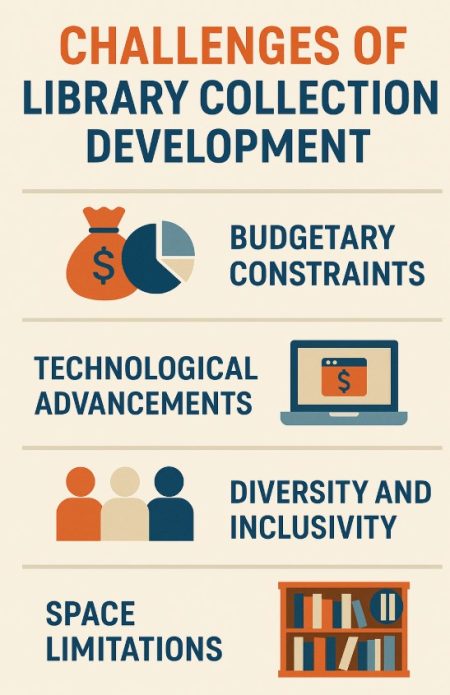
At the same time, collection development must address challenges such as limited budgets, rising costs of electronic resources, licensing restrictions, and the need for inclusivity and diversity in collections. Public libraries, for instance, often strive to provide materials in multiple languages to serve diverse communities or add large-print editions and audiobooks to support elderly users and those with visual impairments. Thus, collection development is not merely about gathering materials but about creating a thoughtful, sustainable, and accessible body of knowledge that supports learning, teaching, and research in a rapidly evolving information landscape.
What is Meant by Collection Development in Libraries?
Collection development in libraries refers to the planned and continuous process of building and managing a library’s resources to meet the informational, educational, research, and recreational needs of its users. It goes beyond simply purchasing books or journals; it involves a thoughtful cycle of selecting, acquiring, evaluating, organizing, and maintaining materials in multiple formats, including print, electronic, and digital resources. For instance, in an academic library, this may include acquiring textbooks, subscribing to scholarly databases, and preserving theses and dissertations, while in a public library, it may involve purchasing children’s literature, community newspapers, or popular fiction. Collection development also ensures that the resources remain relevant by periodically evaluating usage patterns and removing outdated or less-used materials through a process known as “weeding.” It is guided by the mission and goals of the institution, budget limitations, user demands, and emerging trends such as open access publishing and digital learning platforms.
Importance of Collection Development for Academic and Public Libraries
Collection development is essential for both academic and public libraries because it ensures that the library’s resources remain purposeful, relevant, and aligned with the needs of its users. In academic libraries, collection development supports the teaching and research missions of the institution by providing access to scholarly journals, textbooks, databases, and other resources that students and faculty rely on for coursework, assignments, and publications. For example, subscribing to specialized databases such as IEEE Xplore or PubMed allows researchers to stay updated in their respective fields, while acquiring course-related textbooks helps students access essential learning materials without financial burden.
In public libraries, collection development plays a key role in serving the diverse needs of the community. It helps build collections that include recreational reading, career development resources, local history archives, children’s literature, and multilingual materials. For instance, a public library may acquire large-print books for elderly readers, children’s picture books to encourage early literacy, and community newspapers or job-preparation guides to support local development. Through careful selection, public libraries can also ensure inclusivity, offering materials that reflect the cultural, linguistic, and social diversity of their communities.
Major Methods of Library Collection Development
Collection development is a critical function of libraries that involves selecting, acquiring, and maintaining materials to meet the needs of their users. To build well-rounded collections, libraries employ several methods depending on their goals, budget, and community needs. The most common methods include purchase, gift and donation, exchange, and consortia-based acquisition. Each has its strengths and challenges, but together they provide libraries with a balanced and sustainable approach to resource development.
- Purchase: Purchasing is the most widely used method of collection development. Libraries acquire materials directly from publishers, vendors, or distributors using allocated budgets. This method gives librarians control over what to include in the collection based on users’ needs, academic requirements, or research priorities. For example, an academic library may purchase textbooks for newly introduced courses or subscribe to e-resources such as JSTOR and Scopus. Public libraries, on the other hand, may purchase popular fiction, children’s books, or audiovisual materials to serve the recreational needs of their community. Although effective, the purchase method often faces challenges such as rising costs of scholarly journals, vendor lock-in, and budget limitations.
- Gift and Donation: Gifts and donations have traditionally played an important role in enriching library collections. Individuals, organizations, or institutions may donate books, journals, manuscripts, or digital resources. For example, alumni of a university may donate copies of their published works, or a local community group might gift children’s books to a public library. This method is cost-effective since it allows libraries to acquire resources without direct financial investment. However, donations may not always align with the library’s collection policy, leading to challenges in terms of storage, duplication, and relevance. To manage this, many libraries have clear guidelines on what types of gifts they can accept.
- Exchange: The exchange method involves libraries or institutions sharing materials with each other on a reciprocal basis. This is particularly common among academic and research libraries, where institutions may exchange journals, research reports, or government publications. For example, two universities may agree to exchange locally published conference proceedings or theses to expand their resources. Exchange programs are especially valuable for acquiring rare or region-specific materials that may not be commercially available. While beneficial, exchanges require strong cooperation, record-keeping, and clear agreements to ensure fairness and consistency.
- Consortia-Based Acquisition: In the digital age, consortia-based acquisition has become a major trend in collection development. Library consortia are cooperative groups of libraries that pool resources to negotiate better deals with publishers and vendors. This method enables libraries to access a wide range of electronic resources at reduced costs. For instance, in Bangladesh, university libraries collaborate through the University Digital Library (UDL) Consortia or LiCoB (Library Consortium of Bangladesh) to provide access to e-journals and databases. Globally, initiatives like Research4Life support access to scholarly resources for institutions in developing countries. The strength of this method lies in cost-sharing, broader access, and collective bargaining power, although it may limit individual libraries’ flexibility in selecting specific resources.
Library collection development is best achieved through a combination of methods rather than reliance on one. Purchasing ensures targeted acquisitions, gifts, and donations expand collections cost-effectively, exchanges foster collaboration, and consortia-based acquisitions maximize access to digital resources at lower costs. Together, these approaches allow libraries to create diverse, inclusive, and sustainable collections that support the evolving needs of their users.
The Role of Demand-Driven Acquisition (DDA) and Evidence-Based Acquisition (EBA) in Modern Collection Building
In today’s information landscape, libraries are under pressure to balance user needs, rising subscription costs, and shrinking budgets. To address these challenges, innovative approaches such as Demand-Driven Acquisition (DDA) and Evidence-Based Acquisition (EBA) have emerged as important strategies in collection development. Both models represent a shift from traditional pre-emptive purchasing toward more user-centered and data-driven decision-making.
Demand-Driven Acquisition (DDA), also known as Patron-Driven Acquisition, allows libraries to make a wide range of resources—typically e-books, journal articles, or streaming media-discoverable in their catalogues without purchasing them in advance. The library only pays when a user requests or uses a resource beyond a set threshold, ensuring that funds are spent on materials with proven demand. For example, an academic library may upload thousands of vendor-supplied e-book records into its catalog but only purchase those titles that students or faculty actually access. This approach reduces waste, maximizes relevance, and allows users to shape the collection directly.
Evidence-Based Acquisition (EBA) builds on a similar principle but works differently. Under this model, libraries pay an upfront fee to gain temporary access to a large body of resources for a fixed period, usually a year. At the end of this period, detailed usage data is analyzed to decide which titles should be purchased permanently. This ensures that investment is guided by actual user engagement rather than assumptions. For instance, a university might gain access to thousands of e-books from a major publisher for a year and then select the most heavily used titles for permanent acquisition.
Both DDA and EBA play a crucial role in modern collection building by making libraries more responsive, flexible, and cost-effective. They help ensure that budgets are directed toward resources that users genuinely need, reduce unnecessary spending, and broaden access to a wider range of materials. At the same time, these models come with challenges, such as unpredictable costs in the case of DDA, heavy reliance on vendor platforms, and the risk of overlooking specialized but low-use materials. Despite these limitations, DDA and EBA are transforming collection development into a more dynamic, sustainable, and user-centered process, making them indispensable in the digital era.
The Influence of the Subscription Model on the Library’s Electronic Resource Collection
The rise of digital publishing has transformed how libraries acquire and manage electronic resources. Unlike print materials that are purchased outright, most electronic journals, databases, and e-books are provided through a subscription model. Under this system, libraries pay recurring fees to vendors or publishers to grant their users temporary access to digital content. While this approach has greatly expanded the range and immediacy of information available, it also presents challenges in sustainability, ownership, and long-term preservation.
- Expanding Access to Information: One of the greatest benefits of the subscription model is the ability to provide users with access to a vast range of electronic resources that would otherwise be unaffordable if purchased individually. For example, an academic library subscribing to Elsevier’s ScienceDirect or SpringerLink can give faculty and students access to thousands of scholarly journals across disciplines such as engineering, medicine, and social sciences. Similarly, public libraries subscribing to services like OverDrive or Hoopla allow patrons to borrow e-books, audiobooks, and streaming videos from home, supporting both recreational reading and lifelong learning. These services have proven especially useful during events like the COVID-19 pandemic, when remote access to information became essential.
- Cost and Budgetary Implications: While the subscription model broadens access, it places heavy pressure on library budgets. Subscription costs, particularly for scholarly journals and large databases, have been rising steadily, often outpacing inflation and institutional funding. This has led to the well-documented “serials crisis”, where libraries struggle to afford essential journal subscriptions. For instance, many universities have had to cancel bundled “Big Deal” packages with major publishers like Elsevier or Wiley due to unsustainable price increases. In 2019, the University of California system canceled its contract with Elsevier because of escalating costs, illustrating how financial pressures can significantly influence collection strategies.
- Impact on Ownership and Control: Another major influence of the subscription model is the issue of ownership. Unlike print books or journals, libraries do not own most electronic resources acquired through subscriptions. Instead, they pay for temporary access, which ends if the subscription is canceled. For example, if a library discontinues its subscription to JSTOR or ProQuest, users immediately lose access to all content, even previously available materials. Licensing agreements often include restrictions on interlibrary loan or multiple simultaneous users, limiting how resources can be shared or preserved. This creates challenges in long-term collection sustainability and diminishes the autonomy libraries traditionally held over their resources.
- Supporting User Needs and Usage Data: Despite its challenges, the subscription model allows libraries to adopt more user-centered approaches by using analytics and usage reports provided by vendors. These reports help libraries assess which journals, databases, or e-books are accessed most frequently and adjust subscriptions accordingly. For instance, a university may find that its EBSCO Business Source Complete database is heavily used by business students, making it a priority for renewal, while less-used databases might be canceled. This evidence-based approach ensures that resources directly support academic programs and community interests.
- Collaboration and Consortia-Based Subscriptions: To manage rising costs, many libraries participate in consortia to negotiate subscription deals collectively. This strategy pools financial resources and increases bargaining power with vendors. For example, in Bangladesh, university libraries collaborate through the University Digital Library (UDL) Consortia and the Library Consortium of Bangladesh (LiCoB) to access e-journals and e-books at reduced costs. Globally, initiatives like Research4Life provide developing countries with free or low-cost access to thousands of scholarly journals. While consortia arrangements greatly expand access, they can sometimes limit individual libraries’ flexibility in selecting specific titles or customizing subscriptions to their local needs.
The subscription model has fundamentally shaped the development of electronic resource collections in libraries by dramatically expanding access to digital content while simultaneously creating challenges in cost, ownership, and sustainability. It has allowed libraries to provide users with unparalleled access to scholarly and recreational resources, from ScienceDirect and JSTOR in academic settings to OverDrive and Hoopla in public libraries. However, the dependence on recurring fees, lack of ownership, and rising costs create long-term vulnerabilities. Moving forward, libraries must balance subscriptions with alternative strategies such as open access initiatives, demand-driven acquisition (DDA), and evidence-based acquisition (EBA) to create sustainable, user-centered, and resilient collections in the digital age.
How Do Librarians Select Materials for Acquisition?
One of the most important responsibilities of librarians is to ensure that the library’s collection remains relevant, balanced, and responsive to the needs of its users. The process of selecting materials for acquisition is not random; it follows systematic guidelines, policies, and professional judgment. Selection involves considering factors such as user demand, academic or community needs, budget availability, quality of resources, and long-term collection goals. Through this process, libraries maintain collections that support teaching, research, cultural engagement, and lifelong learning.
- User Needs and Demands: The primary guiding factor in selecting materials is the actual or anticipated needs of the library’s community. Academic librarians, for example, analyze course curricula, faculty requests, and research trends to acquire textbooks, scholarly journals, and databases that directly support teaching and learning. In contrast, public librarians often consider community demographics and interests when selecting popular fiction, children’s literature, or local history resources. For instance, a university offering a new program in Data Science may request subscriptions to specialized databases such as IEEE Xplore or ACM Digital Library, while a public library in a multilingual community may prioritize materials in multiple languages.
- Collection Development Policies: Libraries typically develop formal collection development policies that outline criteria for acquisition. These policies provide consistency and transparency in selection decisions. They may specify priorities such as supporting institutional missions, promoting cultural diversity, or ensuring age-appropriate resources. For example, a school library may emphasize acquiring children’s books that promote reading habits, while a national library may prioritize preserving historical documents and rare publications.
- Reviews, Bibliographies, and Professional Tools: Librarians rely on authoritative reviews, bibliographies, and selection tools to assess the quality and relevance of potential acquisitions. Reviews from sources like Library Journal, Booklist, or academic review journals provide valuable insights into the credibility, content, and suitability of materials. Additionally, bibliographies, publishers’ catalogs, and book fairs expose librarians to new and emerging resources. For instance, academic librarians may consult Choice Reviews Online to evaluate scholarly books before purchase.
- Budget Considerations: Budget plays a central role in determining which materials can be acquired. Since funds are limited, librarians must balance priorities, often choosing between essential databases, high-demand print books, and new digital media. In academic libraries, expensive subscriptions such as Elsevier’s ScienceDirect or SpringerLink may consume a significant portion of the budget, forcing librarians to make careful trade-offs. Public libraries may use circulation statistics to prioritize popular genres or media formats that deliver the highest community benefit.
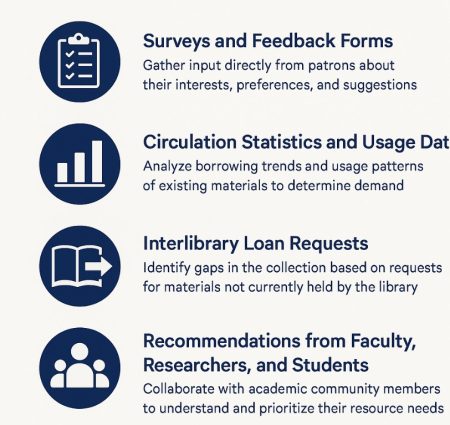
- Usage Data and Analytics: Modern collection development increasingly depends on usage data and analytics. Circulation statistics, e-resource usage reports, and interlibrary loan requests provide insights into what users value most. For example, if a large number of requests come in for materials on entrepreneurship, an academic library may expand its business-related collection. Similarly, if analytics show that a streaming video platform like Kanopy is underused, librarians may reconsider renewing the subscription.
- Faculty, Student, and Community Input: Libraries often seek direct input from their patrons. Academic librarians collaborate with faculty to identify core texts and reference works needed for courses, while student surveys help highlight popular or in-demand resources. Public libraries may host community meetings, suggestion boxes, or online surveys to gather recommendations from patrons. For instance, a city library may add graphic novels or manga series if teenagers in the community express growing interest.
- Balance, Diversity, and Inclusivity: Another crucial aspect of selection is ensuring that the collection represents diverse perspectives, voices, and cultures. Librarians aim to create inclusive collections that meet the needs of all user groups, including marginalized or underrepresented communities. For example, public libraries in multicultural cities may expand their collections to include works by local authors or resources in minority languages. Academic libraries may focus on ensuring representation across disciplines, perspectives, and global viewpoints.
The selection of materials for acquisition in libraries is a complex process that blends professional judgment, institutional policy, financial considerations, and user input. By analyzing community needs, consulting professional tools, managing budgets, and promoting diversity, librarians build collections that are dynamic, accessible, and impactful. Whether it is subscribing to a global database for researchers, adding children’s picture books to foster early literacy, or preserving historical manuscripts for cultural heritage, each acquisition decision contributes to the library’s role as a vital center of knowledge and learning.
Challenges in Balancing Print and Digital Collections in Modern Libraries
Modern libraries are increasingly tasked with striking a balance between maintaining traditional print collections and expanding digital resources. While digital collections provide convenience, accessibility, and vast coverage, print materials remain valuable for their permanence, tangibility, and cultural significance. Balancing the two formats is not straightforward, as it involves financial, technological, logistical, and user-related challenges. Understanding these challenges is essential for building collections that are both sustainable and relevant in the digital age.
- Budget Constraints and Rising Costs: One of the most pressing challenges is financial. Digital resources, such as e-journals, databases, and e-books, often require ongoing subscription fees that can consume a large portion of a library’s budget. At the same time, print collections involve costs for acquisition, binding, preservation, and storage. Academic libraries may struggle to maintain subscriptions to platforms like Elsevier’s ScienceDirect or SpringerLink while still purchasing essential print textbooks for students. Public libraries face similar dilemmas, needing to subscribe to services like OverDrive while continuing to provide physical books for patrons who prefer them. Allocating limited funds across both formats creates constant tension.
- Space and Infrastructure Limitations: Print collections require physical space, shelving, and climate-controlled storage, especially for rare or archival materials. Digital collections, while not taking up physical space, demand robust technological infrastructure, including servers, high-speed internet, and user-friendly access platforms. For example, a university library may need to expand its digital infrastructure to support remote access to e-resources, while also struggling with overcrowded shelves of print books. Balancing these demands often requires libraries to rethink space planning and invest in both physical and digital infrastructure.
- User Preferences and Access Needs: Different user groups have varying preferences for print and digital formats. Some students and researchers prefer e-books and online journals for their convenience and searchability, while others value print materials for deep reading, note-taking, or reduced screen fatigue. For instance, younger generations may expect instant access to e-resources from home, while older patrons may rely on traditional print collections. Meeting these diverse needs requires libraries to maintain both formats, often stretching resources thin.
- Licensing and Ownership Issues: With print materials, libraries own the resources outright once purchased. In contrast, digital resources are usually licensed, meaning libraries pay for temporary access rather than permanent ownership. For example, if a library cancels its subscription to JSTOR or ProQuest, access to past issues may be lost. This creates long-term sustainability challenges, as libraries must continually renew licenses or risk losing significant portions of their digital collections. Balancing the permanence of print with the conditional access of digital materials is an ongoing struggle.
- Preservation and Sustainability: Print materials face deterioration over time, requiring preservation strategies such as binding, digitization, or climate-controlled storage. Digital collections, while immune to physical decay, face challenges of technological obsolescence, file format compatibility, and platform dependency. For example, a digitized archive may become inaccessible if the software used to view it becomes outdated. Ensuring the long-term preservation of both print and digital resources requires significant investment and expertise.
- Inclusivity and Digital Divide: While digital collections offer remote access and flexibility, not all users have equal access to technology, internet connectivity, or digital literacy skills. In developing countries, or even in rural areas of developed nations, the digital divide remains a barrier. For example, a student without reliable internet access may depend heavily on print materials. Public libraries often play a crucial role in bridging this gap, but ensuring equitable access to both formats remains a challenge.
- Collection Management and Evaluation: Balancing print and digital collections also requires careful evaluation and weeding. Libraries must decide which print resources can be discarded or digitized without losing value and which digital subscriptions justify their high costs based on usage. For instance, if usage reports show low demand for a costly online database, libraries may reconsider the subscription, but this risks depriving a small but important group of researchers. Similarly, reducing print collections too aggressively may alienate users who rely on them.
Balancing print and digital collections is one of the most complex challenges modern libraries face. Financial limitations, user preferences, licensing issues, preservation concerns, and the digital divide all play a role in shaping collection decisions. While digital collections provide unparalleled accessibility and efficiency, print resources continue to hold unique value for cultural preservation, inclusivity, and deep engagement. To achieve balance, libraries must adopt flexible, user-centered strategies that consider both short-term access needs and long-term sustainability. Ultimately, the goal is not to choose between print and digital but to create a complementary collection that serves the diverse needs of library users in a rapidly changing information environment.
How Do Libraries Deal with Budget Constraints When Selecting Collection Development Methods?
Budget constraints are among the most pressing challenges libraries face in maintaining and developing their collections. The rising costs of scholarly journals, electronic databases, and subscription services often exceed available funding, while print resources still require investment in acquisition, preservation, and storage. To manage these limitations, libraries adopt a range of strategies that ensure their collections remain relevant, accessible, and user-centered.
One common approach is to prioritize user needs so that limited funds are directed toward the most impactful resources. Academic libraries, for example, may focus on acquiring databases like IEEE Xplore for engineering students or PubMed for medical researchers, while public libraries may prioritize high-demand fiction, children’s books, or digital platforms such as OverDrive. This ensures that acquisitions directly support the academic or recreational needs of the community. In addition, many libraries adopt Evidence-Based Acquisition (EBA) and Demand-Driven Acquisition (DDA) models to make cost-effective decisions. In EBA, libraries pay for temporary access to large collections and then purchase only the titles most used during the trial period. Similarly, DDA triggers payment only when a user requests or uses a resource, meaning funds are spent only on materials with proven demand.
Collaboration through library consortia is another important strategy for addressing financial pressures. By pooling resources, libraries gain access to broader collections at reduced costs. For instance, in Bangladesh, the University Digital Library (UDL) Consortia and the Library Consortium of Bangladesh (LiCoB) allow universities to subscribe to electronic resources more affordably. On a global scale, initiatives such as Research4Life provide discounted or free access to thousands of scholarly journals for institutions in developing countries. At the same time, librarians conduct careful cost-benefit analyses to determine whether subscriptions or databases justify their cost based on usage data and user feedback. If a resource shows consistently low use, it may be canceled, with funds redirected to more essential materials.
Beyond acquisition, libraries rely on interlibrary loans (ILL) and resource-sharing agreements to fill gaps without the expense of outright purchases. For example, a university library might borrow a specialized research monograph from another institution instead of buying it. Libraries also increasingly promote open access (OA) materials such as journals, repositories, and open educational resources, which provide valuable content at little or no cost. Incorporating OA resources reduces reliance on expensive subscriptions while supporting global scholarly communication. Additionally, regular evaluation and weeding of collections allow libraries to remove outdated or underused items, freeing space and redirecting funds toward more relevant acquisitions.
How Do Consortia Arrangements Affect Collection Development Strategies?
Consortia arrangements play a transformative role in shaping library collection development strategies by allowing institutions to collaborate, share resources, and negotiate more favorable terms with publishers and vendors. Through consortia such as the University Digital Library (UDL), the Library Consortium of Bangladesh (LiCoB), or international initiatives like Research4Life, libraries gain access to a wide range of electronic journals, databases, and e-books that would be financially difficult to acquire individually. By pooling resources, member libraries benefit from reduced subscription costs, broader access to scholarly materials, and stronger collective bargaining power. For example, a single university may not be able to afford comprehensive access to databases like Elsevier’s ScienceDirect or Wiley Online Library, but participation in a consortium enables it to secure access at a fraction of the cost.
These arrangements also influence collection strategies by shifting the focus from individual acquisition to collaborative access. Instead of competing for the same resources, libraries coordinate their collection development to avoid duplication and ensure comprehensive coverage across institutions. Consortia agreements encourage libraries to prioritize digital resources, enabling remote access for students, researchers, and faculty. In developing countries, programs like Research4Life bridge the gap between resource scarcity and global scholarship by offering free or low-cost access to scientific literature, significantly enhancing the quality of research and teaching. However, reliance on consortia can also limit a library’s flexibility, as collective agreements may include bundled packages that contain titles with low or no local demand.
Overall, consortia arrangements reshape collection development by fostering collaboration, maximizing cost efficiency, and expanding the scope of available resources. They enable libraries, particularly those with limited budgets, to provide users with access to high-quality information resources, thereby strengthening their role in supporting education, research, and lifelong learning.





1 Comment
So useful to lis students