Traditional libraries shouldn’t be completely replaced by digital libraries because each has its own unique strengths that work together. Digital libraries have changed how we access information, allowing us to browse e-books, journals, databases, and multimedia resources anytime and from almost anywhere with internet access. For instance, researchers can tap into databases such as Scopus, JSTOR, SpringerLink, and IEEE Xplore without having to physically step into a library. This is particularly helpful for distance learners, researchers, and people with disabilities. However, many valuable resources, such as rare books, manuscripts, historical newspapers, and special collections, remain available only in physical form. Institutions such as the British Library and the Library of Congress protect these important texts, which require careful preservation. According to the International Federation of Library Associations and Institutions (IFLA), digital resources should support traditional collections, ensuring people have wide access to knowledge.
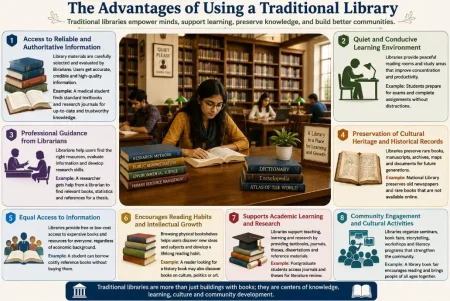
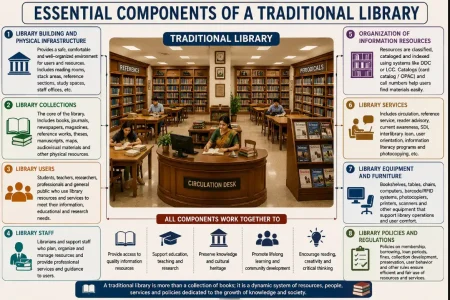
Beyond just storing information, traditional libraries serve vital educational, cultural, and social roles that digital libraries cannot fully replace. They act as community hubs where people come together to read, study, collaborate, attend workshops, and receive help from librarians. For example, university libraries often run research workshops on managing citations, avoiding plagiarism, and using databases effectively. Public libraries, on the other hand, host storytelling sessions for children, book clubs, art exhibitions, and community learning events. These physical spaces encourage collaboration and creativity, nurturing lifelong learning in ways that online platforms simply can’t match. The IFLA–UNESCO Public Library Manifesto (2022) highlights how public libraries are essential for promoting education, culture, access to information, and informed citizenship.
We also need to address the digital divide. Even though technology is ubiquitous, many people still lack reliable internet access, suitable devices, or the skills to navigate digital tools. If we were to replace traditional libraries with digital ones entirely, countless individuals would struggle to access information. Many students from rural or economically disadvantaged backgrounds rely on public and university libraries not just for books, but for computers, high-speed internet, printers, and the guidance of librarians. UNESCO recognizes that libraries play an essential role in bridging this gap by offering free internet access, computer facilities, digital literacy training, and equal opportunities for learning, no matter someone’s background.
Preservation is another vital reason why traditional libraries should continue to exist alongside digital libraries. While digitizing materials helps protect delicate items and offers people around the globe access to invaluable resources, it also comes with its own set of challenges, such as hardware failures, cyberattacks, outdated software, file format issues, and high costs for long-term storage. On the other hand, well-preserved printed books and manuscripts have lasted for centuries. For instance, medieval manuscripts, ancient Qur’ans, early printed books, and important historical records are still available today thanks to the careful preservation efforts of physical libraries and archives.
Additionally, organizations like the Europeana Digital Library and the Digital Public Library of America (DPLA) have done an incredible job of digitizing millions of historical documents. This allows people worldwide to explore and appreciate our shared cultural heritage while ensuring that fragile originals are kept safe. These examples show that physical and digital preservation can—and should—work together rather than be seen as rivals.
That’s why many researchers and library organizations support the hybrid library model, which marries traditional collections with digital technologies and services. A hybrid library offers users the best of both worlds. For example, a university student might check out a printed textbook for in-depth study while also being able to browse electronic journals, e-books, and online reference databases from the comfort of their home. In a similar vein, storied institutions like the British Library, the Library of Congress, and many outstanding university libraries not only house extensive collections of printed works but also provide access to millions of digital resources, online catalogs, institutional repositories, and virtual reference services. This blended approach gives users flexibility and helps meet their varied needs in today’s fast-paced world.