Academic writing is fundamentally based on trust, originality, and respect for intellectual contributions, all of which are essential to the concept of academic integrity. In scholarly communication, researchers are expected not only to present new ideas but also to acknowledge the work of others that has informed their thinking. One of the most effective ways to ensure this acknowledgment is by using a properly organized bibliography.
A bibliography serves as a comprehensive record of all sources consulted during the research process, allowing readers to trace the intellectual foundation of a study. For instance, if a student writes a research paper on the impact of artificial intelligence in libraries and includes books, journal articles, and reports in the bibliography, readers can easily identify where the information originated and verify its authenticity. A bibliography goes beyond a mere list of references; it reflects the depth, scope, and credibility of the researcher’s engagement with existing literature. For example, a paper that cites authoritative databases like Scopus or relies on peer-reviewed journal articles demonstrates greater academic reliability than one that uses unverified online sources.
In an academic environment where issues such as plagiarism, misrepresentation of sources, and unethical research practices are under increasing scrutiny, the role of a bibliography becomes even more significant. For example, if a student copies a paragraph from a journal article without acknowledging the source, it constitutes plagiarism. However, properly citing the source through both in-text citations and a bibliography ensures the ethical use of information. Additionally, when a researcher includes all consulted materials—even those not directly quoted—in the bibliography, it shows transparency in the research process. By clearly documenting sources, a bibliography enables the verification of information; for instance, a reader can follow a cited article to check whether the interpretation presented in the paper is accurate.
Therefore, understanding the significance of a bibliography is essential not only for producing high-quality academic work but also for fostering a culture of honesty, accountability, and scholarly responsibility in academic and research environments.
Concept of Bibliography
 The term “bibliography” refers to a systematic and organized list of all sources consulted during research and academic writing. This list is typically found at the end of a document and provides detailed information about each source, including the author’s name, title of the work, publication year, publisher, and sometimes the place of publication. Unlike a casual list, a bibliography adheres to a specific format or citation style, such as APA, MLA, or Chicago style, ensuring consistency and clarity.
For example, if a student writes an assignment on climate change, the bibliography may include textbooks, journal articles, government reports, and credible websites that were used to gather information, even if none of them were directly quoted in the text.
It is important to differentiate a bibliography from related terms like references and citations. A citation typically appears within the text to indicate the source of a specific idea or quotation, while a reference list includes only those works that have been directly cited in the document. In contrast, a bibliography is broader in scope, as it may include all materials consulted during the research process. For instance, a researcher might read ten articles to understand a topic but cite only five in the text; however, all ten can be included in the bibliography to reflect the complete range of sources consulted.
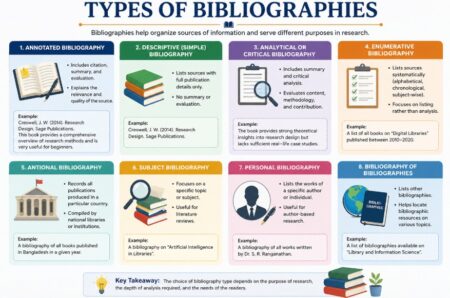
Bibliographies can also take different forms depending on the purpose of the work. A descriptive bibliography simply lists the sources with standard publication details, while an annotated bibliography includes a brief summary or evaluation of each source. For example, in an annotated bibliography on digital libraries, a student might list a journal article and add a short paragraph explaining its key arguments and relevance to the research topic. Additionally, there is the analytical bibliography, which examines the physical or textual features of books and documents, often used in advanced scholarly studies.
Academic Integrity: Meaning and Importance
Academic integrity is the ethical foundation of teaching, learning, and research. It emphasizes honesty, trust, fairness, respect, and responsibility in all scholarly activities. Students, researchers, and educators are required to produce original work, properly acknowledge the contributions of others, and avoid any form of academic misconduct. In practical terms, this means that when a student uses an idea, data, or quotation from a book or journal article, they must give proper credit through citation and include the source in their bibliography. For example, if a student copies a paragraph from a research article without acknowledgment, it is considered plagiarism. However, if they paraphrase the idea and cite the original author, they demonstrate adherence to academic integrity. Similarly, fabricating data in a research project or manipulating results to achieve desired outcomes also violates these ethical principles.
The importance of academic integrity lies in its role in maintaining the credibility and reliability of academic work. When researchers follow ethical standards, their findings can be trusted and built upon by others. A research paper that accurately cites sources and presents genuine data allows other scholars to verify the information and use it for further study. In contrast, a lack of integrity—such as falsified data or improper citation—can mislead readers and damage the reputation of both the individual and the institution. Academic integrity also supports intellectual fairness by ensuring that original authors receive proper recognition for their contributions, which is essential in a knowledge-based society. Moreover, academic integrity plays a crucial role in the personal and professional development of students. By practicing honesty in their academic work, students develop critical thinking, research skills, and ethical awareness that are vital for their future careers. For instance, a student who consistently follows proper citation practices and avoids plagiarism is more likely to produce high-quality, credible work in professional settings, such as research institutions, corporate environments, or public service roles.
In today’s digital age, where information is easily accessible and copy-paste practices are common, maintaining academic integrity has become even more significant. Therefore, it is essential to understand its meaning and importance not only for academic success but also for fostering a culture of responsibility, trust, and ethical scholarship.
Role of Bibliography in Ensuring Academic Integrity
The role of a bibliography in ensuring academic integrity is essential to the practice of ethical and responsible scholarship. In academic writing, integrity is upheld not only through original thinking but also through the proper acknowledgment of sources that contribute to the development of ideas. A bibliography serves as a structured record of all the materials consulted during the research process, allowing readers to understand the foundation upon which a study is built. For instance, when a student writes a paper on digital transformation in libraries and includes relevant books, journal articles, and reports in the bibliography, it clearly shows that the work is informed by credible and existing knowledge rather than being based on unsupported claims.
In an era where vast amounts of information are easily accessible, the risks of plagiarism, misrepresentation, and improper use of sources have significantly increased. In this context, the bibliography plays a crucial role in promoting transparency, accountability, and ethical research practices. By systematically listing sources, it enables readers to verify information, trace arguments back to their original authors, and assess the reliability of the research. Including peer-reviewed sources from databases like Scopus not only strengthens the authenticity of the study but also reflects the researcher’s commitment to academic standards.
Therefore, the bibliography is not merely a formal requirement; it is a vital tool that upholds academic integrity, supports credible research, and fosters trust within the scholarly community. The following points discuss the major roles of a bibliography in maintaining academic integrity.
- Preventing Plagiarism: One of the most critical roles of a bibliography is to prevent plagiarism, which is considered a serious violation of academic integrity. Plagiarism occurs when a writer presents someone else’s ideas, words, or findings as their own without proper acknowledgment. A well-structured bibliography ensures that all consulted sources are clearly documented, making it evident that the researcher has relied on existing knowledge rather than claiming originality for borrowed ideas. For example, if a student uses a concept from a journal article on artificial intelligence in libraries, listing that article in the bibliography—along with proper in-text citation—demonstrates ethical use of information. This practice not only protects the writer from accusations of misconduct but also reinforces honesty in academic work. Moreover, maintaining a bibliography encourages researchers to be mindful of their sources throughout the writing process, reducing the likelihood of accidental plagiarism.
- Acknowledging Intellectual Property: A bibliography plays a vital role in recognizing and respecting the intellectual property of other scholars. Academic research is cumulative in nature, meaning that new knowledge is built upon previous studies, theories, and discoveries. By including all relevant sources in a bibliography, a researcher formally acknowledges the contributions of others, thereby giving them due credit. For instance, when a student cites books, research articles, and reports that have shaped their understanding of a topic, it reflects respect for the original authors’ efforts and ideas. This acknowledgment is not only an ethical obligation but also a professional practice that sustains trust within the academic community. Furthermore, recognizing intellectual property rights encourages innovation, as researchers are more likely to share their work when they know it will be properly credited and protected.
- Enhancing Credibility and Reliability: A comprehensive bibliography significantly enhances the credibility and reliability of a research paper. It demonstrates that the writer has engaged with authoritative, relevant, and scholarly sources rather than relying on unverified or superficial information. For example, a research paper that includes peer-reviewed journal articles, academic books, and sources from databases like Scopus is generally considered more trustworthy than one based solely on random websites or blogs. The bibliography acts as evidence of the researcher’s effort to gather accurate and high-quality information, which strengthens the overall argument of the paper. Additionally, evaluators and readers often assess the quality of a research work by examining its bibliography, as it reflects the depth of research and the academic rigor applied during the study.
- Ensuring Transparency and Verifiability: Bibliography ensures transparency by providing a clear pathway for readers to trace the origins of the information presented in a research work. This transparency allows others to verify the accuracy of facts, interpretations, and conclusions. For instance, if a researcher makes a claim about the effectiveness of digital library services, readers can consult the sources listed in the bibliography to confirm whether the claim is supported by evidence. This ability to verify information is essential for maintaining trust in academic writing. Moreover, transparency through bibliography supports reproducibility in research, as other scholars can follow the same sources to replicate or extend the study. In this way, bibliography contributes to the reliability and accountability of scholarly communication.
- Supporting Scholarly Communication: Bibliographies serve as an important bridge between existing knowledge and new research, thereby supporting scholarly communication. By listing relevant sources, a bibliography helps readers discover additional materials related to the topic, facilitating further study and exploration. For example, a student researching “AI in libraries” can use the bibliography of a previous research paper to identify key authors, journals, and studies in that field. This interconnectedness allows knowledge to circulate within the academic community and promotes continuous learning and development. Furthermore, bibliographies help establish a research context by showing how a study fits within the broader body of literature, making it easier for others to understand its significance and contribution.
- Demonstrating Depth of Research: A detailed bibliography reflects the extent and depth of a researcher’s investigation into a topic. It indicates that the writer has consulted a wide range of sources, including books, journal articles, conference papers, and credible online materials. For example, a research paper with a diverse bibliography covering multiple perspectives on a topic demonstrates thorough preparation and critical engagement with the subject matter. This depth not only strengthens the arguments presented in the paper but also shows the researcher’s commitment to academic excellence. In contrast, a limited or weak bibliography may suggest insufficient research, which can reduce the overall quality and impact of the work. Therefore, a well-developed bibliography is often seen as a hallmark of serious and rigorous academic effort.
- Promoting Ethical Research Culture: Finally, the consistent use of bibliography contributes to the development of an ethical research culture in academic institutions. When students and researchers are trained to properly document their sources, they develop habits of honesty, accountability, and responsibility. For instance, using reference management tools like Mendeley or EndNote helps organize sources systematically and reduces the risk of missing citations or incorrect formatting. Over time, these practices become an integral part of the research process, fostering a culture where ethical standards are valued and upheld. In the long run, promoting such a culture not only improves the quality of academic work but also prepares individuals to maintain integrity in their professional and research careers.
Tools and Techniques for Managing Bibliography
Effectively managing a bibliography is a crucial aspect of academic writing, ensuring accuracy, consistency, and adherence to academic integrity. In today’s research environment, where scholars engage with numerous digital and print sources, relying solely on manual methods can lead to errors, omissions, and inconsistencies. Therefore, using appropriate tools and systematic techniques has become essential for organizing and maintaining bibliographic information in a structured and efficient manner.
One of the most effective ways to manage bibliographies is through reference management software such as Mendeley and EndNote. These tools allow researchers to collect, store, and organize references in a centralized database, making it easier to retrieve and use them during the writing process. For example, a student working on a research paper can import journal articles directly from online databases into the software, categorize them into folders based on research themes, and generate citations automatically. This not only saves time but also reduces the risk of formatting errors. Furthermore, these tools support various citation styles, including APA, MLA, and Chicago, enabling researchers to maintain consistency throughout their work.
In addition to using software, adopting systematic techniques during the research process is equally important. One such technique is to record bibliographic details while consulting a source rather than waiting until the end. For instance, when a researcher reads a journal article, noting essential details such as the author’s name, title, publication year, and source immediately helps prevent the loss of information later. This practice ensures completeness and accuracy in the final bibliography and minimizes the chances of unintentional plagiarism. Another useful technique is to organize references thematically, grouping sources according to specific topics or sections of the research. This approach simplifies the writing process and aids in developing a coherent literature review by allowing the researcher to easily identify relevant materials.
Academic databases and indexing platforms like Scopus play a significant role in facilitating bibliography management. These platforms provide structured citation data that can be exported directly into reference management tools, ensuring accuracy and standardization. They also offer features such as citation tracking and related article suggestions, which help researchers expand their bibliography and stay updated with current literature. Finally, maintaining consistency in citation style and regularly reviewing bibliographic entries are essential for ensuring quality. Even minor errors in formatting or missing details can affect the credibility of research work. Therefore, by combining the use of advanced tools with careful and systematic techniques, researchers can effectively manage their bibliographies and enhance the overall quality and integrity of their academic writing.
Best Practices for Effective Bibliography
Creating an effective bibliography is crucial for ensuring the quality, credibility, and integrity of academic work. A well-organized bibliography not only demonstrates the depth of research but also reflects the researcher’s commitment to ethical scholarship and accurate documentation. One of the most important practices is to record complete bibliographic details as soon as each source is consulted. Instead of postponing this task until the end, researchers should immediately note essential information, such as the author’s name, title, publication year, and source. For example, when reading a journal article, either saving its citation directly or writing down its full details helps prevent the loss of information and reduces the risk of accidental plagiarism.
Another key practice is maintaining consistency in citation style throughout the document. Researchers are usually required to follow a specific format, such as APA Style, MLA Style, or Chicago Style, and all entries in the bibliography must strictly adhere to that format. Inconsistent formatting—such as mixing styles or incorrectly arranging elements—can diminish the professionalism and clarity of the work. Therefore, careful attention should be given to punctuation, capitalization, and the order of information in each entry.
Using reference management tools is a highly effective practice for managing bibliographies. Software such as Mendeley and EndNote allows researchers to collect, organize, and format references efficiently. These tools enable automatic generation of citations and bibliographies, saving time and minimizing human error. For instance, a student working on a thesis can organize references by chapter or theme and insert citations directly into the document, ensuring accuracy and consistency.
In addition to using these tools, selecting credible and authoritative sources is crucial for building a strong bibliography. Researchers should prioritize peer-reviewed journal articles, academic books, and reliable databases such as Scopus. Including high-quality sources enhances the reliability of the research and demonstrates scholarly rigor. Conversely, relying on unverified or low-quality sources can weaken the overall argument and reduce the academic value of the work.
Regular review and proofreading of the bibliography are equally important to ensure accuracy and completeness. Even when automated tools are used, errors such as missing publication details, incorrect author names, or formatting inconsistencies may occur. Carefully checking each entry helps maintain a high standard of presentation and prevents potential issues during evaluation. Finally, organizing the bibliography in a clear and logical manner—typically in alphabetical order by the author’s last name—improves readability and allows readers to easily locate sources. By following these best practices, researchers can create effective bibliographies that support their work and uphold the principles of academic integrity and scholarly excellence.