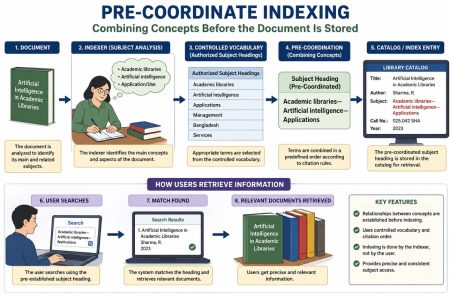
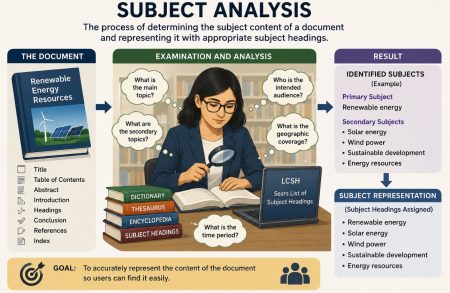
An indexing language is a structured system of terms used to represent the subject content of documents in a consistent and standardized manner for the purpose of information retrieval. It acts as a bridge between the language of documents and the language of users by translating complex ideas into controlled and meaningful terms. For example, a book titled “Introduction to Machine Learning” may be indexed under the controlled term “Machine learning” rather than using varied expressions such as AI learning, computer learning, or intelligent systems. Unlike natural language, which is often ambiguous, an indexing language applies vocabulary control to address problems such as synonymy and homonymy. For instance, the word “bank” may refer to a financial institution or a riverbank, but an indexing language clearly distinguishes these meanings using separate controlled terms.
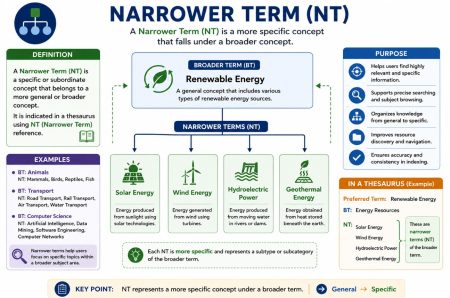
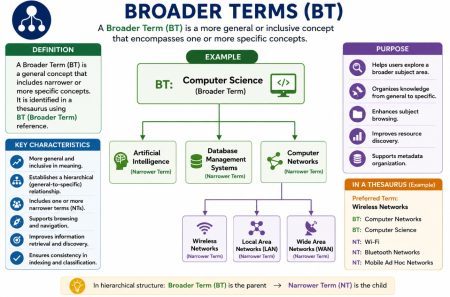
In library and information systems, indexing languages play a vital role in organizing knowledge and ensuring efficient access to information. They are widely used in library catalogs, bibliographic databases, and digital repositories to assign subject headings or descriptors that accurately reflect a document’s content. Common examples of indexing languages include Library of Congress Subject Headings (LCSH), Medical Subject Headings (MeSH), and specialized thesauri used in academic databases. For example, in MeSH, the term “Diabetes Mellitus” is used consistently to represent all documents related to diabetes, regardless of whether authors use terms like diabetes, sugar disease, or high blood glucose. These systems also provide semantic relationships such as broader terms, narrower terms, and related terms- such as “Information Retrieval” (broader term), “Indexing Language” (narrower term), and “Thesaurus Construction” (related term)- which help users refine or expand their searches. Through such mechanisms, indexing languages enhance search precision and recall, enabling users to retrieve relevant information effectively from large and complex information systems.
Why Is an Indexing Language Necessary in Information Retrieval?
The effectiveness of any information retrieval system depends largely on how well information is organized and represented. With the continuous growth of information resources in libraries, databases, and digital repositories, users often face difficulties in locating relevant documents quickly and accurately. An indexing language is necessary in information retrieval because it provides a systematic and controlled way of representing the subject content of documents, enabling efficient matching between users’ information needs and available resources.
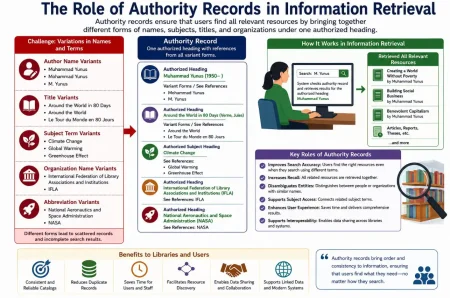
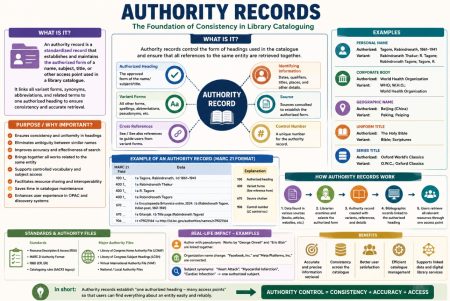
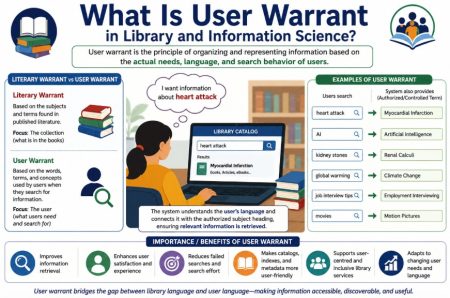
One of the primary reasons for the need of an indexing language is the inherent limitations of natural language. Natural language is flexible and expressive, but it is also ambiguous and inconsistent. The same concept can be described using different terms, such as “global warming” and “climate change”, while a single term may have multiple meanings depending on context, such as “network” in computing or social sciences. An indexing language resolves these problems by selecting preferred terms and controlling synonyms and homonyms. Through this vocabulary control, all documents related to a particular concept are indexed under a single standardized term, ensuring that users can retrieve relevant materials even when different expressions are used by authors.
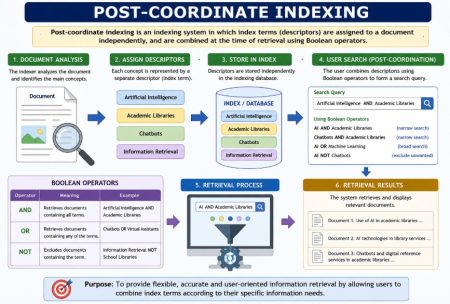
Indexing languages are also essential for improving precision and recall, which are key measures of retrieval effectiveness. Precision refers to retrieving only relevant documents, while recall refers to retrieving all relevant documents. Controlled indexing terms reduce irrelevant results by clearly defining subject meanings, thereby improving precision. At the same time, by bringing together all documents indexed under the same controlled term, indexing languages enhance recall. Furthermore, semantic relationships such as broader terms, narrower terms, and related terms allow users to systematically refine or expand their searches. For example, a search on “Information Technology” can be narrowed to “Cloud Computing” or expanded to include “Digital Transformation”, depending on the user’s requirement.
Consistency in subject representation is another crucial reason for the use of indexing languages. In large information systems, documents are indexed by different professionals at different times. Without a standardized indexing language, subject representation would vary widely, leading to confusion and incomplete retrieval. Established systems such as the Library of Congress Subject Headings (LCSH) and Medical Subject Headings (MeSH) provide uniform rules and controlled vocabularies that ensure consistency across collections. This consistency allows users to retrieve relevant documents reliably, regardless of differences in authors’ terminology or indexing practices.
In addition, indexing languages play a vital role in organizing knowledge and supporting advanced information retrieval systems. They form the foundation of subject catalogs, bibliographic databases, and digital libraries, and they enable features such as faceted searching and semantic browsing. Even with the widespread use of full-text searching and artificial intelligence–based retrieval, indexing languages remain indispensable. Full-text search may retrieve large volumes of information, but without controlled subject representation, results can be overwhelming and unfocused. Indexing languages help filter, structure, and contextualize search results, making information retrieval more meaningful and user-friendly.