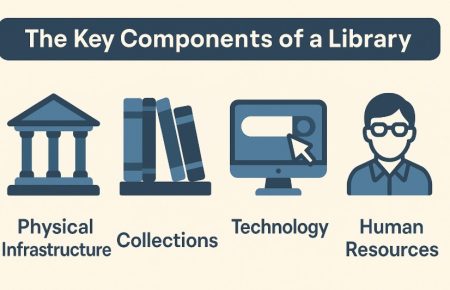
A library is an institution dedicated to collecting, preserving, and providing access to information, knowledge, and cultural resources. Historically, libraries have been repositories of books and manuscripts, but in the modern age, they have evolved into dynamic spaces that offer access to both physical and digital resources. Libraries serve a fundamental role in society and education, acting as guardians of knowledge and facilitators of learning. They are not merely places where books are stored, but rather hubs of intellectual growth, offering an environment conducive to inquiry, discovery, and collaboration.
In society, libraries function as knowledge repositories, safeguarding historical records, scientific research, cultural texts, and educational resources. They provide access to a vast array of information, supporting the intellectual development of individuals and the progress of society as a whole. Libraries also act as information providers, ensuring that people can access the tools and materials they need for education, personal development, and professional advancement. From books and journals to digital databases and multimedia resources, libraries make information accessible to everyone, regardless of socioeconomic background. Moreover, libraries serve as community centers, where individuals can come together to learn, share ideas, and participate in social programs. They offer educational workshops, literacy programs, career support, and cultural events that foster a sense of community and promote social well-being. Libraries are safe, inclusive spaces that support lifelong learning and engagement, enabling people of all ages to continue their education and personal growth.
Understanding libraries’ functions and objectives is essential to appreciating their significant impact on society. Libraries do much more than simply lend books—they provide vital services that contribute to education, cultural preservation, and social cohesion. Recognizing their broader roles as educational resources, community hubs, and custodians of knowledge underscores the importance of libraries in shaping informed, connected, and thriving communities.
The Functions of a Library
Libraries have long been vital institutions that serve as centers of knowledge, education, and culture. Their functions extend beyond merely storing books; libraries play a critical role in supporting individuals’ and communities’ intellectual, social, and educational needs. As society evolves, so too do the functions of libraries, adapting to new technological advancements and changing societal needs. Below is an exploration of the core functions of a library and how they contribute to the broader community, with examples from both Asian and European contexts.
- Providing Access to Information: At its core, the primary function of a library is to provide access to information. Libraries house various materials, such as books, journals, newspapers, digital content, e-books, and multimedia resources. Whether through physical collections or digital platforms, libraries ensure that all individuals, regardless of their background or financial status, have the ability to access critical information. This access supports learning, research, and personal development.
For example, the National Library of China in Beijing offers an extensive collection of historical and modern texts, making it one of the largest libraries in the world. It provides access to invaluable resources on Chinese culture, history, and government. Similarly, in Japan, the National Diet Library serves as the national library for the country, providing extensive legislative and governmental documents, supporting the research needs of the public and policymakers.
The British Library in London serves as a key example, offering millions of physical and digital resources accessible to the public. It is renowned for its historical collections, which include works such as the Magna Carta and early manuscripts of literary works by Shakespeare. The Bibliothèque nationale de France in Paris, on the other hand, preserves and provides access to a treasure trove of French literary and historical works, ensuring the French population and scholars worldwide can access national treasures. - Supporting Education and Research: Libraries play an indispensable role in supporting education at all levels, from early childhood education to post-graduate research. Academic libraries serve the educational needs of students and faculty by offering access to specialized resources such as textbooks, research papers, and scholarly journals. These resources enable students and researchers to complete assignments, conduct studies, and stay up-to-date with the latest developments in their fields. Universities such as the University of Tokyo have large, specialized libraries catering to various academic disciplines. The Tata Institute of Social Sciences (TISS) in India provides students with extensive resources for research in social sciences, enabling critical research in areas like public policy and social work. Public libraries in China, such as the Shanghai Library, support students and professionals, offering access to technical journals and databases for those looking to advance their careers or continue their research.
European universities also place heavy emphasis on their libraries’ role in education. The University of Oxford Library system, for instance, serves students and academics with a vast collection of research materials in various disciplines. The National Library of Greece, in Athens, plays a central role in supporting research on ancient Greek history and culture, allowing students and scholars to access rare manuscripts and historical works. - Promoting Literacy and Reading: A key function of libraries is to promote literacy and encourage reading. Libraries provide an environment where individuals can access a wide range of reading materials, including books, magazines, and newspapers, which helps people improve their reading skills and expand their knowledge. For young learners, libraries are essential in building literacy skills through programs like storytime, reading clubs, and book recommendations. Countries such as Singapore have taken a proactive approach to literacy through initiatives like the Singapore National Library, which regularly runs reading programs and storytelling sessions for children. The Public Library of the Philippines in Manila also hosts programs that encourage children to engage in reading from a young age.
Countries like Sweden have highly developed library systems that offer children and adults access to reading materials, fostering a deep love of literature. The Swedish Library Association significantly promotes reading among the young through its wide network of public libraries, ensuring children grow up with easy access to books. In Finland, public libraries are recognized as central to literacy and lifelong learning, with programs designed to engage children, encourage creativity, and promote literacy for all age groups. - Fostering Community Engagement and Social Interaction: Libraries serve as important community centers, providing a space for social interaction, cultural exchange, and collaborative activities. Libraries are not only places to borrow books; they are gathering spots where individuals from diverse backgrounds come together to engage in social programs, workshops, and events. By hosting activities like author talks, book clubs, exhibitions, and cultural events, libraries create opportunities for people to interact, share ideas, and learn from one another. For example, the Kuala Lumpur Library in Malaysia is a place for accessing books and a community hub where local groups come together to learn and collaborate. It offers programs for literacy and community engagement, such as seminars, reading clubs, and cultural activities. The Berlin Central and Regional Library (Zentral- und Landesbibliothek Berlin) serves as a gathering place for Berlin’s diverse population. It hosts cultural events, readings, and community outreach programs, making it a vital part of the city’s social fabric. Similarly, the Biblioteca Nacional de España (National Library of Spain) organizes educational programs and exhibitions that invite the public to learn about Spanish history, literature, and culture, contributing to cultural awareness and social cohesion.
- Preserving Cultural and Historical Heritage: Libraries function as custodians of cultural and historical knowledge, preserving rare books, manuscripts, documents, and archives for future generations. This is especially important for national libraries and specialized libraries that focus on collecting materials of historical and cultural significance. Through their archival collections, libraries ensure that a community’s intellectual and cultural heritage is preserved and accessible. For example, the National Library of India in Kolkata preserves valuable works related to India’s rich cultural and historical past, making them accessible for researchers and the public. Similarly, in Japan, the National Diet Library serves as a national archive, preserving government documents and historical records crucial to Japan’s political and cultural history. The Vatican Library in Rome plays an essential role in preserving ancient manuscripts and religious texts, which are critical to understanding the cultural and spiritual development of Europe. The British Library, with its historical collections and manuscripts, preserves England’s literary heritage and serves as a repository for global culture.
- Encouraging Innovation and Creativity: Libraries have embraced the role of fostering innovation and creativity by providing spaces and resources for hands-on learning and exploration. Many libraries now offer makerspaces, which are community-driven creative spaces equipped with tools like 3D printers, digital media equipment, and crafting supplies. These spaces allow individuals to explore new technologies, experiment with different media, and engage in creative projects.
The Tokyo Public Library offers workshops and events that promote digital literacy and creative expression, allowing patrons to engage with new technologies such as virtual reality and 3D design. South Korea’s Seoul Metropolitan Library has incorporated makerspaces that encourage innovation and provide patrons with access to new technologies that enhance their creative skills.
Libraries serve a diverse range of functions that are essential to the intellectual, social, and cultural development of individuals and communities. From providing access to information and promoting literacy to fostering creativity and preserving cultural heritage, libraries play a central role in shaping an informed and engaged society. By continuously adapting to technological advancements and societal needs, libraries remain vital institutions that support education, community engagement, and innovation in today’s rapidly changing world.
Reference Articles:
- Beech, N. (n.d.). Guides: Manuscripts: Introduction. Retrieved April 29, 2025, from https://bl.libguides.com/reference-services/manuscripts/introduction
- Best public libraries in Kuala Lumpur. (2024, May 8). Time Out Kuala Lumpur. https://www.timeout.com/kuala-lumpur/things-to-do/best-public-libraries-in-kl
- Biblioteca Nacional de España. (2025). In Wikipedia. https://en.wikipedia.org/w/index.php?title=Biblioteca_Nacional_de_Espa%C3%B1a&oldid=1277475581
- Bibliothèque nationale de France. (2025). In Wikipedia. https://en.wikipedia.org/w/index.php?title=Biblioth%C3%A8que_nationale_de_France&oldid=1282622663
- Home. (n.d.). Retrieved April 29, 2025, from https://www.vaticanlibrary.va/en/home.php
- IFLA SDG Stories –. (n.d.). Retrieved April 29, 2025, from https://librarymap.ifla.org/stories/Philippines/LIBRARY%E2%80%99S-OUTREACH-PROGRAMME-PROVIDES-GROWTH-OPPORTUNITIES-TO-STREET-CHILDREN/177
- Libraries | University of Oxford. (n.d.). Retrieved April 29, 2025, from https://www.ox.ac.uk/research/support-researchers/information-and-data-services/libraries
- National Library of India | Ministry of Culture, Government of India. (n.d.). Retrieved April 29, 2025, from https://www.indiaculture.gov.in/national-library-india
- NLB. (n.d.). Retrieved April 29, 2025, from https://www.nlb.gov.sg/main/whats-on/events/ChildrenAndTeens
- SEAtongue, & Aida. (2024, October 14). Asia’s Largest Libraries: A Journey Through Knowledge and History. SEAtongue. https://seatongue.com/blog/business/the-biggest-libraries-in-asia-a-journey-through-knowledge-and-history/
- Seoul Metropolitan Library. (n.d.). Retrieved April 29, 2025, from https://lib.seoul.go.kr/rwww/html/en/main.jsp
- Shanghai Library – Access. (2022, October 26). https://librarylearningspace.com/tag/shanghai-library/
- The British Library: The National Library of the UK. (n.d.). The British Library. Retrieved April 29, 2025, from https://www.bl.uk/
- The Legislative Support Services of Japan’s Diet—61st IFLA General Conference. (n.d.). Retrieved April 29, 2025, from https://origin-archive.ifla.org/IV/ifla61/61-nakf.htm
- The University of Tokyo. (n.d.). The University of Tokyo. Retrieved April 29, 2025, from https://www.u-tokyo.ac.jp/en/about/libraries.html
- Training Session. (n.d.). University of Tokyo Library System. Retrieved April 29, 2025, from https://www.lib.u-tokyo.ac.jp/en/library/literacy/training
- Welcome to SDTM Library | SDTML. (n.d.). Retrieved April 29, 2025, from http://library.tiss.edu/
- Zentral- und Landesbibliothek Berlin (ZLB). (n.d.). ZLB. Retrieved April 29, 2025, from https://www.zlb.de/en/who-we-are/
- Εθνική Βιβλιοθήκη της Ελλάδος. (n.d.). Εθνική Βιβλιοθήκη Της Ελλάδος. Retrieved April 29, 2025, from https://www.nlg.gr/?lang=en