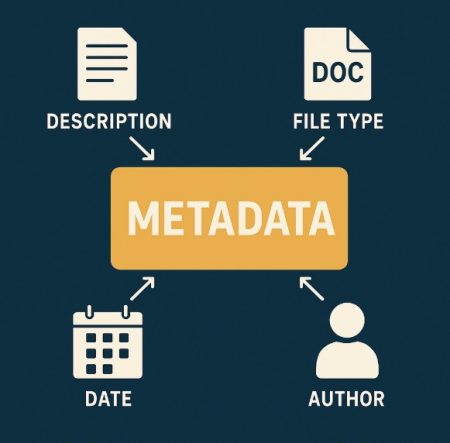
Metadata is often described as “data about data,” but in practice, it is much more than a simple label. It provides the contextual information that makes digital resources understandable, searchable, and usable over time. In libraries, archives, databases, and digital platforms, metadata acts like an invisible framework that organizes knowledge. It tells us what a resource is, how it is structured, and how it should be managed or preserved.
For instance, descriptive metadata includes elements such as the title, author, publication year, and subject keywords of a book; these help a library user quickly find “Introduction to Data Science” by John Doe, 2022, in the catalogue. Structural metadata explains how components of a resource fit together, such as linking individual chapters in an e-book or organizing image files into a digital photo collection so that users can navigate from “Chapter 1: Basics” to “Chapter 2: Applications” seamlessly. Administrative metadata, on the other hand, deals with management and technical details: for example, noting that a thesis is saved in PDF/A format, is under a Creative Commons license, and should be preserved in the institutional repository for a minimum of 10 years.
Without these layers of metadata, digital content would remain disorganized, difficult to retrieve, and prone to losing context. A scanned image without metadata may appear as just a random file named IMG12345.jpg, but with proper metadata, it becomes “Graduation Ceremony, NSU Library, April 2023, Photographer: Jane Smith”. In essence, metadata transforms raw digital objects into meaningful and accessible information, ensuring that knowledge can be located, interpreted, and trusted across systems and generations.
The Main Types of Metadata
Metadata plays a critical role in organizing, managing, and preserving information resources. It is often defined as “data about data,” but its role goes far beyond mere description. Metadata provides structure and context to information, ensuring that digital and physical resources can be discovered, accessed, and preserved effectively. Broadly, metadata can be classified into three main types: descriptive, structural, and administrative. Each type serves a distinct purpose and contributes to the life cycle of information in unique ways.

1. Descriptive Metadata:
Descriptive metadata focuses on the information needed to identify, discover, and retrieve a resource. It includes details such as the title, author, keywords, subject, publisher, and publication year. For example, in a library catalog, descriptive metadata allows a student to search for “Data Science for Beginners by John Doe, published in 2021” and retrieve the exact resource from thousands of records.
Descriptive metadata is also widely used in digital platforms. For instance, an image uploaded to an online archive might contain descriptive metadata such as “Dhaka University Convocation, 2019, Photographer: Rahman Khan.” These details provide meaning to the object and make it discoverable through search engines and digital repositories.
2. Structural Metadata:
Structural metadata explains how different parts of a resource relate to each other. It acts as a roadmap, ensuring that users can navigate and interact with complex digital objects. For example, in an e-book, structural metadata organizes chapters and sections, allowing readers to move from Chapter 1 to Chapter 2 in a logical order. Similarly, in a digital photo collection, structural metadata might link images to an album, maintaining the intended sequence of photographs.
Another example can be seen in multimedia files, where structural metadata defines how audio, video, and subtitles are synchronized to create a complete viewing experience. Without structural metadata, digital objects could lose their coherence and usability.
3. Administrative Metadata
Administrative metadata deals with the management and preservation aspects of information resources. It includes technical details such as file format, size, creation date, copyright information, and access restrictions. For instance, a thesis uploaded to an institutional repository may contain administrative metadata stating that it is in PDF/A format, licensed under Creative Commons Attribution, and restricted to campus-only access for the first year.
Administrative metadata also supports long-term preservation. For example, a rare manuscript digitized by a library may include metadata about the scanner used, digitization resolution (e.g., 600 dpi), and preservation requirements. This ensures the file remains authentic, usable, and legally compliant over time.
The three main types of metadata (descriptive, structural, and administrative) work together to ensure that information is not only stored but also remains meaningful and accessible. Descriptive metadata makes resources discoverable, structural metadata maintains their organization, and administrative metadata guarantees their proper management and preservation. Without these metadata layers, digital collections and information systems would be incomplete, difficult to navigate, and at risk of losing context. Metadata, therefore, is the backbone of effective information management and a cornerstone of libraries, archives, and digital repositories.