Mnemonics in Library Classification
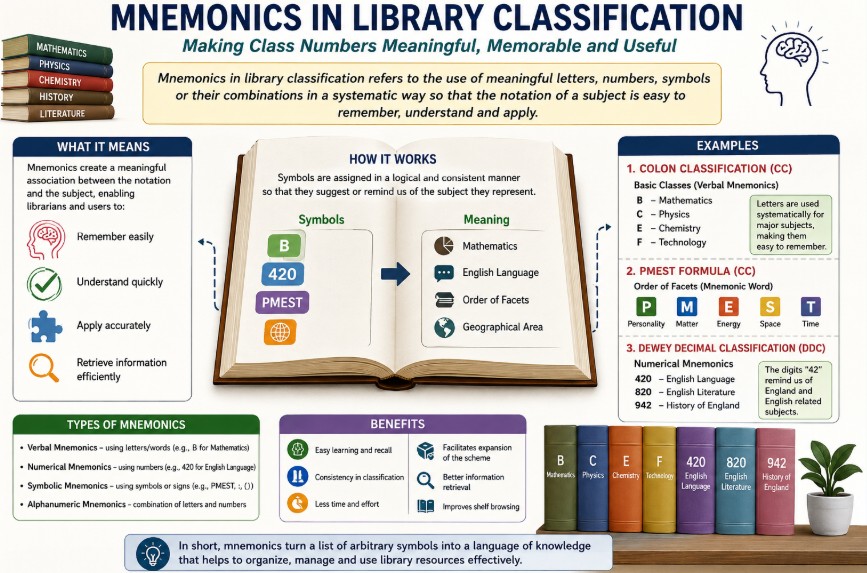
Mnemonics in library classification refer to techniques or devices used to make classification notations easier to remember, understand, and apply. The term mnemonic originates from the Greek word mnemonikos, meaning “related to memory.” In library classification, mnemonics are used to establish meaningful relationships between symbols, letters, numbers, or combinations of characters and the subjects they represent. A mnemonic notation enables librarians and users to recognize and recall the significance of a class number more easily than a notation that is assigned arbitrarily. By creating logical and consistent patterns within a classification scheme, mnemonics facilitate the organization, arrangement, and retrieval of library materials.
The primary purpose of mnemonics is to aid memory and reduce the complexity of classification work. Instead of requiring librarians to memorize thousands of unrelated class numbers, mnemonic systems use symbols that have a recognizable connection to the subject. For example, in the Colon Classification, mnemonic principles are extensively used in assigning notations to basic classes. The notation B represents Mathematics, C represents Physics, and E represents Chemistry. Because these symbols are assigned consistently, classifiers can easily remember and recognize the subjects they represent. Another important mnemonic feature of Colon Classification is the PMEST formula—Personality, Matter, Energy, Space, and Time—which helps classifiers remember the standard sequence of facets when constructing class numbers.
Mnemonics can take several forms, including alphabetical, numerical, and symbolic mnemonics. Alphabetical mnemonics use letters that correspond to the names of subjects or places. For instance, a library classification scheme might use E for English literature and F for French literature. Numerical mnemonics may employ a consistent sequence of numbers to represent related concepts. In the Dewey Decimal Classification, the number 940 represents the history of Europe, while 954 represents the history of India. Once a user understands the pattern, it becomes easier to identify and remember related subjects. Symbolic mnemonics may use punctuation marks or special symbols to indicate specific relationships between subjects, facets, or forms.
Mnemonics are especially valuable in faceted classification systems because they help maintain consistency when combining different facets to create complex class numbers. For example, in Colon Classification, a class number for a subject may include separate symbols representing personality, matter, energy, space, and time. Since each facet uses a standardized set of symbols, librarians can construct and interpret class numbers more accurately. A classifier dealing with “Agricultural Education in Bangladesh in the 21st Century” can combine the appropriate facet symbols according to established mnemonic rules rather than creating an entirely new notation from memory.
The use of mnemonics offers several advantages. It reduces the time required to learn and apply a classification scheme, improves accuracy in class number construction, and facilitates the expansion of classification systems without disrupting existing arrangements. Moreover, mnemonic notation enhances communication among librarians and assists users in locating materials on library shelves. For example, when books on related subjects share similar notation patterns, users can easily browse nearby shelves to discover additional resources on the same topic.
Why Are Mnemonics Considered an Important Feature of a Classification Scheme?
Mnemonics play a crucial role in classification schemes because they make it easier to remember, understand, and apply classification notations. In library classification, a wide range of subjects and subtopics must be represented using symbols, letters, or numbers. Without mnemonics, classifiers would need to memorize numerous arbitrary notations, which would complicate and prolong the classification process. Mnemonics create logical connections between notations and the concepts they represent, enabling librarians to recall and interpret class numbers more effectively. Consequently, they reduce mental effort and enhance the overall usability of a classification system.
One of the main advantages of mnemonics is that they aid in learning and applying classification schemes. Librarians, students of Library and Information Science, and information professionals can master a classification system more easily when notations follow consistent and meaningful patterns. For instance, in the Colon Classification, the notation ‘B’ stands for Mathematics, ‘C’ represents Physics, and ‘E’ signifies Chemistry. These systematic assignments help classifiers remember the relationships between symbols and subjects. Additionally, the PMEST formula (Personality, Matter, Energy, Space, and Time) serves as a mnemonic device that guides classifiers in organizing facets in a standard order when constructing class numbers.
Mnemonics also promote consistency and accuracy in classification. When symbols and notations are assigned according to established mnemonic principles, different classifiers are more likely to generate similar class numbers for the same subject. This uniformity is vital for maintaining organized library collections and ensuring that users can easily locate materials. Furthermore, mnemonic notation reduces the likelihood of errors because classifiers can often infer the meaning of a notation based on its structure and pattern, rather than relying solely on memory or repeatedly consulting classification schedules.
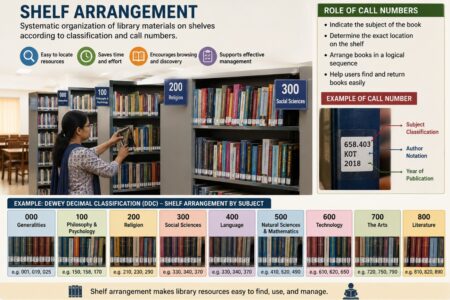
Another significant benefit of mnemonics is their role in facilitating information retrieval and browsing on library shelves. Books on related subjects often share similar notation patterns, helping users identify subject relationships and discover additional resources on the same topic. For example, in the Dewey Decimal Classification (DDC), the notation ‘420’ represents the English language, ‘820’ stands for English literature, and ‘942’ denotes the history of England. The recurring digits ’42’ create a meaningful association with England and English-related subjects, making the notation easier to understand and remember.
Mnemonics are also valuable for the expansion and maintenance of classification systems. As new subjects emerge and knowledge continues to evolve, classification schemes must accommodate additional topics without disrupting the existing structure. Mnemonic principles provide a systematic framework for assigning new notations while preserving logical relationships among subjects. This flexibility enables classification schemes to remain relevant and adaptable over time.