What is a Class Number in Library Classification?
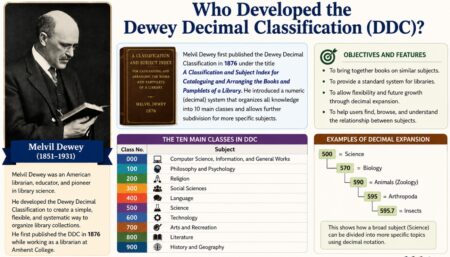
A class number is a fundamental element of library classification that represents the subject or topic of a document through a systematic combination of numbers, letters, or symbols. It is assigned according to a specific classification scheme, such as the Dewey Decimal Classification or the Library of Congress Classification, in order to arrange materials in a logical and hierarchical manner. The class number reflects the intellectual content of a resource by organizing knowledge into broad categories and progressively narrower subdivisions. For example, in the Dewey Decimal system, the number 500 represents natural sciences, 510 indicates mathematics, and 516 refers to geometry. Similarly, in the Library of Congress system, QA denotes mathematics, while QA76 is used for computer science, demonstrating how subjects are systematically divided into more specific areas.
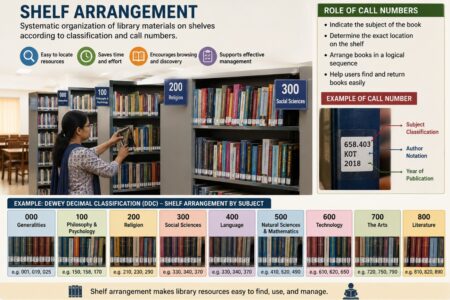
In practical terms, the class number acts as both a location tool and an organizational device within the library. It groups materials on similar subjects together, enabling users to browse related resources easily. For instance, books on programming may be placed under 005 in the Dewey Decimal Classification, allowing a student searching for programming books to find numerous relevant titles in the same section. Likewise, in an academic library using the Library of Congress system, books on database systems might be classified under QA76.9, helping researchers quickly locate specialized materials. Moreover, the class number forms a key part of the call number, which uniquely identifies each item. For example, a complete call number like 005.133 PYT may indicate a book on Python programming. Thus, through clear subject representation and practical shelf arrangement, class numbers play a crucial role in organizing knowledge and facilitating efficient information retrieval in libraries.
The Main Components of a Class Number
 A class number is an essential part of any library classification system. It serves as a specific code that identifies the subject matter of a document and determines its location on the shelf. Whether a library uses the Dewey Decimal Classification or the Colon Classification, the creation of a class number follows a logical structure made up of several key components. These components work together to systematically organize knowledge, making it easy and intuitive for users to retrieve information.
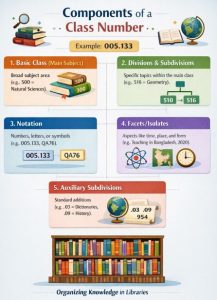
- Basic Class (Main Subject): The basic class serves as the foundation of the class number and represents a broad subject area of a document. It provides the first level of classification, grouping materials into general categories. For instance, in the Dewey Decimal System, the number 500 signifies Natural Sciences, while 300 corresponds to Social Sciences. Each class number begins with this core subject, which defines the primary focus of the resource.
- Divisions and Subdivisions: Classification systems organize information by moving from broad categories to more specific ones through divisions and subdivisions. These divisions refine each subject by adding additional digits or symbols to the basic classification. For example, within the 500 category (Natural Sciences), the number 510 represents Mathematics, and 516 further specifies it as Geometry. This hierarchical arrangement enables libraries to group related subjects together while clearly distinguishing between different topics.
- Notation: Notation is the symbolic language used to express the class number. It may consist of numbers, letters, or a combination of both, depending on the classification system. In DDC, notation is purely numeric, such as 005.133 for programming languages. In contrast, systems like the Library of Congress Classification use alphanumeric notation, such as QA76 for computer science. Notation ensures uniformity, scalability, and ease of interpretation across the classification system.
- Facets or Isolates (in Faceted Systems): In faceted classification systems, particularly the Colon Classification developed by S. R. Ranganathan, class numbers are constructed using facets or isolates. These represent different aspects of a subject, such as personality (main subject), matter, energy, space, and time. For example, a topic like “Teaching Mathematics in Bangladesh in 2020” may combine subject (Mathematics), activity (Teaching), place (Bangladesh), and time (2020) into a single, synthesized class number. This approach allows for highly flexible and detailed subject representation.
- Auxiliary or Common Subdivisions: Another important component is the use of auxiliary or common subdivisions, which add standard details applicable across many subjects. These may indicate form, place, language, or other recurring aspects.
For example, in DDC:-
- .03 indicates dictionaries
- .09 represents historical or geographical treatment
- 954 denotes the history of Bangladesh
Such subdivisions enrich the class number by providing additional context without altering the main subject.
-
- Synthesis of Components: A complete class number is typically formed by combining various components in a logical order. For example, the number 005.133 represents a main subject, which is computer programming, along with a specific subdivision focused on programming languages. In faceted classification systems, this synthesis becomes even more dynamic, as multiple facets are integrated to represent complex or interdisciplinary topics.
The main components of a class number—such as the basic class, divisions, subdivisions, notation, facets, and auxiliary elements—create a structured framework for organizing knowledge in libraries. Together, they ensure precise subject representation, a logical arrangement of materials, and efficient access to information. As libraries continue to evolve in the digital age, these components remain essential for maintaining order and supporting effective information retrieval in both physical and electronic collections.
Importance of Class Number in Library Organization
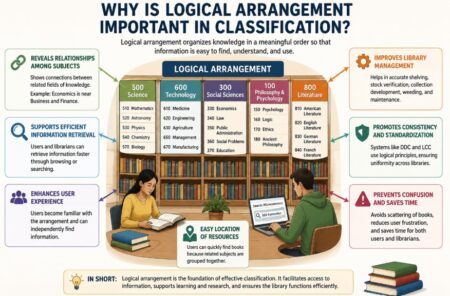
A class number is essential for organizing libraries by providing a systematic and logical arrangement of materials based on their subject matter. It ensures that books and other resources on similar topics are grouped together, making it easier for users to locate and browse related materials. For example, in the Dewey Decimal Classification system, books on computer science are assigned the numbers 004–006. This means that a user searching for programming resources can find multiple relevant titles in one section. This subject-based organization not only saves time but also enhances the user’s ability to explore additional resources within the same field.
Furthermore, the class number serves as a precise location tool within the library. It is a crucial part of the call number, which helps both library staff and users identify the exact position of an item on the shelf. For instance, a book classified as 005.133 can be quickly found among other programming-related materials that are arranged in numerical order. In academic libraries that use systems like the Library of Congress Classification, a number such as QA76 directs users to collections related to computer science, ensuring efficient retrieval even in large collections. Additionally, class numbers contribute to the consistency, standardization, and effective management of library collections. They enable librarians to organize, shelve, and maintain materials systematically, which reduces confusion and minimizes errors. Even in digital library environments, class numbers aid in organizing metadata and subject indexing, improving search and retrieval processes. Therefore, by facilitating logical arrangement, precise location, and efficient access, the class number remains a vital tool in both traditional and modern library systems.