What Is Mixed Notation in Library Classification?
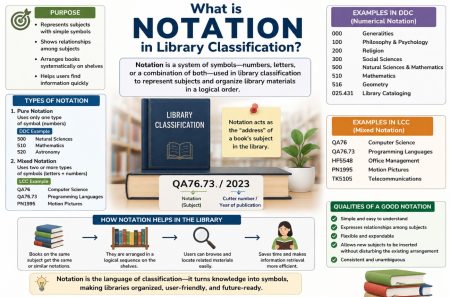
Mixed notation is a system of notation in library classification that uses more than one type of symbol, such as Arabic numerals, uppercase or lowercase letters, Roman numerals, punctuation marks, and other special symbols, to represent subjects and their relationships. Unlike pure notation, which relies on only one type of symbol (such as the primarily numeric notation used in the Dewey Decimal Classification), mixed notation combines different symbols to create more expressive, flexible, and detailed class numbers. This enables classification systems to represent both simple and complex subjects accurately while maintaining a logical arrangement of library materials.
The primary purpose of mixed notation is to increase the flexibility and capacity of a classification system. As new fields of knowledge emerge and interdisciplinary subjects become more common, a library classification scheme must be able to accommodate them without disrupting its existing structure. Mixed notation achieves this by combining letters, numbers, and punctuation symbols to construct new class numbers. It also supports subject synthesis, allowing multiple concepts—such as place, time, language, form, or related disciplines—to be combined into a single notation. As a result, mixed notation is particularly valuable in faceted and analytico-synthetic classification systems.
One of the best-known examples of mixed notation is the Library of Congress Classification (LCC). LCC combines alphabetic letters, Arabic numerals, decimal numbers, and Cutter numbers (letter-number combinations) to create unique call numbers. For example, the call number QA76.73.J38 represents a book on the Java programming language. Here, QA denotes Mathematics and Computer Science, 76.73 represents programming languages, and J38 is the Cutter number for Java. Similarly, KF4558 .A2 represents a work on United States constitutional law, where KF indicates U.S. law, 4558 identifies constitutional law, and .A2 is the Cutter number. The combination of letters and numbers makes LCC a classic example of a mixed notation system.
Another important example is the Universal Decimal Classification (UDC), which uses Arabic numerals together with symbols such as : (colon), + (plus), / (slash), = (language indicator), and ( ) (parentheses) to express relationships between subjects and other characteristics. For instance, the notation 621.395:004 represents the relationship between telecommunications (621.395) and computer science (004), where the colon (:) indicates a relationship between the two subjects. Likewise, 94(540) represents the history of India, where 94 denotes history and (540) specifies the geographical location, India. Another example is 821.111=111, where 821.111 represents English literature and =111 specifies the English language.
A third example is Colon Classification (CC), developed by S. R. Ranganathan. This system employs a combination of letters, numbers, and punctuation marks such as colons (:), semicolons (;), commas (,), apostrophes (‘), and periods (.) to connect different facets of a subject. For example, a topic like “Teaching Mathematics in Secondary Schools in Bangladesh during the 21st Century” can be represented by combining separate notations for Education, Mathematics, Secondary Schools, Bangladesh, and Time into a single synthesized class number. Although the exact notation varies depending on the edition of Colon Classification, this example illustrates how mixed notation enables the precise representation of multidimensional subjects.
Mixed notation offers several important advantages. It provides greater expressiveness, allowing detailed subject relationships to be represented in a compact notation. It is highly flexible, making it easier to introduce new subjects without reorganizing the entire classification scheme. It also improves subject specificity, enabling libraries to classify interdisciplinary topics more accurately. For example, a book on Artificial Intelligence in Healthcare can be assigned a notation that combines concepts from both computer science and medicine, rather than placing it under only one discipline.
Despite these advantages, mixed notation also has some limitations. Because it uses different types of symbols and punctuation marks, it can be more difficult for beginners to understand and apply. The notation may appear more complex than pure numeric systems, requiring additional training for cataloguers and library staff. Furthermore, users unfamiliar with the classification scheme may find long synthesized notations harder to interpret.
How Does Mixed Notation Help in Arranging Library Materials?
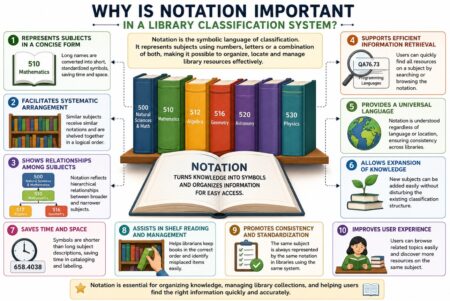
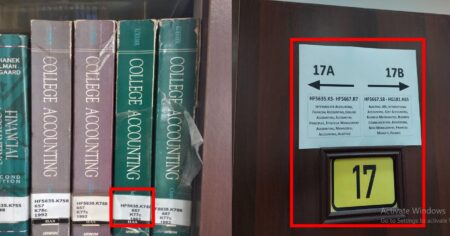
Mixed notation plays a crucial role in organizing library materials by providing a systematic, flexible, and precise method for arranging books and other information resources on library shelves. By combining different types of symbols—such as letters, Arabic numerals, decimal numbers, and punctuation marks—mixed notation can represent subjects in greater detail than pure notation. This enables libraries to group materials on closely related topics while clearly distinguishing between different subjects, subtopics, authors, and editions. As a result, users can quickly locate resources and understand the logical relationships among materials.
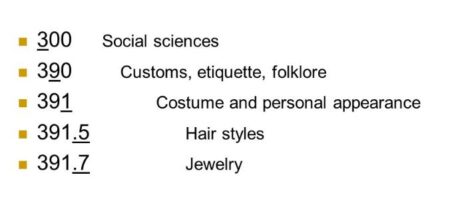
One of the main advantages of mixed notation is its ability to create a hierarchical arrangement of knowledge. Broad subject areas are represented by one set of symbols, while additional letters, numbers, or punctuation marks indicate increasingly specific topics. For example, in the Library of Congress Classification (LCC), the call number QA76 represents Computer Science, QA76.73 represents Programming Languages, and QA76.73.J38 represents books about the Java programming language. This hierarchical structure ensures that books on general computer science are shelved before books on programming languages, and that books on Java are grouped together within the programming language section. Such an arrangement simplifies browsing for library users.
Mixed notation also helps keep related materials together while separating unrelated subjects. For instance, in the LCC, books with call numbers QA76.73.P98 (Python programming) and QA76.73.J38 (Java programming) are shelved close to each other because both belong to the programming languages category. However, books classified under RC (Medicine) or KF (United States Law) are placed in entirely different sections of the library, reflecting their distinct subject areas. This logical organization allows users to find multiple resources on the same topic in one location.
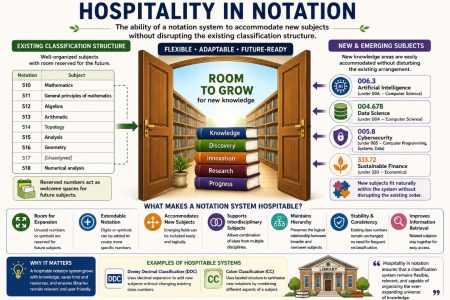
Another important benefit of mixed notation is its expandability. Libraries continually acquire new books, journals, and digital resources covering emerging subjects. Mixed notation allows for the insertion of new topics into the existing classification system without requiring a complete rearrangement of the entire collection. For instance, if a new programming language becomes popular, it can be assigned a new notation within the QA76.73 sequence, allowing books on the new language to be shelved alongside other programming language books while maintaining the overall order.
Mixed notation is also highly effective for organizing complex and interdisciplinary materials. Classification systems like the Universal Decimal Classification (UDC) use punctuation symbols to combine multiple subjects into a single notation. For example, 621.395:004 represents the relationship between telecommunications and computer science, positioning books that cover both subjects appropriately rather than classifying them under only one discipline. Similarly, 94(540) denotes the history of India, where 94 represents history and (540) identifies India. This level of specificity helps libraries organize specialized collections more accurately. Furthermore, mixed notation facilitates accurate shelving and retrieval by providing unique call numbers for individual items. In the LCC, a call number like QA76.73.J38 H67 2022 not only identifies the subject of Java programming but also distinguishes the book by its Cutter number (representing the author’s name or title) and year of publication. Consequently, books on the same subject are arranged alphabetically by author and chronologically by edition, making it easier for both library staff and users to locate specific items.
Which Is More Flexible: Pure Notation or Mixed Notation?
When comparing pure notation and mixed notation in library classification, mixed notation is generally considered more flexible. This is due to its use of a combination of different symbols—such as letters, Arabic numerals, decimal numbers, and punctuation marks—to represent subjects. In contrast, pure notation relies on only one type of symbol, typically either numbers or letters. The incorporation of multiple symbols in mixed notation allows for a greater capacity to represent complex, interdisciplinary, and newly emerging subjects without disrupting the existing classification structure.
One of the primary reasons mixed notation is seen as more flexible is its expandability. As knowledge continues to grow, libraries must classify new subjects and emerging disciplines. Mixed notation offers more possible combinations of symbols, making it easier to insert new topics between existing class numbers. For instance, the Library of Congress Classification (LCC) combines letters and numbers to create highly specific call numbers. Here, a general class such as QA represents Mathematics, QA76 signifies Computer Science, QA76.73 indicates Programming Languages, and QA76.73.J38 represents books on the Java programming language. If a new programming language is introduced, it can be assigned a new Cutter number and placed in the correct sequence without affecting the arrangement of existing books.
Similarly, the Universal Decimal Classification (UDC) illustrates the flexibility of mixed notation by using numbers in conjunction with punctuation marks to express relationships between subjects. For example, 621.395:004 represents the intersection of telecommunications and computer science, while 94(540) details the history of India. These combinations enable UDC to classify interdisciplinary topics and complex subjects more precisely than systems that rely solely on one type of notation.
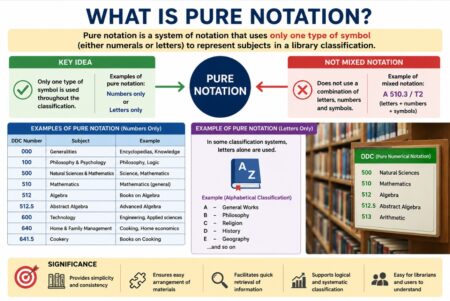
In contrast, pure notation features a simpler structure because it utilizes only one type of symbol. The Dewey Decimal Classification (DDC) is a well-known example in which subjects are represented primarily by Arabic numerals. For instance, 500 corresponds to Natural Sciences, 510 to Mathematics, and 516 to Geometry. While this simplicity makes pure notation easy to learn and apply, it offers fewer possibilities for expansion and may necessitate longer numerical sequences to accommodate new or highly specialized subjects.
Although mixed notation is more flexible, it is also more complex. Library staff and users must understand how different symbols, letters, and punctuation marks function within the classification system. Pure notation, on the other hand, is easier to read, remember, and shelve, making it more suitable for many public and school libraries where simplicity is preferred.